
Quick answer: Optum and UnitedHealthcare are two arms of the same company, UnitedHealth Group. A November 2025 study in Health Affairs, from researchers at Brown University and UC Berkeley, found UnitedHealthcare pays doctor practices owned by Optum 17% more than nearby practices it does not own. In markets where UnitedHealthcare controls at least a quarter of the insurance business, that premium climbs to 61%.
When your health plan reviews a therapy claim, it helps to know who does the reviewing. For many UnitedHealthcare members, that job belongs to Optum. Optum runs the mental health benefit. It reviews the claims. It sets the therapist’s pay. It decides who gets into the network. And it answers to the same parent company as the insurer that pays the bill.
Most people meet Optum as a name on a letter. The letter comes when a claim needs review. Or when a therapist asks for an approval. It reads like it came from an outside expert. It did not. Optum and UnitedHealthcare are sister companies. This article is about what that changes.
Insurance paperwork often calls Optum a partner, a vendor, or an administrator. Those words do a job. They make the review feel independent. But the org chart says otherwise. That chart shows who owns what, and it is public.
I’ve written before about insurers building their own therapy arms. This is the grown-up version of that move. And the numbers finally became public this year. Once you see how it is built, a lot of confusing things about American health care stop being confusing.
Who actually owns Optum and UnitedHealthcare?
One company owns both: UnitedHealth Group. Its own 2025 report lays it out. The parent company brought in $447.6 billion for the year (UnitedHealth Group, January 2026). UnitedHealthcare, the insurance arm, made $344.9 billion and served 49.8 million people. Optum, the care and services arm, made $270.6 billion and reached more than 123 million people.
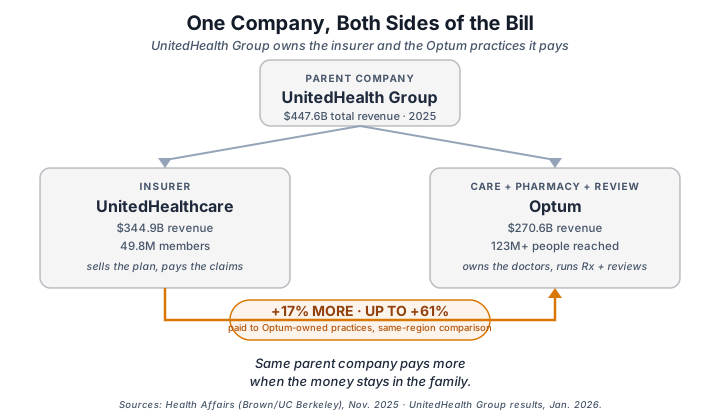
Two quick terms, because I’ll use them a lot. A parent company owns other companies. Sister companies share the same parent. UnitedHealthcare and Optum are sisters. UnitedHealth Group is the parent.
Now try some math. Add those two numbers up. They come to far more than the company’s total. How can the parts be bigger than the whole? Because the parts pay each other. A big slice of Optum’s money comes from its own sister insurer. The parent takes that inside money back out when it reports the combined number. Optum’s biggest customer works down the hall.
Here is what sits under the one roof:
- UnitedHealthcare sells the insurance and pays, or denies, the claims.
- Optum Health owns doctor groups, clinics, and surgery centers.
- Optum Rx runs prescription drug benefits.
- Optum Insight sells billing, data, and claims software to the rest of the industry.
- Optum’s behavioral health arm runs mental health benefits, including for UnitedHealthcare members.
None of this is a secret. It is all in UnitedHealth Group’s own reports and filings. The parts have different logos, different websites, and different letterheads. The profits land in one place.
The scale is hard to picture, so hold one number. Optum owns or is tied to about 90,000 doctors. That is about one out of every ten doctors in the United States (Healthcare Dive, February 2024). The biggest employer of doctors in America is the parent of an insurance company.
What happens when an insurer pays its own doctors?
They get paid more. In November 2025, researchers from Brown University and UC Berkeley published a study in Health Affairs. They used federal price-transparency data from 2024. That is the public list of prices insurers must post by law. The finding was blunt. For common services, UnitedHealthcare paid Optum-owned practices 17% more than nearby practices it does not own. Where UnitedHealthcare held at least 25% of the local insurance market, the gap rose to 61%.
Think about what that money is. When UnitedHealthcare pays an outside doctor, cash leaves the company. When it pays an Optum doctor, the money stays in the family. The higher rate gets baked into the cost of the plan. And the parent counts income on both sides of the payment.
If you get insurance through work, this is your money. Employers and workers pay for the plan through premiums, the monthly cost of coverage. The plan then pays the parent’s own practices at the higher rate. Nobody at that table is bargaining for you.
Fairness means hearing the other side. UnitedHealth disputes the study and calls it “flat-out wrong.” You can weigh that answer against where the prices came from: the federal price files that insurers post themselves.
And this study does not stand alone. A Cornell University team looked at prices after Optum bought ambulatory surgery centers. Those are the clinics that do same-day surgery. Prices rose 11%, about $239 more per procedure. And the jump showed up within two quarters, six months, of the sale (Healthcare Dive, February 2026). The owner changed, and the price followed within months.
What vertical integration means for your mental health care
Vertical integration is the business term for this setup. It means one company owns more than one step in the chain. Here that is the insurer, the doctor’s office, the pharmacy manager, and the claims reviewer. For your therapy benefits, the chain works like this.
Your employer buys a UnitedHealthcare plan. The mental health part is handed to Optum’s behavioral health unit to run. Optum builds the therapist network. Optum sets the pay rates. Optum reviews the claims. If a therapist decides the pay is too low to live on, the therapist quits the network. You are left calling a list of names who never call back.
This setup also has a track record with mental health patients. In August 2021, United Behavioral Health and UnitedHealthcare Insurance Co. agreed to pay $15.6 million. The U.S. Department of Labor and the New York Attorney General had investigated them (U.S. Department of Labor, August 2021).
Regulators found two problems. First, the companies had cut out-of-network pay for therapy from psychologists and masters-level therapists, going back to about 2013. Out-of-network means the therapist has no contract with the plan. Second, a program called ALERT flagged mental health patients for extra review of their care. Both broke the federal parity law. That is the rule that says insurers must cover mental health no more strictly than physical health.
That settlement is old news now, and the companies agreed to fix the problems. I bring it up as precedent, an example that sets a pattern. It shows how this setup treated therapy patients when nobody was watching closely. Enforcement has picked up since. I covered the newer fines in the parity crackdown piece.
Therapists live inside this machine every week. When Optum calls a therapist for a “clinical review” of a patient’s care, the person asking the questions works for the same corporate family that pays the claim. There is a practical guide for clinicians on handling an Optum clinical review call.
For patients, the takeaway is the fact I keep coming back to: coverage on a card doesn’t guarantee care in a room. The card in your wallet says covered. Whether care actually happens depends on rates, reviews, and networks. Here, one company runs all three.
Is anyone pushing back on this?
Yes, slowly. In February 2024, the Department of Justice opened an antitrust investigation into UnitedHealth Group. Antitrust law is meant to stop one company from choking off competition. The Wall Street Journal broke the news (Healthcare Dive, February 2024). Investigators focused on the tie between UnitedHealthcare and Optum. Two questions sit at the center. Does UnitedHealthcare give Optum-owned providers better rates? Does it push members toward Optum care to keep the money in the family? As of this writing, no lawsuit has been filed against that core setup.
One deal did reach a courtroom. In November 2024, the DOJ sued to block UnitedHealth’s $3.3 billion purchase of Amedisys, a large home health company. The two sides settled in August 2025. To close the deal, UnitedHealth had to sell 164 home health and hospice locations across 19 states, about $528 million a year in sales (STAT News, August 2025). A federal court signed off on the final judgment in December 2025.
Why does this move so slowly? Antitrust cases run at the speed of paperwork. And the old rules were built for a world where the danger was one insurer buying another. An insurer’s parent buying one tenth of the country’s doctors came through a side door.
Notice what the Amedisys settlement did and did not do. It trimmed one deal at the edges. The bigger setup, insurer and provider under one roof, came through untouched. Regulators cut off one branch. The tree is fine.
What can you actually do about it?
You cannot un-merge a $447.6 billion company from your kitchen table. You can get sharper about dealing with it. Four moves:
- Find out who reviews your claim. If you have UnitedHealthcare, ask whether Optum runs your mental health benefit. A denial letter reads differently once you know who owns the reviewer.
- Get every denial in writing, with the exact reason. A vague denial is easy to send but hard to defend. Prior authorization is when the plan must say yes before you get care. I broke down that playbook in how insurers weaponize prior authorization.
- Name the parity law when you appeal. If your plan reviews mental health care more strictly than physical health care, say exactly that, in writing. An appeal that names parity is harder to brush off.
- If you pick benefits for a workplace, ask the ownership question. Who runs the mental health benefit? Who owns them? Who keeps the money when a claim is denied?
Employers carry real weight here. A company choosing between plans can ask these questions before signing, while the insurer still has a reason to answer. Most never ask. The answer about ownership would surprise a lot of benefits teams.
I am not sharing this to make you feel small. I am sharing it because the confusion helps someone, and it is never the patient. The company that approves your claim, sets your therapist’s rate, and employs your doctor can all be one company. Once you know that, its letters read differently. And your questions get better.
That belief is why I spend my time building tools like VibeCheck.luxury for the people who give care. And why I write pieces like The Business of Being Unwell about the people who bill for it. The system counts on you never reading the org chart. So read the org chart.
FAQ
Does UnitedHealth Group own both Optum and UnitedHealthcare? Yes. Both are divisions of UnitedHealth Group, which reported $447.6 billion in total 2025 revenue (UnitedHealth Group, January 2026). UnitedHealthcare, the insurer, generated $344.9 billion and served 49.8 million people. Optum, the care and services arm, generated $270.6 billion and reached more than 123 million people.
Does UnitedHealthcare really pay Optum-owned doctors more? A November 2025 Health Affairs study by Brown University and UC Berkeley researchers found UnitedHealthcare paid Optum-owned practices 17% more on average than non-Optum practices in the same region, and up to 61% more in markets where it held at least 25% of the insurance business. UnitedHealth disputes the study, calling it “flat-out wrong.”
Has this structure been penalized over mental health coverage? Yes, historically. In August 2021, United Behavioral Health and UnitedHealthcare Insurance Co. agreed to pay $15.6 million after the U.S. Department of Labor and the New York Attorney General found they cut out-of-network pay for psychotherapy and used a program called ALERT to flag mental health patients for extra review, violating the federal parity law (U.S. Department of Labor, August 2021).
Is the government investigating UnitedHealth’s insurer-provider setup? The Department of Justice opened an antitrust investigation in February 2024 into whether UnitedHealthcare favors Optum-owned providers and steers members in-house, first reported by the Wall Street Journal. Separately, after the DOJ sued over the $3.3 billion Amedisys deal, an August 2025 settlement forced the sale of 164 locations across 19 states before the deal closed.
Sources
- Health Affairs (Brown University / UC Berkeley), analysis of 2024 federal price-transparency data on UnitedHealthcare payments to Optum-owned practices, November 2025. healthaffairs.org
- UnitedHealth Group, Reports 2025 Results and Issues 2026 Outlook, January 27, 2026. unitedhealthgroup.com
- Healthcare Dive (reporting The Wall Street Journal), DOJ opens antitrust investigation into UnitedHealth, February 2024. healthcaredive.com
- STAT News, DOJ reaches agreement with UnitedHealth on Amedisys divestitures, August 7, 2025. statnews.com
- U.S. Department of Labor (EBSA), United Behavioral Health and UnitedHealthcare Insurance Co. to pay $15.6 million settlement, August 12, 2021. dol.gov
- Healthcare Dive, Cornell study in Health Affairs: surgery center prices rose 11% after Optum acquisitions, February 2026. healthcaredive.com
Figures current as of July 2026.
Disclaimer
This article is for educational and informational purposes only. It does not constitute medical, clinical, legal, or therapeutic advice, and reading it does not create a therapist-client relationship with Matthew Sexton, LCSW or Mental Wealth Solutions, Inc. Although the author is a licensed clinical social worker, the content in this article is not clinical assessment, diagnosis, or treatment.
Corporate ownership, payment rates, network contracts, and enforcement actions described here reflect the cited studies, filings, and press releases as of their publication dates, and they can change after this article is published. Nothing here is a substitute for reviewing your own plan documents or for guidance from your benefits administrator, your state insurance department, or qualified counsel about your specific coverage and appeal rights. Plans and circumstances differ, and what is described here may not match your situation.
If you are in immediate emotional crisis, you can reach the 988 Suicide & Crisis Lifeline by calling or texting 988 (US). If you are experiencing domestic violence or are in physical danger, contact the National Domestic Violence Hotline at 1-800-799-7233 or visit thehotline.org. In a life-threatening emergency, call 911.
Frequently asked questions.
- Does UnitedHealth Group own both Optum and UnitedHealthcare?
- Yes. Both are divisions of UnitedHealth Group, which reported $447.6 billion in total 2025 revenue. UnitedHealthcare, the insurer, generated $344.9 billion and served 49.8 million people. Optum, the care and services arm, generated $270.6 billion and reached more than 123 million people (UnitedHealth Group results, January 2026).
- Does UnitedHealthcare really pay Optum-owned doctors more?
- A November 2025 Health Affairs study by Brown University and UC Berkeley researchers found UnitedHealthcare paid Optum-owned practices 17% more on average than non-Optum practices in the same region, and up to 61% more in markets where it held at least 25% of the insurance business. UnitedHealth disputes the study, calling it 'flat-out wrong.'
- Has this structure been penalized over mental health coverage?
- Yes, historically. In August 2021, United Behavioral Health and UnitedHealthcare Insurance Co. agreed to pay $15.6 million after the U.S. Department of Labor and the New York Attorney General found they cut out-of-network pay for psychotherapy and used a program called ALERT to flag mental health patients for extra review, violating the federal parity law.
- Is the government investigating UnitedHealth's insurer-provider setup?
- The Department of Justice opened an antitrust investigation in February 2024 into whether UnitedHealthcare favors Optum-owned providers and steers members in-house, first reported by the Wall Street Journal. Separately, after the DOJ sued over the $3.3 billion Amedisys deal, an August 2025 settlement forced the sale of 164 locations across 19 states.
Want to discuss this for your program?
Book a 30-min conversation. We'll walk you through deployment, the BAA, and what your rollout looks like in production.
Book a 30-min conversation