
Quick answer: EviCore is a company most patients have never heard of. It makes coverage decisions for about 100 million insured Americans, roughly 1 in 3 people with insurance, on behalf of more than 100 insurers including UnitedHealthcare, Aetna, and Blue Cross Blue Shield plans (ProPublica / The Capitol Forum, October 2024). For therapy, the best-documented hidden reviewer is different: UnitedHealth’s Optum ran a program of more than 50 algorithms that flagged up to 15% of patients getting outpatient mental health care (ProPublica, November 2024).
Your insurance card has a company name on it. Maybe Aetna. Maybe UnitedHealthcare. Maybe a Blue Cross plan. You’d think that company decides what gets covered. Often, it doesn’t. A company called EviCore makes coverage decisions for about 100 million insured Americans. It works with more than 100 insurers (ProPublica and The Capitol Forum, October 2024). That’s about 1 in 3 people with insurance in this country.
You never picked EviCore. You never signed anything with its name on it. Its name rarely shows up on a denial letter. Reporters spent months just to map who it works for. Have you ever read a denial and wondered who decided you didn’t need care? This piece is about that company.
I’ll do two things here. First, I’ll show you how the hidden-reviewer business works. EviCore is the best-documented example we have. Second, I’ll answer the title’s question honestly. For mental health care, the hidden gatekeeper usually isn’t EviCore. It’s a program with a name almost nobody knows. Let’s name both.
What is EviCore, and why have you never heard of it?
First, a plain definition. Prior authorization is one step. Your insurer must say yes before it agrees to pay for care. Your clinician orders the care. The insurer reviews the request. Until the yes arrives, you wait.
From your side, it looks like a deal between two parties. You, then your insurer. But there’s a middle step you don’t see. The request can leave your insurer’s building entirely.
Many insurers don’t do the review themselves. They hire EviCore. EviCore is part of Evernorth, which Cigna owns. ProPublica and The Capitol Forum spent months looking into the company. They found EviCore makes coverage calls for about 100 million people. It works across more than 100 insurance companies, including UnitedHealthcare, Aetna, and Blue Cross Blue Shield plans (ProPublica / The Capitol Forum, October 2024).
Think about what that means. Is your care “medically necessary”? That call can come from a company you’ve never heard of. It works under a contract you’ve never seen. You agreed to your insurer. Nobody asked you about the hired reviewer.
The dial: a business built on saying no
Why would an insurer pay another company to review care? Because a no is worth money.
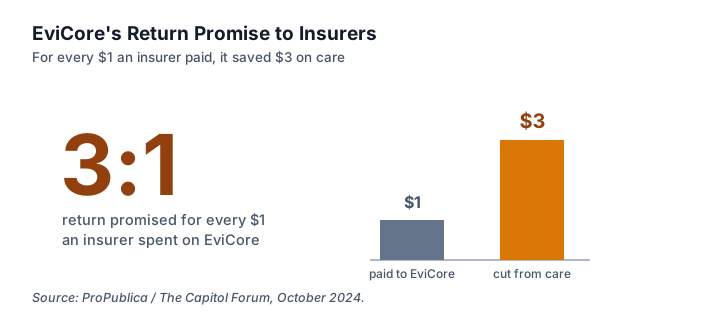
The investigation found EviCore made insurers a simple promise: a 3-to-1 return. For every $1 an insurer spent on EviCore, it would pay out $3 less on care (ProPublica / The Capitol Forum, October 2024). Read that promise again. It says nothing about better care. It promises smaller payouts.
It gets more specific. EviCore’s salespeople bragged they could raise denials by 15%. They did it by adjusting the company’s AI screening tool. Insiders had a nickname for that adjustment. They called it “the dial” (ProPublica / The Capitol Forum, October 2024). A dial needs a hand to turn it. Here, the denial rate is a setting, like a volume knob on a radio.
One more detail. Cigna is one of the country’s biggest insurers. It has owned EviCore since 2018 (same investigation). So a company owned by one insurer judges care for its rivals’ members. I looked for any sign this setup changed after the story ran. I found none. EviCore’s health-plan pages were still live as of July 2026.
So who actually reviews your mental health care?
Here’s where I want to be exact. This part gets repeated wrong online.
EviCore’s own published list of clinical guidelines covers imaging, heart care, sleep studies, cancer care, and lab tests. Mental health is not on that list as of July 2026. So if your therapy got cut short, EviCore probably wasn’t holding the scissors. For mental health, the best-documented hidden reviewer is a different giant. It’s Optum, the arm of UnitedHealth that runs mental health benefits.
ProPublica dug into Optum’s system in a second report. United’s program is called ALERT. It used more than 50 algorithms to watch people in therapy. An algorithm is a computer program that follows rules to flag people. ALERT flagged up to 15% of patients getting outpatient mental health care, meaning care with no overnight stay (ProPublica, November 2024).
What tripped a flag? Going to therapy twice a week for six weeks. Or having more than 20 sessions in six months (same investigation). Sit with that for a second. Showing up on time is the exact thing your therapist asks of you. It’s also what made the computer suspicious. A flag meant your care could get a closer look. Your coverage was on the line.
New York regulators checked the results. They found United had denied claims for more than 34,000 therapy sessions in New York alone. That’s about $8 million worth of care. In 2021, the company paid over $4 million in refunds and penalties. ProPublica later reported that United quietly renamed ALERT instead of shutting it down nationwide (ProPublica, November 2024).
None of this shows up in your benefits booklet. The denial letter says “medical necessity.” It doesn’t say a 50-algorithm program flagged you first. Staying invisible is the whole business model. And it cuts both ways. You can’t argue with a reviewer you can’t see.
United owns the insurer. It owns the reviewer. It owns a growing share of the clinicians too. I’ve written about what it means when your insurer becomes your therapist. Are you a therapist who gets one of those “clinical review” phone calls? There’s a separate guide on whether you have to engage with Optum’s review calls.
Why does this hit mental health harder?
Because the wall is higher here. And the people climbing it have less to spare.
KFF surveyed insured adults. Among those who got treatment or took medication for a mental health condition in the past year, 26% ran into prior authorization problems. For insured adults overall, the number was 16% (KFF, September 2023). Same system. Higher wall.
The wall also does its own damage. In KFF’s January 2026 tracking poll, 34% of insured adults called prior authorization the single biggest burden in getting care. Among people who faced a denial or delay, 1 in 3 said it did major harm to their mental health (KFF, February 2026). Say that loop out loud. The process for getting mental health care is hurting people’s mental health.
And remember who’s being asked to fight. Someone in the middle of a depressive episode gets handed an appeals process. That’s like asking a person with a broken leg to walk the paperwork across town. The machinery isn’t new. I broke down how insurers weaponize prior authorization in an earlier piece. What’s new is the naming. The wall has hired reviewers. And those reviewers have sales decks.
Didn’t insurers promise to fix prior authorization?
They did, loudly. In June 2025, about four dozen insurers made a public promise. Aetna, Cigna, and UnitedHealthcare were among them. They told the federal government they would roll back prior authorization.
Ten months later, the industry’s own progress report told the real story. Insurers had cut 11% of prior authorization rules, about 6.5 million fewer requests (AHIP and BCBSA data, via Healthcare Dive, April 2026). Eleven percent. The review layer was still standing in 2026. That includes the hired-reviewer programs above.
Doctors aren’t convinced either. The AMA surveyed 1,000 physicians and released it in May 2026. 95% said prior authorization delays needed care. 26% said it led to a serious harm event for one of their patients. Doctors reported handling an average of 40 prior authorizations a week. Only 33% believe the insurers’ pledge will make a real difference (AMA, May 2026).
If that gap between promise and delivery feels familiar, it should. The parity fines are real now. But collecting them is still a waiting game. Promises are cheap when the dial pays 3-to-1.
What can you do when the invisible reviewer says no?
You can’t remove the gatekeeper. You can make it earn its fee. In my experience, this system counts on people quitting at the first no. So don’t quit quietly. Here’s the short version:
- Ask who reviewed your care. Send your insurer a written question. Did an outside company or an in-house program make this call? Ask for the reviewer’s name and credentials.
- Ask for the rule. In writing, ask for the exact guideline your care supposedly failed. A vague no is a choice. Make them name a specific one.
- Appeal. Every denial comes with appeal rights. Use them. The New York findings above exist because people refused to accept the first answer.
- Bring in your state. Your state insurance department takes complaints for free. Regulators counted those 34,000 denied sessions because people spoke up.
- Loop in your clinician. Your therapist or doctor can add records. They can challenge a “medical necessity” call with clinical facts.
- Keep everything. Save letters, portal messages, and call notes with dates and names. A paper trail turns your story into evidence.
One last thought. It’s the reason I keep writing these pieces. “Covered” was never the same as “cared for.” The gap between those two words is where the companies above earn their living. Naming them doesn’t close the gap. It tells you where to push. A patient who pushes in writing, with a paper trail, is the most expensive kind to keep telling no.
FAQ
What is EviCore and what does it do? EviCore is a prior authorization company. Insurers hire it to decide whether care is “medically necessary” before they agree to pay. It makes those coverage decisions for about 100 million insured Americans, roughly 1 in 3 people with insurance, working with more than 100 insurers (ProPublica / The Capitol Forum, October 2024). Cigna has owned it since 2018.
Does EviCore review mental health care? Its own published list of clinical guidelines had no mental health category as of July 2026. The list covers services like imaging, heart care, sleep studies, cancer care, and lab tests. The best-documented hidden reviewer for mental health is Optum’s ALERT program, which used more than 50 algorithms to flag people in therapy (ProPublica, November 2024).
Can a computer program really limit my therapy? It has happened at scale. United’s ALERT program flagged up to 15% of outpatient mental health patients, using triggers like therapy twice a week for six weeks. New York regulators found more than 34,000 denied therapy sessions in that state alone, and United paid over $4 million in refunds and penalties in 2021 (ProPublica, November 2024). Denials can be appealed, and appeals matter.
Did the insurers’ 2025 promise to cut prior authorization work? Not much, so far. Ten months after about four dozen insurers pledged to roll back prior authorization, they had eliminated 11% of requirements, about 6.5 million fewer requests (Healthcare Dive, April 2026). Only 33% of physicians believe the pledge will make a meaningful difference (AMA, May 2026).
Sources
- ProPublica / The Capitol Forum: investigation into EviCore’s prior authorization business for America’s largest insurers, October 23, 2024. propublica.org
- ProPublica: investigation into UnitedHealth/Optum’s ALERT program and outpatient therapy denials, November 19, 2024. propublica.org
- EviCore by Evernorth: public clinical guidelines list (no behavioral health category), accessed July 2026. evicore.com
- KFF: Consumer Problems with Prior Authorization: Evidence from the KFF Survey of Consumer Experiences with Health Insurance, September 29, 2023. kff.org
- KFF: Health Tracking Poll: Prior Authorizations Rank as Public’s Biggest Burden When Getting Health Care, February 2, 2026. kff.org
- American Medical Association: 2025 Prior Authorization Physician Survey (reform pledge falls short with physicians), released May 13, 2026. ama-assn.org
- Healthcare Dive: insurer prior authorization pledge progress report (AHIP / Blue Cross Blue Shield Association data), April 7, 2026. healthcaredive.com
Figures current as of July 2026.
Disclaimer
This article is for educational and informational purposes only. It does not constitute medical, clinical, legal, or therapeutic advice, and reading it does not create a therapist-client relationship with Matthew Sexton, LCSW or Mental Wealth Solutions, Inc. Although the author is a licensed clinical social worker, the content in this article is not clinical assessment, diagnosis, or treatment.
Prior-authorization programs, outside review companies, and insurer coverage rules vary by health plan, state, and over time, and may change after this article is published. The companies and programs described here are drawn from public investigations and regulator findings as of the dates cited. Nothing here is a substitute for confirming a specific requirement, or challenging a specific decision, with your insurer, your benefits administrator, or qualified counsel. Plans and circumstances differ, and what is described here may not match your situation.
If you are in immediate emotional crisis, you can reach the 988 Suicide & Crisis Lifeline by calling or texting 988 (US). If you are experiencing domestic violence or are in physical danger, contact the National Domestic Violence Hotline at 1-800-799-7233 or visit thehotline.org. In a life-threatening emergency, call 911.
Frequently asked questions.
- What is EviCore and what does it do?
- EviCore is a prior authorization company. Insurers hire it to decide whether care is medically necessary before they agree to pay. A 2024 ProPublica and Capitol Forum investigation found it makes coverage decisions for about 100 million insured Americans, roughly 1 in 3 people with insurance, working with more than 100 insurers. Cigna has owned it since 2018.
- Does EviCore review mental health care?
- Its published list of clinical guidelines had no mental health category as of July 2026. The list covers services like imaging, heart care, sleep studies, cancer care, and lab tests. For mental health, the best-documented hidden reviewer is Optum's ALERT program, which used more than 50 algorithms to flag people in therapy, per ProPublica's November 2024 investigation.
- Can a computer program really limit my therapy?
- It has happened at scale. United's ALERT program flagged up to 15% of outpatient mental health patients, using triggers like therapy twice a week for six weeks. New York regulators found more than 34,000 denied therapy sessions in that state alone, and United paid over $4 million in refunds and penalties in 2021. Denials can be appealed.
- Did the insurers' 2025 promise to cut prior authorization work?
- Not much so far. Ten months after about four dozen insurers pledged to roll back prior authorization, they had eliminated 11% of requirements, about 6.5 million fewer requests, per industry data reported by Healthcare Dive in April 2026. In the AMA survey released May 2026, only 33% of physicians believe the pledge will make a meaningful difference.
Want to discuss this for your program?
Book a 30-min conversation. We'll walk you through deployment, the BAA, and what your rollout looks like in production.
Book a 30-min conversation