California's RTO Mandate Doubles Amid Employer Mental Health Push
California's auditor found the old schedule saved $225 million a year, yet the state doubled its RTO mandate, while 87% of employers call mental health a priority.
From the earlier archive. This article’s original writing is retained and has not been fact-checked as part of our current review. Product references may reflect an earlier version; see current solutions for today’s status.
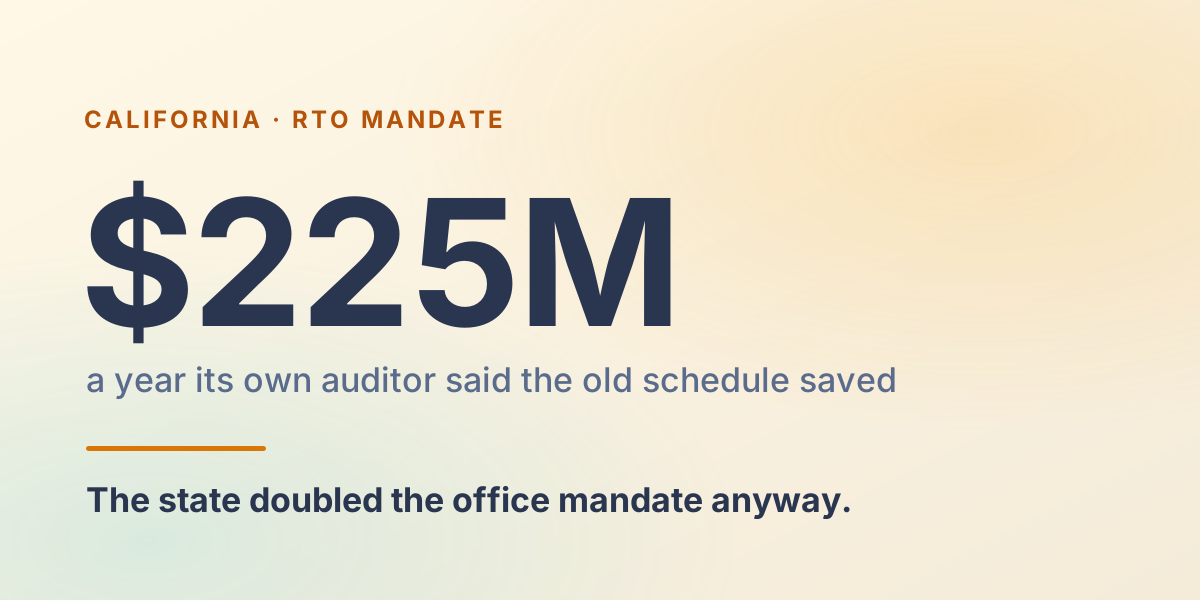
California’s own independent auditor already answered the question the governor’s office never asked. Keeping state employees on their prior two-day-a-week office schedule would have saved taxpayers $225 million a year and let the state shrink its office footprint by roughly 30%, and Newsom’s office “did not use any data about state workers’ productivity” to justify doubling the requirement anyway, according to the California State Auditor’s Report 2024-118 (released August 2025). The state’s own watchdog checked the math before the mandate took effect. The math didn’t support it.
Quick answer: California doubled its state-worker in-office mandate from two days to four starting July 1, 2026, even though the state’s own independent auditor found the prior hybrid schedule saved $225 million a year with no productivity data behind the change. At the same time, national surveys show 87% of employers calling mental health benefits a top priority. The gap between what employers say about mental health and what some of those same institutions actually schedule is the story here, and it’s a fixable one.
What Changed, and For Whom
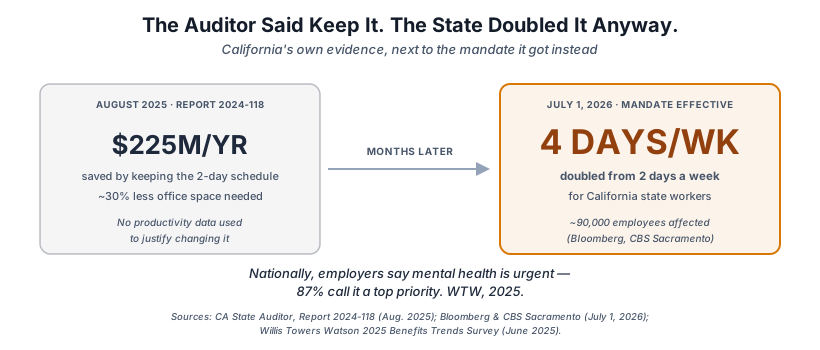
Newsom’s executive order raised the in-office requirement for California state workers from two days a week to four, effective July 1, 2026, a change that touches roughly 90,000 employees (Bloomberg, 2026; CBS Sacramento, 2026). It’s the second such order in two years, doubling a schedule that had already been raised once before.
That’s a lot of people whose commute, childcare arrangement, and weekly budget just changed by government order, on a timeline that gave them months, not the kind of runway a household needs to rebuild a schedule around school pickup or a partner’s own job. I want to be clear about what this piece is and isn’t. It isn’t an argument that remote work is always better, or that no job needs in-person time. It’s an argument that when an institution claims mental health is a strategic priority, the attendance policy is where that claim gets tested.
What the State’s Own Auditor Found
The auditor’s findings are the strongest evidence in this whole story, because they came from inside the system, not from a union press release. Report 2024-118 found the state could have saved $225 million a year and reduced its office footprint by about 30% by keeping the prior hybrid schedule, and explicitly noted the governor’s office used no productivity data to justify moving away from it (California State Auditor, August 2025; CalMatters, 2025).
That’s worth sitting with. This wasn’t an advocacy group’s estimate. It was the state’s own independent oversight office, reviewing the state’s own numbers, concluding the mandate wasn’t backed by evidence of better performance. When your own watchdog says the receipts don’t support the policy, “mental health is a priority” starts to sound like something printed on a poster rather than something built into a decision.
How Workers Are Pushing Back
SEIU Local 1000, which represents 96,000 state workers, filed an unfair-labor-practice complaint with California’s Public Employment Relations Board around May 12, 2026, alleging the state bargained in bad faith over the mandate (Bloomberg, 2026). More than 2,500 workers showed up at the Capitol to protest on July 1, 2026, the day the four-day requirement took effect (CapRadio, 2026).
That’s not a fringe reaction. That’s tens of thousands of unionized public employees, represented by a formal legal complaint and a Capitol-steps protest, telling their employer the process itself felt imposed rather than negotiated. Process matters here as much as the outcome. A mandate handed down without the bargaining a union contract requires reads as something done to workers, not with them, regardless of what the policy itself says about wellbeing.
The Employer Mental Health Numbers the Return-to-Office Mandate Ignores
Nationally, employers are not shy about saying mental health matters. 73% of large employers reported increasing mental health and substance-use-disorder services in 2026, and another 17% expect to increase them soon, according to Business Group on Health’s 2026 Employer Health Care Strategy Survey of 121 employers covering 11.6 million lives (Business Group on Health, 2026). Separately, 87% of employers told Willis Towers Watson that improving mental health benefits is a top priority for their organization (WTW 2025 Benefits Trends Survey, 2025).
Those numbers are real, and I don’t think they’re cynical. Most benefits leaders I’ve talked to actually believe in the counseling sessions and EAP expansions they’re adding. The problem isn’t that the benefits budget is fake. It’s that attendance policy gets set somewhere else entirely, by people optimizing for office occupancy or political optics, with no requirement that it touch the same evidence base the benefits team uses. Two departments, two philosophies, one workforce absorbing both.
Why Commute Time Is a Mental Health Variable, Not a Logistics Detail
Commute length isn’t a neutral scheduling detail. It’s a measurable driver of psychological distress, and the research on this has gotten more specific, not less, over the past two years. Healthcare workers with commutes over 30 minutes show measurably higher burnout, and commutes past 50 minutes make it worse, an effect partly explained by musculoskeletal pain from time spent sitting or driving (PMC, 2024).
A 2025 study in Social Currents found something sharper: a U-shaped relationship between commute duration and psychological distress. Distress actually drops for roughly the first 44 minutes of commute time, then climbs past that point, and the effect concentrates almost entirely among workers carrying high demands at home, meaning parents and caregivers (Montazer, Brumley & Pineault, Social Currents, May 2025). A short buffer between work and home can help. A long one, stacked on caregiving, is where the damage shows up.
That’s the detail a blanket four-days-a-week order can’t see. It treats every employee’s commute as identical, when the research says the people with the most caregiving load are the ones who pay the steepest mental health cost for the exact same number of miles.
The Second Pay Cut Nobody Budgets For
Every in-office day carries a cost that never shows up on a benefits slide. Owl Labs’ 2025 State of Hybrid Work Report, based on a sample of 2,000 U.S. workers, put the average in-office day at roughly $15 in commuting costs, $9 in parking, $13 for breakfast or coffee, and $18 for lunch, close to $55 a day once you add it up (Owl Labs, 2025). Double someone’s in-office days and you’ve effectively handed them a pay cut they never agreed to, layered on top of the mandate itself.
That’s the part missing from most of the coverage of RTO mandates: they get discussed as a culture or productivity question, when for the household budget they function exactly like a wage cut, just one that never appears on a pay stub. One CalMatters opinion piece captured that math from a single worker’s own account. Wasim Ali, a CARB engineer and a bargaining-team member for his union PECG, estimated the mandate adds roughly $500 a month in gas and parking and 2.5 extra hours a week of travel for him personally (CalMatters opinion, March 2026). I’m citing that as one advocate’s own account of his situation, not as a statewide average, but it’s the kind of arithmetic thousands of workers under this mandate are almost certainly doing on their own kitchen tables right now.
What a Recovery-Designed Policy Would Actually Look Like
Here’s the part I want to end on, because naming the contradiction is easy and fixing it is the actual job. A policy genuinely designed around recovery, not just around mental health messaging, would look almost nothing like a flat attendance quota. It would tie flexibility to measured outcomes, whatever those are for a given role, instead of counting badge swipes. It would build in commute-aware scheduling, recognizing that the 44-minute threshold the research points to is a real design constraint, not a complaint to wave off. And it would publish its own productivity data before a mandate, the way the state auditor did after the fact, so the evidence leads the policy instead of trailing behind it by a year.
None of that requires abandoning in-person work. Plenty of roles genuinely benefit from more overlap time, and I’m not arguing otherwise. What it requires is treating the attendance calendar with the same rigor an employer already claims to bring to its EAP contract or its counseling benefit. If mental health is a strategic priority, the schedule is where that priority either shows up or doesn’t. In the conversations I’ve had with HR and benefits leaders this year, the mental health line items keep growing while the attendance policy keeps getting decided in a completely separate room. That’s the gap. It’s not mysterious, and closing it doesn’t cost $225 million. California’s auditor just showed the opposite: doing it right can save that much.
FAQ
What did California’s return-to-office mandate actually change? Governor Newsom’s executive order doubled the in-office requirement for California state workers from two days a week to four, effective July 1, 2026, affecting roughly 90,000 employees, according to Bloomberg and CBS Sacramento reporting on the order.
What did California’s independent auditor find about the mandate? The California State Auditor’s Report 2024-118, released in August 2025, found the state could save $225 million a year and cut office space by roughly 30% by keeping the prior two-days-in schedule, and that Newsom’s office did not use any productivity data to justify the four-day mandate.
How have state workers responded to the mandate? SEIU Local 1000, which represents 96,000 state workers, filed an unfair-labor-practice complaint with California’s Public Employment Relations Board around May 12, 2026, alleging bad-faith bargaining. More than 2,500 workers protested at the Capitol on July 1, 2026, the day the mandate took effect.
Do employer mental health surveys actually contradict mandates like this? Yes. Business Group on Health’s 2026 survey of 121 large employers found 73% increased mental health and substance-use-disorder services in 2026, and Willis Towers Watson’s 2025 survey found 87% of employers call improving mental health benefits a top priority, even as some of those same institutions issue blanket attendance mandates unrelated to any recovery or performance data.
What would a return-to-office policy designed around mental health actually look like? It would tie flexibility to measured outcomes instead of seat time, build schedules around commute research showing distress rises sharply past roughly 44 minutes each way, and publish the productivity data before the mandate rather than after workers ask for it.
Sources
- California State Auditor, Report 2024-118 (August 2025) — $225 million annual savings, ~30% office-space reduction, no productivity data used to justify the mandate.
- CalMatters, “California could save millions by letting state workers telework” (August 2025).
- Bloomberg, “Return-to-Office Mandate for California State Workers Sets Up Union Clash” (July 1, 2026) — mandate scope (90,000 employees, 2 to 4 days), SEIU Local 1000 PERB complaint.
- CBS Sacramento, “California state workers return to office” (July 1, 2026).
- CapRadio, “California’s state workers protest as return-to-office mandate takes effect” (July 1, 2026) — 2,500+ Capitol protest.
- Business Group on Health, 2026 Employer Health Care Strategy Survey (121 employers, 11.6 million covered lives) — 73% increased mental health/SUD services, 17% anticipate future increase.
- Willis Towers Watson, 2025 Benefits Trends Survey (June 2025) — 87% of employers call mental health benefits a top priority.
- PMC / National Library of Medicine, commute length and healthcare-worker burnout study (2024).
- Montazer, Brumley & Pineault, “A Time to Unwind or Despair?”, Social Currents (Sage), May 1, 2025 — U-shaped commute/distress relationship, 44-minute inflection point, effect concentrated among caregivers.
- Owl Labs, 2025 State of Hybrid Work Report (2,000 U.S. worker sample) — per-day in-office cost breakdown, ~$55/day.
- CalMatters opinion, “State workers deserve a say in telework” (March 20, 2026) — Wasim Ali’s first-person commute-cost estimate.
Figures current as of July 2026.
Disclaimer
This article is for educational and informational purposes only. It does not constitute medical, clinical, legal, or therapeutic advice, and reading it does not create a therapist-client relationship with Matthew Sexton, LCSW or Mental Wealth Solutions, Inc. Although the author is a licensed clinical social worker, the content in this article is not clinical assessment, diagnosis, or treatment.
State employment policy, union bargaining positions, and the survey data on employer mental health strategy referenced here vary by employer, jurisdiction, and over time, and may change after this article is published. Nothing here is a substitute for confirming a specific policy with your employer, your union representative, or qualified counsel. Organizations and circumstances differ, and what is described here may not match your situation.
If you are in immediate emotional crisis, you can reach the 988 Suicide & Crisis Lifeline by calling or texting 988 (US). If you are experiencing domestic violence or are in physical danger, contact the National Domestic Violence Hotline at 1-800-799-7233 or visit thehotline.org. In a life-threatening emergency, call 911.
Frequently asked questions
- What did California's return-to-office mandate actually change?
- Governor Newsom's executive order doubled the in-office requirement for California state workers from two days a week to four, effective July 1, 2026, affecting roughly 90,000 employees, according to Bloomberg and CBS Sacramento reporting on the order.
- What did California's independent auditor find about the mandate?
- The California State Auditor's Report 2024-118, released in August 2025, found the state could save $225 million a year and cut office space by roughly 30% by keeping the prior two-days-in schedule, and that Newsom's office did not use any productivity data to justify the four-day mandate.
- How have state workers responded to the mandate?
- SEIU Local 1000, which represents 96,000 state workers, filed an unfair-labor-practice complaint with California's Public Employment Relations Board around May 12, 2026, alleging bad-faith bargaining. More than 2,500 workers protested at the Capitol on July 1, 2026, the day the mandate took effect.
- Do employer mental health surveys actually contradict mandates like this?
- Yes. Business Group on Health's 2026 survey of 121 large employers found 73% increased mental health and substance-use-disorder services in 2026, and Willis Towers Watson's 2025 Benefits Trends Survey found 87% of employers call improving mental health benefits a top priority, even as some of those same institutions issue blanket attendance mandates unrelated to any recovery or performance data.
- What would a return-to-office policy designed around mental health actually look like?
- It would tie flexibility to measured outcomes instead of seat time, build schedules around commute research showing distress rises sharply past roughly 44 minutes each way, and publish the productivity data before the mandate rather than after workers ask for it.