Holidays are the most predictable breaking point in no contact. Valentine’s Day, anniversaries, birthdays, and the stretch between Thanksgiving and New Year’s all produce the same pattern: the nervous system, already conditioned to anticipate a “reward window” inside the abusive relationship, reaches peak anticipation on a date the culture has marked in advance. The narcissist often hoovers on the same schedule, because manufactured nostalgia is the most reliable re-entry tool they have. Understanding why the craving intensifies on a calendar day — and treating the day as a nervous-system event rather than a character test — is what allows survivors to hold the line without shame.
Why Do Holidays Trigger Trauma-Bond Cravings?
Holidays do not care about healing timelines. They arrive on schedule regardless of where someone is in recovery, and they carry weight — social, cultural, and the specific weight of memory.
Valentine’s Day is particularly charged for narcissistic abuse survivors. It was likely a vehicle for the idealization phase — grand gestures, intense focus, the performance of devotion that characterizes the early relationship. Those associations are now attached to a day culture insists on celebrating.
The triggering is not weakness. It is the neurological reality of how memory and emotion interact. Certain dates, songs, and rituals are encoded with the relationship. Encountering them activates the encoding. Understanding this does not eliminate the difficulty, but it removes the shame layer that makes it worse.
There is a more specific mechanism underneath the memory activation. Inside the relationship, the brain learned that some days were more likely to produce the brief window of warmth, attention, and relief the trauma bond is organized around. Anniversaries, birthdays, and holidays often became the days on which the narcissist performed. The nervous system encoded the date itself as a predictor of the reward window. Variable reinforcement schedules (Skinner, 1953) are remarkably durable — and even more durable when partially time-locked to a recurring cue. That is what a holiday becomes for many survivors: a time cue the brain has learned to wait for.
Helen Fisher’s imaging work on romantic attachment and rejection (Fisher, 2004; Fisher et al., 2010, Journal of Neurophysiology) documented that dopaminergic reward circuitry is activated not only by reward itself but by its anticipation — most intensely when the reward is uncertain. On Valentine’s Day, the survivor knows on one level that no reward is coming. The anticipatory circuitry does not know that. It knows only that this date used to produce the window, and it is waiting for the window to open again.
Why Do Narcissists Hoover on Holidays?
Hoovering is not random. It follows predictable windows, and calendar days with cultural weight are some of the most predictable ones.
A hoover attempt on Valentine’s Day is not a coincidence, and it is rarely sincere. It is an exploitation of the nervous-system window described above. The narcissist does not need to understand the neuroscience to have learned, over the course of the relationship, that the survivor is softer on certain days. That softness is the opening. The message arrives framed as nostalgic, kind, regretful, or simply “I was thinking about you” — because it does not need to say anything in particular. It only needs to land inside the anticipation window.
The specific forms this takes include:
- A short, ambiguous text that looks innocent and requires a decision about how to respond.
- A message referencing a shared memory from the early idealization phase — a place, a song, a moment.
- A performative apology timed to the holiday, designed to reopen a channel without committing to anything.
- A check-in phrased to make no response feel cold.
- A message routed through a mutual friend, so the survivor hears about it indirectly.
Patrick Carnes, in The Betrayal Bond (1997), describes these exploitative reconnections as a core maintenance mechanism of trauma bonds. They are not about reconciliation. They are about keeping the intermittent reinforcement schedule alive. Each successful hoover, even a partial one, refreshes the reward anticipation system and rewinds the clock on recovery. On a day when the nervous system is already leaning forward, the message does not need to be convincing. It only needs to arrive.
Why Is the Urge to Break No Contact So Strong on These Days?
Survivors often describe the urge to break no contact on a holiday as coming out of nowhere — as if a decision that was settled the day before is suddenly up for renegotiation. It is not coming out of nowhere. It is coming out of a predictable, physiologically driven state.
Bessel van der Kolk, in The Body Keeps the Score (2014), describes how chronic interpersonal stress keeps the nervous system locked in hypervigilance, and how brief moments of perceived safety inside that stress release outsized surges of relief-related neurochemistry. Those surges get encoded with the intensity usually reserved for survival experiences. They become what the brain later craves — not the relationship, but the relief.
Stephen Porges’s polyvagal theory (Porges, 2011, The Polyvagal Theory) adds another layer. The ventral vagal branch of the nervous system — responsible for social engagement, connection, and felt safety — is activated by moments of reciprocal warmth. When those moments are rare and embedded inside a larger pattern of threat, the ventral vagal response becomes tightly linked to the specific person who produced it. The nervous system does not easily separate “the feeling of safety” from “the person I felt it with,” even when that person was also the source of the threat. On a holiday, that linkage lights up.
Judith Herman’s foundational work on complex trauma (Herman, 1992) describes the grieving phase of recovery as a period when survivors mourn two distinct losses: the believed version of the other person, and the self that existed inside the belief. On Valentine’s Day, both losses come forward at once. The survivor is missing a version of themselves — the one who believed the grand gestures meant something, the one who was hopeful, the one who still thought the relationship could be what it seemed in the beginning. Dutton and Painter’s (1993) work on traumatic bonding, in Violence and Victims, explains why that belief persists physiologically after it has been intellectually abandoned. Traumatic bonding does not dissolve on the day the survivor decides the relationship was abusive.
The urge to break no contact on a holiday is not a sign that recovery is failing. It is a sign that the holiday is doing exactly what the nervous system learned it would do.
What Actually Works on the Day: Nervous-System Tactics
No contact is a boundary, and like all boundaries, it requires active maintenance — especially on days when the pull is strongest.
The goal on a high-charge holiday is not to feel nothing. The goal is to stay out of contact while the wave passes. That is a nervous-system task, not a willpower task, and it is handled best with nervous-system tools. The S.T.O.I.C.K. method is one framework for working with impulse, body state, and response when the urge to reach out arises. The principle is the same across any approach: the body state needs to shift before the decision can be trusted.
Anticipate the contact attempt. Valentine’s Day is a high-probability hoovering occasion. A message framed as nostalgic, kind, or innocent is a common tactic on dates with emotional significance. Knowing this in advance reduces its power. An expected move is easier to not respond to than a surprise. Decide in advance what you will do with it. A pre-made decision is held by a different part of the brain than a decision made mid-craving.
Remove the pathway. If blocking has not happened, this is the time. If the decision to keep communication channels open feels necessary, having a clear rule about what constitutes a violation — and what happens when one occurs — matters more now than in low-risk periods. Reading a message “just to see” counts as contact; the nervous system does not distinguish between active reply and passive exposure.
Make a plan for the day. An unstructured Valentine’s Day with no social contact and active grief is a difficult combination. Planning does not need to be elaborate. It needs to fill the time with something that is not rumination. Bodies in motion are harder to hijack than bodies at rest. Walks, cold exposure, physical tasks, prepared meals, and low-stimulation social contact all give the nervous system something to do besides reach for the reward window that no longer exists.
Identify who to contact if the urge hits. Not to be talked out of reaching out — but to have a real person available who understands what is at stake. The urge to break no contact tends to be time-limited. Bridging that time with a different kind of connection is a practical strategy. The person you call does not need to fix anything. They need to be on the phone while the wave passes.
Work the body before the thoughts. Paced breathing, bilateral movement, cold water, and physical grounding are direct inputs to the autonomic nervous system, not stress-relief accessories. Frameworks like R.A.V.E.S. exist because recovery is a nervous system project, not a willpower project, and the tools that actually work on these days are the ones that change body state, not the ones that rehearse arguments inside the head.
What Survivors Are Actually Grieving on the Holiday
Kenneth Doka’s concept of “disenfranchised grief” (Doka, 1989) describes grief that a person’s social world does not recognize or validate. Grieving the loss of a relationship with someone who also harmed you falls squarely into this category. Survivors are often told they should feel relief on Valentine’s Day, not grief, and when grief arises anyway they feel there is something wrong with them. There is not. Disenfranchised grief is still grief, and it is often more painful than validated grief because it has to be carried privately.
There is a version of the relationship that exists only in memory — the version from the beginning, or from the good moments scattered through the hard ones. On Valentine’s Day, that version is the loudest one. The day is culturally organized around performance of romance, and the early idealization phase was nothing if not a performance of romance. The missing is not the missing of who the person actually was. It is the missing of who they were presenting themselves to be, on the day the presentation was most convincing.
The survivor already knows the presentation was false. What they are mourning is that the presentation was convincing — that they believed it, that the belief felt real, and that the real felt good. Herman (1992) emphasizes that this grieving cannot be bypassed. The work is not to decide the grief is illegitimate. The work is to feel it without using it as a justification to reopen the channel.
Why Each Successful Holiday Reduces the Next One’s Intensity
The first holiday held in no contact is the hardest one. This is an observation that tracks across trauma recovery work.
The mechanism is straightforward. The nervous system is running a prediction: on this date, the reward window opens. When the date passes without the reward window — and without any contact that reactivates the intermittent reinforcement pattern — the prediction gets updated. The updating is slow, because trauma-bonded associations are durable, but it is real. Each holiday that passes in no contact weakens the predictive weight of the next one. This is consistent with what behavioral research describes as extinction of a conditioned response: the response does not disappear on first exposure, but it weakens when the cue is repeatedly presented without the reinforcement that originally trained it (Skinner, 1953).
A rough arc, though individual timelines vary:
- First holiday post-separation: Intense. The nervous system is running the old prediction at full strength. This is the holiday most often broken, and the one where hoover attempts are most likely to land.
- Second holiday post-separation: Still difficult, usually with more texture. Survivors report being able to feel the urge without being pulled under by it.
- Third holiday post-separation: The charge on the specific date begins to shift. The day still carries weight, but the weight is increasingly about memory rather than craving.
- Subsequent holidays: Most survivors describe the day becoming ordinary, with occasional waves that arrive and pass. Not because caring stopped, but because the prediction updated.
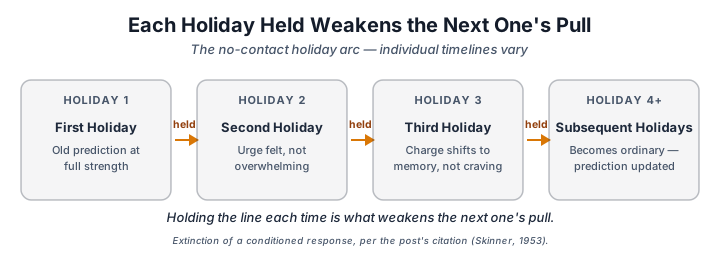
The progression is not linear, and intermittent contact — even a single text — tends to reset the clock. This is the clinical basis for strict no contact on high-charge days: not punishment of the other person, but protection of the survivor’s nervous system during the phase when it is most vulnerable to reinforcement.
Reclaiming the Day for Yourself
No contact on Valentine’s Day is not about punishing the other person. It is not about proving strength or performing recovery. It is about protecting the conditions that make healing possible.
Healing requires distance. Distance requires no contact. No contact requires treating certain days as higher-risk and adjusting accordingly.
Over time, the charge on these dates diminishes. The associations become less immediate. The day stops being about the lost relationship and starts being an ordinary day again. That shift cannot be forced. What can be done is to not interrupt it by reopening contact at the moments when the pull is strongest — because those are exactly the moments when the cost is highest. The work is not to feel differently. The work is to let the wave move through the body and leave the channel closed while it does.
Frequently Asked Questions
Why is breaking no contact on Valentine’s Day more likely than on an ordinary day? The nervous system has encoded the date as a predictor of the reward window central to the trauma bond. On ordinary days, the prediction is diffuse. On a holiday, it is concentrated, so anticipation, craving, and urge all spike at once. Meanwhile, the narcissist is statistically more likely to hoover on that day. Both pressures converge, which is why the day feels so much harder to hold even when intellectual conviction has not changed.
If my ex texts me on Valentine’s Day, does it mean they miss me? It does not. A holiday hoover is a pattern, not a feeling — a message timed to the window of greatest vulnerability in the survivor, not one reflecting genuine change in the sender. Research on traumatic bonding (Carnes, 1997; Dutton and Painter, 1993) describes these contacts as structural rather than sincere. Responding in the hope that this time is different reinforces the intermittent reward schedule and resets the clock on recovery.
How do I stop myself from reaching out when the urge feels unbearable? Treat the urge as a physiological event with a predictable duration, not a verdict about the relationship. Use body-based tools first: paced breathing, cold water, bilateral movement, short phone contact with someone who understands what is at stake. Have a pre-made decision in place before the urge arrives. A pre-made decision is held more reliably than one you are trying to make inside a craving wave. The wave passes. The decision does not need to be re-litigated each time.
Will I ever be able to enjoy Valentine’s Day again? Most survivors describe the day becoming ordinary over time, and many describe it becoming reclaimable — not as a commemoration of the past relationship, but as a day that no longer carries the same charge. The shift happens as the nervous system updates its prediction that the date produces a reward window. Each successful holiday held in no contact contributes to that update.
Is it okay to feel grief on a holiday even though I know the relationship was abusive? Yes. The grief and the knowledge are two different systems, and they are not required to agree. Disenfranchised grief — grief the culture does not recognize — is still grief (Doka, 1989). Feeling the loss of who you believed the person to be is a legitimate part of recovery. Grieving that belief does not mean reopening the channel. The work is to feel the loss without using it as a justification to restart the pattern.
A Note on Recovery
Understanding the physiology does not make the holiday easier to live through in real time. It makes it survivable without shame. A holiday held in no contact is not a day of failure because the craving came up. It is a day of recovery, measured in the fact that the channel stayed closed while the wave moved through.
If you want to do this work with someone who treats the holiday urge as physiology rather than weakness, book a free consultation.
Matthew Sexton, LCSW is a licensed clinical social worker who has treated survivors of narcissistic abuse and complex trauma since 2015. He has directed clinical programs across thirteen settings, including substance abuse treatment, forensic assertive community treatment, and disaster case management. He founded Mental Wealth Solutions to help survivors rebuild their nervous system, reclaim their sovereignty, and do the real work of recovery in a setting that respects the physiological reality of what they have been through.
Disclaimer
This article is for educational and informational purposes only. It does not constitute medical, clinical, legal, or therapeutic advice, and reading it does not create a therapist-client relationship with Matthew Sexton, LCSW or Mental Wealth Solutions, Inc.. Although the author is a licensed clinical social worker, the content in this article is not clinical assessment, diagnosis, or treatment.
The patterns, concepts, and recovery frameworks described here reflect clinical research and general observations across trauma recovery work. Individual experiences vary, and what is described here may not match every reader’s situation. If you are working through narcissistic abuse, complex trauma, or a trauma bond, please consult a licensed mental health professional who can assess your specific circumstances.
If you are in immediate emotional crisis, you can reach the 988 Suicide & Crisis Lifeline by calling or texting 988 (US). If you are experiencing domestic violence or are in physical danger, contact the National Domestic Violence Hotline at 1-800-799-7233 or visit thehotline.org. In a life-threatening emergency, call 911.
References
Carnes, P. (1997). The Betrayal Bond: Breaking Free of Exploitive Relationships. Health Communications.
Doka, K. J. (1989). Disenfranchised Grief: Recognizing Hidden Sorrow. Lexington Books.
Dutton, D. G., & Painter, S. (1993). Emotional attachments in abusive relationships: A test of traumatic bonding theory. Violence and Victims, 8(2), 105–120.
Fisher, H. (2004). Why We Love: The Nature and Chemistry of Romantic Love. Henry Holt.
Fisher, H. E., Brown, L. L., Aron, A., Strong, G., & Mashek, D. (2010). Reward, addiction, and emotion regulation systems associated with rejection in love. Journal of Neurophysiology, 104(1), 51–60.
Herman, J. L. (1992). Trauma and Recovery: The Aftermath of Violence. Basic Books.
Porges, S. W. (2011). The Polyvagal Theory: Neurophysiological Foundations of Emotions, Attachment, Communication, and Self-Regulation. W. W. Norton.
Skinner, B. F. (1953). Science and Human Behavior. Macmillan.
van der Kolk, B. A. (2014). The Body Keeps the Score: Brain, Mind, and Body in the Healing of Trauma. Viking.
If this named something you're living with —
You don't have to figure it out from articles. Matthew Sexton, LCSW, NATC sees adults in therapy at his separate private practice (telehealth · NY · ME · DE · FL). Or take this piece to your own therapist — it's written to be shared.
Visit the practice