When a narcissistic ex refuses to let go, what survivors are usually seeing is not love, regret, or a change of heart. They are seeing a predictable behavioral sequence: the apology text, the fabricated crisis, the mutual friend who “just happened” to reach out, the gift on the doorstep, the “I’ve changed” email, and, when those fail, the threats. This sequence has a clinical name — hoovering — and it escalates in a predictable way when ignored. Hoovering can cross the line into stalking, and in intimate-partner contexts it often does (Tjaden & Thoennes, 1998; Logan & Walker, 2009). No contact is not punishment. It is the only condition under which the nervous system can recover, and it is also the condition that causes the hoover to escalate before it burns out. Both things are true. Neither is a reason to break it.
What is hoovering?
The term “Hoover maneuver” was popularized in narcissistic abuse literature by Sam Vaknin to describe a predictable pattern in which someone with narcissistic, antisocial, or borderline features attempts to pull an ex-partner back into the relationship after a separation. The metaphor is mechanical: a vacuum, sucking the survivor back into the orbit of someone who needed them for supply, control, or regulation of their own internal state.
Hoovering is not the same as a genuine repair attempt. Repair contains accountability, changed behavior over time, respect for stated limits, and willingness to accept no as an answer. A hoover does none of those things. A hoover is a tactic, not a repair, and its goal is to re-establish access, not to acknowledge harm. Clinically, it maps onto what Patrick Carnes (1997) called the “betrayal bond” — a bond formed under conditions of exploitation that the person causing the harm actively cultivates. The person doing the hoovering is not trying to reach a conclusion. They are trying to re-open the loop.
The predictable hoover playbook looks something like this:
- The apology that isn’t one. “I’m sorry you felt that way.” “I’m sorry things got so bad between us.” Notice the structure: the apology names feelings and events, not specific behaviors. It almost never contains “I did X and I know it harmed you.”
- The crisis fabrication. A sudden health scare, a family emergency, a suicide threat, a claim of a car accident, a pet that is “asking for you.” The point is to create an emotional emergency the survivor feels obligated to respond to.
- Flying monkeys. Mutual friends, family members, or acquaintances who “reach out” on the person’s behalf — often without being explicitly asked to — repeating the narrative that “they really have changed” or “they just want closure.”
- Gift-sending. Flowers, delivered food, objects left on a doorstep. Physical delivery is a power move because it makes the survivor’s home address part of the interaction.
- The “I’ve changed” narrative. Sometimes presented as a new therapist, a twelve-step program, a religious conversion, a reading list, a diagnosis the survivor was supposedly right about. These claims may or may not be literally true. Either way, they are leveraged as permission to contact.
- The breadcrumb memory. A photograph, an inside joke, a song lyric. Not framed as a request. Framed as nostalgia. Designed to activate the reward-anticipation circuitry that trauma-bond research (Dutton & Painter, 1993) has linked to the intermittent-reinforcement architecture of the original relationship.
- The threat. When the softer tactics fail: rage, implied or explicit threats to the survivor, to themselves, to reputation, to children, to property. This is the phase in which hoovering most often crosses into stalking behavior.
One clinical note. Hoovering is not always intentional deception. Some people hoovering an ex genuinely believe the apology in the moment. The sincerity of the feeling does not change the function of the behavior. The function is to re-establish access. The question for the survivor is not whether the other person’s pain is real, but whether re-opening the door is safe.
Why do hoovers escalate after no contact?
There is a concept in operant conditioning called the extinction burst. When a behavior has been reinforced in the past and is then placed on an extinction schedule — no reward, no response — the behavior does not immediately fade. It first intensifies. Frequency goes up, intensity goes up, the variety of attempts goes up. This is well-documented in the foundational operant conditioning literature (Skinner, 1953), and it is the single most important thing a survivor can understand about no contact.
The hoovers get worse before they stop. Not because no contact is not working. Because no contact is working.
The nervous system of the person doing the hoovering was shaped by a relationship in which rage, apology, charm, threat, and flying monkeys reliably produced contact and supply. When those behaviors stop producing any response, the system does what any learning system does under extinction: it tries harder, tries new variants, escalates.
In practice, in rough sequence:
- Week 1 to 3 of no contact: standard playbook — apologies, I-miss-yous, a gift.
- Week 3 to 6: crisis fabrications, flying monkeys, appeals through family.
- Week 6 to 12: anger, threats of exposure, contact attempts through new numbers, accounts, workplaces.
- Week 12 and beyond: either genuine extinction or escalation into stalking.
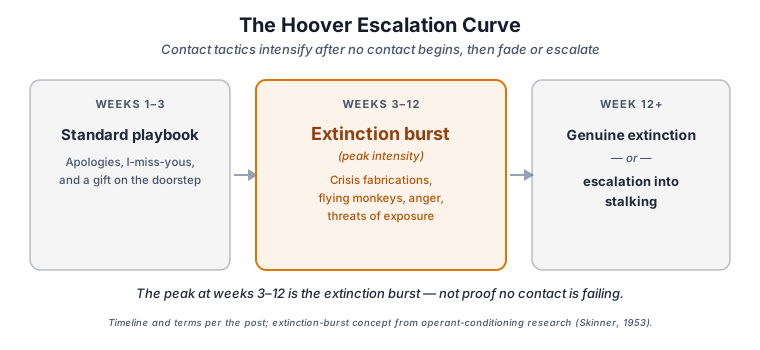
The extinction burst is the phase during which survivors most often break no contact, because the intensification of the hoover feels like evidence that the other person “really has changed” or “really is in crisis.” It is, in almost every case, not evidence of either. It is the operant curve. Understanding this does not make the hoover stop hurting. It makes the hurt a data point rather than a verdict. The urge to respond is a nervous-system event, not a truth. The S.T.O.I.C.K. method is one framework for working with that urge when it hits — the phase where the phone is in your hand and the fingers already want to type.
When does hoovering cross into stalking?
The clinical and legal literatures converge on a working definition. J. Reid Meloy, in The Psychology of Stalking (1998) and subsequent clinical writing, defines stalking as a pattern of unwanted, repeated contact or pursuit that induces fear in a reasonable person. The U.S. National Institute of Justice report by Tjaden and Thoennes (1998), Stalking in America, operationalized the definition for prevalence research and documented that intimate-partner stalking is far more common than stranger stalking and that the risk of physical harm rises when the stalker and victim have a prior intimate relationship. Logan and Walker’s subsequent work (Logan & Walker, 2009) has consistently found that stalking in the context of a former intimate relationship is associated with higher rates of physical violence, escalation, and lethality risk than stalking by strangers.
For clinical purposes, hoovering has crossed into stalking behavior when any of the following are present:
- Repeated contact after the survivor has said no, or contact through multiple channels when one channel has been blocked.
- Contact through third parties against the survivor’s stated wishes — recruiting flying monkeys who continue to message after being told to stop.
- Surveillance: showing up at the survivor’s home, workplace, gym, usual coffee shop, child’s school, or places the hoover would only know about from the relationship.
- Monitoring of social media with enough frequency that the hoover references specific posts, stories, or interactions the survivor made publicly.
- New accounts, spoofed numbers, or burner phones used to circumvent a block.
- Threats — explicit or implied — against the survivor, their children, pets, reputation, or themselves as a means of forcing contact.
- Unwanted gifts or deliveries sent to an address the survivor has not shared.
- Tracking or GPS-related behaviors: references to the survivor’s location, an AirTag, a shared account the hoover should not still be using.
The presence of any one of these elements warrants a documentation practice. The presence of two or more warrants immediate safety planning and consultation with a domestic violence advocate or attorney. Meloy’s clinical guidance, echoed across the stalking literature, is that prior intimate partnership is itself an elevated risk factor, and that the escalation from hoovering to stalking to physical violence is not linear — it can be rapid, and the warning period is often short.
How do I document a hoover?
Documentation is not vindictiveness. It is legal and clinical infrastructure. Courts grant protective orders on the basis of a documented pattern, not on a survivor’s report alone. Documentation is what converts a story into evidence, and evidence is what converts fear into legal standing.
A clinically sound documentation practice:
- One place, one format. A single timeline — a notebook, a password-protected document, a dedicated email thread — with dates, times, channel, and exact content where possible.
- Screenshots, not summaries. Screenshot everything with timestamps and sender identifier. Back up to cloud storage the hoover cannot access.
- Witness log. If a flying monkey reaches out, document name, channel, and content. Note witnesses willing to provide statements.
- Same-day entries. Memory degrades quickly under threat. Same-day entries are treated as more credible in legal settings than retrospective reconstructions.
- Do not respond to the hoover to document. This is the most common mistake. Screenshots are evidence. Your responses weaken the no-contact posture and can be used against you in court.
- Consult before you publish. Do not post about the hoover on social media without legal advice. It can compromise a protective order application.
Documentation serves two functions. The first is legal. The second is psychological: the survivor stops carrying the incidents internally as “am I crazy” and begins carrying them externally as a record. That shift is itself a nervous-system regulation event.
When should I get a restraining order?
Restraining orders — also called protective orders or no-contact orders depending on jurisdiction — are legal instruments, not clinical ones. The threshold for pursuing one is not whether the survivor is “sure enough” but whether the documented pattern meets the legal standard in their state. That threshold is almost always lower than survivors assume. An attorney or a domestic violence advocate can assess it in one conversation.
The indications for pursuing a protective order include:
- Any explicit threat of physical harm, self-harm framed as a weapon, or harm to children, pets, or property.
- Repeated contact after a clear request to stop, especially across multiple channels.
- Physical appearance at the survivor’s home, workplace, or other location against the survivor’s stated wishes.
- Escalation through third parties who continue to message after being asked to stop.
- Any behavior that meets the jurisdictional definition of stalking — the standard varies but is usually some version of Meloy’s definition: repeated unwanted contact inducing reasonable fear.
- Prior physical violence in the relationship, whether or not it was ever reported. Prior intimate-partner violence is the single strongest predictor of post-separation escalation (Tjaden & Thoennes, 1998; Logan & Walker, 2009).
Before filing, survivors should consult with a domestic violence advocate, a family law attorney, or both. Advocates are free in most jurisdictions. The National Domestic Violence Hotline (1-800-799-7233) can connect survivors to local advocates and walk through safety planning in real time.
A protective order is not a force field. Meloy and others have been clear: orders reduce certain categories of contact but do not eliminate risk, and in a small subset of high-lethality cases filing can briefly elevate risk. This is not an argument against pursuing one. It is an argument for pursuing one alongside a safety plan, not instead of one.
Why no contact is the whole project
No contact is not silence as revenge. It is silence as medicine. Herman’s work on complex trauma recovery (Herman, 1992) describes the three stages of recovery — establishing safety, remembrance and mourning, and reconnection — and the first stage cannot occur when the source of the harm still has contact with the survivor. Safety is not an emotional state. It is a set of environmental conditions. And one of those conditions is the absence of intermittent contact with the person whose unpredictability shaped the trauma bond in the first place.
Dutton and Painter’s (1993) traumatic bonding theory describes how intermittent contact — even a single text — reinforces the bond by reactivating the reward anticipation pattern that maintained it. A single reply resets the clock. Not metaphorically. Physiologically. The ventral vagal system does not distinguish between “we are in a relationship” and “we are now communicating after a separation.” It registers contact as contact and files the dopamine surge the same way it filed it the first time.
This is why the clinical answer to hoovering is always the same: do not respond, do not explain, do not justify, do not clarify, do not correct the record. Every one of those is a reward. The survivor owes nothing to a request for closure that was designed to reopen access. Recovery is a nervous system project, not a willpower project, and R.A.V.E.S. exists because the long arc of building a life the hoover cannot reach is what actually extinguishes the loop. Not cleverness. Not the perfect final word. Time plus environmental safety plus the daily accumulation of a life that no longer requires managing someone else’s state.
Frequently Asked Questions
Is my narcissistic ex hoovering me or do they genuinely want to reconcile? The distinction is in the behavior, not the feeling. A genuine reconciliation attempt contains specific accountability, respects stated limits, does not escalate when declined, and accepts no as an answer. A hoover does none of those. Hoovers use apology, crisis, nostalgia, and threat as tactics to re-establish access. If declining contact produces escalation rather than acceptance, it is a hoover.
How long do hoovering attempts usually last? There is no fixed timeline, but clinical observation suggests most hoovering attempts follow an extinction curve lasting roughly three to six months before substantially fading, with occasional recurrence at anniversaries, life transitions, or when the hoover’s current circumstances deteriorate. The middle of this curve — roughly weeks three through twelve of no contact — is typically the phase of highest intensity, when the extinction burst is active. Maintaining no contact through this phase is what produces extinction.
What should I do if my ex sends a suicide threat to force contact? Do not respond directly. Call a welfare check through local law enforcement or contact a mutual party who can notify emergency services. Document the threat with timestamps. Threatened self-harm used instrumentally to force contact is a recognized coercive-control tactic and does not obligate the survivor to re-open communication. If the threat is credible, the appropriate responders are trained crisis professionals, not the ex-partner the person is trying to reach.
Will getting a restraining order make things worse? Research on protective orders is mixed but generally favorable: most survivors who obtain protective orders report reduced contact and reduced fear, and the act of filing creates a legal record that supports future enforcement. A minority of high-lethality cases can see temporary elevation in risk around filing, which is why protective orders should be pursued in conjunction with a safety plan developed with a domestic violence advocate, not in isolation. The answer to “will it make things worse” is almost always “not if you file alongside a safety plan.”
Why do I feel guilty ignoring a hoover even when I know it’s manipulation? Guilt in this context is usually not evidence of wrongdoing. It is a trauma-bond residue — the ventral vagal response that formed the original attachment firing under the new stimulus of rejected contact. The nervous system does not distinguish between “I am declining manipulation” and “I am hurting someone I loved,” even when the intellectual mind draws the line cleanly. The guilt fades as the nervous system recalibrates. It is a symptom to tolerate, the way any withdrawal symptom is tolerated, until it passes.
A Note on Recovery
The hoover is designed to test whether the door is still open. Every response — a firm refusal, a careful explanation, a final-final goodbye — teaches the hoover that the door is still there. The clinical answer is not to explain better. The answer is to become unreachable, stay unreachable while the extinction curve runs its course, and treat every urge to respond as a nervous-system event rather than a verdict. The work is tolerating the extinction burst without opening the door.
If you are in physical danger, call 911 or the National Domestic Violence Hotline at 1-800-799-7233 first. A blog post is not a safety plan. An advocate is.
If you want to do this work with someone who treats hoovering and no contact as physiology rather than weakness, book a free consultation.
Matthew Sexton, LCSW is a licensed clinical social worker who has treated survivors of narcissistic abuse and complex trauma since 2015. He has directed clinical programs across thirteen settings, including substance abuse treatment, forensic assertive community treatment, and disaster case management. He founded Mental Wealth Solutions to help survivors rebuild their nervous system, reclaim their sovereignty, and do the real work of recovery in a setting that respects the physiological reality of what they have been through.
Disclaimer
This article is for educational and informational purposes only. It does not constitute medical, clinical, legal, or therapeutic advice, and reading it does not create a therapist-client relationship with Matthew Sexton, LCSW or Mental Wealth Solutions, Inc.. Although the author is a licensed clinical social worker, the content in this article is not clinical assessment, diagnosis, or treatment.
The patterns, concepts, and recovery frameworks described here reflect clinical research and general observations across trauma recovery work. Individual experiences vary, and what is described here may not match every reader’s situation. If you are working through narcissistic abuse, complex trauma, or a trauma bond, please consult a licensed mental health professional who can assess your specific circumstances.
If you are in immediate emotional crisis, you can reach the 988 Suicide & Crisis Lifeline by calling or texting 988 (US). If you are experiencing domestic violence or are in physical danger, contact the National Domestic Violence Hotline at 1-800-799-7233 or visit thehotline.org. In a life-threatening emergency, call 911.
References
Carnes, P. (1997). The Betrayal Bond: Breaking Free of Exploitive Relationships. Health Communications.
Dutton, D. G., & Painter, S. (1993). Emotional attachments in abusive relationships: A test of traumatic bonding theory. Violence and Victims, 8(2), 105–120.
Herman, J. L. (1992). Trauma and Recovery: The Aftermath of Violence. Basic Books.
Logan, T. K., & Walker, R. (2009). Partner stalking: Psychological dominance or “business as usual”? Trauma, Violence, & Abuse, 10(3), 247–270.
Meloy, J. R. (Ed.). (1998). The Psychology of Stalking: Clinical and Forensic Perspectives. Academic Press.
Skinner, B. F. (1953). Science and Human Behavior. Macmillan.
Tjaden, P., & Thoennes, N. (1998). Stalking in America: Findings from the National Violence Against Women Survey (NCJ 169592). U.S. Department of Justice, National Institute of Justice.
If this named something you're living with —
You don't have to figure it out from articles. Matthew Sexton, LCSW, NATC sees adults in therapy at his separate private practice (telehealth · NY · ME · DE · FL). Or take this piece to your own therapist — it's written to be shared.
Visit the practice