Emotional Regulation Is a Skill You Can Learn
Emotional regulation includes skills you can practice. What DBT research shows, what Gross’s process model offers, and why no strategy works in every situation.
Updated with targeted factual corrections. The revision note in the article describes the review scope; other claims and linked articles may remain unreviewed. See current solutions for today’s product information.
Emotional regulation includes skills you can practice: noticing what you feel, considering your options, and choosing what to do next. That does not mean every difficult feeling is a skills deficit, or that practice alone addresses every mental health concern.
One clinical example comes from a randomized trial of dialectical behavior therapy (DBT). It followed 101 women with borderline personality disorder and recent suicidal or self-injurious behavior through a year of treatment and a year of follow-up. The DBT group had fewer suicide attempts than the group receiving treatment from expert community therapists. This was a test of a complete treatment program in a particular clinical population, not proof that a few self-help exercises produce the same results for everyone.
Where “I’m just an emotional person” comes from
People say it like a fixed identity. I cry at commercials. I snap when I’m stressed. I shut down when things pile up. I’m just like this.
Your experience of feelings can be shaped by temperament, relationships, health, current pressures, and what you have had a chance to learn. If adults around you modeled naming a feeling and responding thoughtfully, you may have had opportunities to practice. If feelings were punished or dismissed, expressing them may still feel difficult. Linehan’s biosocial model describes one way emotional vulnerability and an invalidating environment can interact; it is an explanatory model, not a complete account of any individual’s childhood or future.
Suppression and regulation are not opposites. Hiding an expression is one possible regulation strategy, sometimes useful for a particular goal. It does not necessarily change how you feel. In Gross’s 1998 experiment, reappraisal and suppression had different effects while people watched a distressing film. A laboratory result helps distinguish strategies; it does not mean showing every feeling is always safe or suppressing one always ends badly.
Emotions unfold in steps, and each step is a door
James Gross’s process model of emotion regulation organizes strategies around the situation, attention, interpretation, and response. The model describes five broad places to intervene:
- Pick the situation. Some emotional weather is optional. You might choose a different time for the news scroll.
- Change the situation. Ask for the agenda before a meeting, or choose a more suitable setting for a hard conversation.
- Move your attention. Try putting a task down briefly or attending to something around you. Shifting focus can be difficult, and difficulty is not failure.
- Change the story. An abrupt email might be an accusation, or it might be a rushed colleague. Reappraisal means considering another interpretation when the facts allow it. It does not mean explaining away mistreatment. Gross and John’s studies linked habitual reappraisal with aspects of well-being and relationships; those associations are not a guarantee for every situation.
- Work with the response. You might pause before sending a message, choose your words, or take a comfortable break. The feeling does not have to disappear before you act thoughtfully.
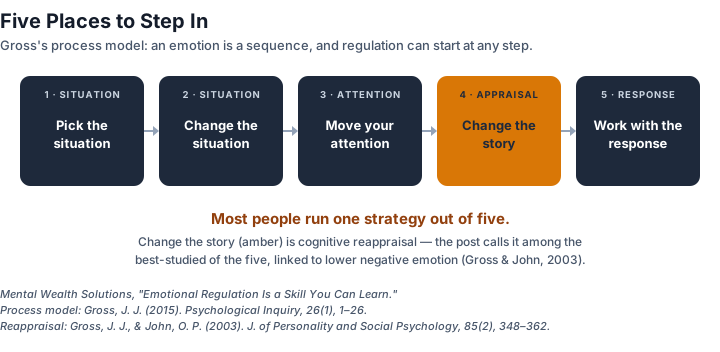
Read this diagram as text
Five Places to Step In: James Gross’s process model groups emotion regulation into five families of strategies.
- Situation selection: pick the situation.
- Situation modification: change the situation.
- Attentional deployment: move your attention.
- Cognitive change: change the story. This fourth family is highlighted in the illustration.
- Response modulation: work with the response.
Different situations can call for different strategies. The model offers several approaches rather than a single best strategy. Process model: Gross (2015), Psychological Inquiry, 26(1), 1–26. Illustration: Mental Wealth Solutions; see the article’s sources for context.
If you tend to rely on one familiar strategy, these categories offer alternatives to explore. Gross’s model is separate from MWS’s founder-developed RAVES reflection framework; evidence about one does not validate the other.
Why “just calm down” never worked
Being told to calm down does not explain what to do. In a difficult moment, an unfamiliar exercise may be hard to remember or may not fit what is happening. Practicing in manageable situations can be a practical way to discover what you find useful, without promising that it will become automatic under pressure.
Dan Siegel’s “window of tolerance” is often used as a picture of being able to stay engaged without feeling overwhelmed or shut down. Treat it as a metaphor for discussing experience, not a measurable band that is guaranteed to widen with exercise.
A new approach may feel awkward. You can change it, stop it, or ask for help. You do not have to reach a particular state of calm before protecting yourself, making a necessary decision, or seeking urgent support.
What emotional regulation practice actually looks like
Therapy can offer a place to identify patterns, try different responses, and discuss what happened afterward. The approach should fit your concerns and goals. DBT is one structured treatment; its evidence should not be transferred to every practice described as “somatic,” every coaching program, or every therapy.
Consider a possible email scenario. A message lands at 6 p.m. and reads as an accusation. You notice an urge to reread it, draft several replies, and snap at someone nearby. If it can wait, you put the phone down and return to the message later. You might discover a misunderstanding. You might instead find that a firm boundary or a direct conversation is needed. The point is to make room for an appropriate response, not to insist the problem was only your interpretation.
Choose one manageable example. Name the feeling more precisely than “stressed,” identify what you need, and consider an available action. Later, ask whether it helped and what you would change. You are gathering information about your experience, not grading yourself against a three-second deadline.
If feelings are repeatedly disrupting sleep, relationships, work, or safety, a licensed clinician can help assess what support fits. Needing treatment is not evidence that you failed to practice hard enough.
The goal is not to become a person without weather. It is to have more ways to respond when feelings arrive, with support where you need it.
Sources
- Linehan, M. M., et al. (2006). Two-year randomized controlled trial and follow-up of DBT vs. therapy by experts. Archives of General Psychiatry, 63, 757–766. Complete DBT program; selected clinical population.
- Gross, J. J. (1998). Antecedent- and response-focused emotion regulation. Journal of Personality and Social Psychology, 74, 224–237. Experiment with 120 participants viewing a film; not an everyday-life treatment trial.
- Gross, J. J., & John, O. P. (2003). Individual differences in two emotion regulation processes. Journal of Personality and Social Psychology, 85, 348–362. Five studies of strategy use and associated outcomes.
- Gross, J. J. (2015). Emotion regulation: Current status and future prospects. Psychological Inquiry, 26, 1–26. Author’s conceptual account of the process model.
- Historical conceptual references retained: Linehan, M. M. (1993), Cognitive-Behavioral Treatment of Borderline Personality Disorder; Siegel, D. J. (1999), The Developing Mind. These are not trials of the MWS frameworks.
Correction — September 9, 2026: The DBT result is now limited to the treatment and population studied. Unsupported brain and guaranteed-practice claims were removed, and Gross’s process model now links to its source rather than to RAVES. This was a targeted claims correction, not a new review of every historical reference. The original publication date and author are retained.
Disclaimer
This article is for educational and informational purposes only. It does not constitute medical, clinical, legal, or therapeutic advice, and reading it does not create a therapist-client relationship with Matthew Sexton, LCSW or Mental Wealth Solutions, Inc. Although the author is a licensed clinical social worker, the content in this article is not clinical assessment, diagnosis, or treatment.
The article distinguishes research findings, explanatory models, and illustrative practice suggestions. Individual experiences vary, and what is described here may not match every reader’s situation. If you are working through the concerns described in this article, please consult a licensed mental health professional who can assess your specific circumstances.
If you are in immediate emotional crisis, you can reach the 988 Suicide & Crisis Lifeline by calling or texting 988 (US). If you are experiencing domestic violence or are in physical danger, contact the National Domestic Violence Hotline at 1-800-799-7233 or visit thehotline.org. In a life-threatening emergency, call 911.