R.A.V.E.S. Explained: Five Domains for Reflection
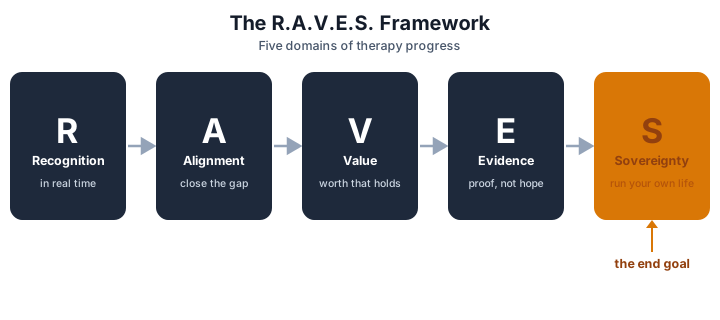
R.A.V.E.S. offers five domains for reflection: Recognition, Alignment, Value, Evidence, and Sovereignty. Explore the prompts and their limits as measures of progress.
Updated with targeted factual corrections. The revision note in the article describes the review scope; other claims and linked articles may remain unreviewed. See current solutions for today’s product information.
R.A.V.E.S. is a five-domain reflection framework I developed for conversations about therapy goals and experiences of change. The letters stand for Recognition, Alignment, Value, Evidence, and Sovereignty. I built it because the field has a measurement problem. Fewer than one in five behavioral health clinicians practice measurement-based care: 17.9% of psychiatrists, 11.1% of psychologists, and 13.9% of master’s-level clinicians, according to a 2019 review in JAMA Psychiatry. Most therapy is never measured at all.
The problem with “you’ll feel better”
Ask how progress gets measured in therapy and the honest answer, in many rooms, is a version of “you’ll feel better.” That is a hope, and hopes make poor instruments. Feeling better on a Tuesday could mean the work is landing. It could also mean you slept well. Without something sturdier, neither you nor your therapist can say where the change is happening, what is driving it, or whether it will hold.
This is a structural gap, and the field knows it. The same JAMA Psychiatry review found that as few as 5% of clinicians use outcome measures on the recommended schedule, which is every session. Clinicians are not the villains here; most were never trained or resourced to measure. The cost still lands on the client, in years of well-intentioned sessions with no clear answer to a basic question: is this working?
Measurement changes the outcome
Tracking progress is one of the few practices with evidence that it improves therapy by itself. In one study cited in the same review, routine measurement cut deterioration by 67% compared with usual care. Clients whose care was tracked were far less likely to quietly get worse while everyone assumed things were fine.
Standardized tools serve specific purposes. The PHQ-9 and GAD-7 have published validation studies for assessing depressive and anxiety symptoms, respectively (Kroenke et al., 2001; Spitzer et al., 2006). Their scores can inform clinical assessment, but do not describe every part of a person’s life or establish what caused a change.
R.A.V.E.S. offers a different kind of conversation: noticing experience, considering values, exploring self-worth, reviewing observations, and discussing agency. These are reflection domains, not a validated scale of capacity or recovery. Evidence for measurement-based care does not establish that R.A.V.E.S. itself improves outcomes.
The five R.A.V.E.S. domains
Each letter opens a conversation that client and therapist can revisit. The definitions and examples below describe possible topics to explore, not a standardized assessment or milestones everyone must meet.
R: Recognition
Recognition invites you to notice what you are feeling, thinking, and experiencing, whether in the moment or afterward. A first label may be incomplete: anxiety, stress, or a possible trauma response needs context. Naming an experience does not by itself establish a diagnosis or its cause.
Example to explore: you notice a familiar pattern and consider what else might explain it. You discuss whether a choice reflects a boundary, avoidance, or something else.
A: Alignment
Alignment asks how choices relate to values, responsibilities, and the options actually available. You can explore a sense of dissatisfaction without assuming that a mismatch in values is its only explanation.
The work of alignment is identifying your actual values, sorting them from the ones you inherited or perform, and building a life that reflects the real ones.
Example to explore: you practice saying no when that is the boundary you want to set, or explain a tradeoff between two things that matter to you.
V: Value
Value is a place to explore self-worth, including how performance, approval, achievement, or comparison affect how you see yourself. The aim is a less conditional relationship with yourself; this domain does not promise that criticism or disappointment will stop hurting.
Example to explore: after a bad day, you can describe what happened and what support you need without treating the setback as a verdict on your whole identity.
E: Evidence
The Evidence domain is about reviewing concrete observations alongside an overall impression. Evidence in clinical care is a broader question. Client and therapist might agree to record sleep, distressing experiences, or how a difficult conversation went. These examples are not outcomes R.A.V.E.S. promises; changes can have several explanations.
Example to explore: you compare specific observations over time, including setbacks or no change, and discuss whether your goals or care need adjustment. Observations alone do not prove that therapy caused an improvement.
S: Sovereignty
Sovereignty describes having a voice in decisions and choosing what support to seek. Agency can include ongoing therapy, accommodations, interdependence, and asking for help. Needing support is compatible with agency; this domain does not grade people by how independent they become.
Example to explore: you ask a question about your care, advocate for a boundary, or choose support that fits your needs. Ending therapy is not required to demonstrate agency.
How it works across a course of therapy
R.A.V.E.S. can organize a conversation about what matters, what feels difficult, and what to revisit. Client and clinician can choose personally meaningful goals and observations together. The framework does not assign a score, determine treatment, or show exactly where care should focus.
As therapy progresses, we revisit each domain. Are you recognizing patterns earlier? Are your choices more aligned? Is your sense of worth more stable? Can you point to real evidence of change? Are you building sovereignty over your own experience?
Nobody is being graded. These prompts can sit alongside appropriate clinical assessment, but are not a replacement for validated measures. The R.A.V.E.S. page carries the revised definitions and evidence limits.
What this means if you are the client
If therapy has felt aimless, like talking in circles with a kind person, you can ask how goals are chosen and progress reviewed. A framework can organize that conversation; having one does not guarantee effective care.
You are allowed to ask any therapist, including me, how they measure progress. It is a fair question about a serious investment of your time and money. Good therapy has an answer.
Sources
- Lewis, C. C., Boyd, M., Puspitasari, A., et al. (2019). “Implementing Measurement-Based Care in Behavioral Health: A Review.” JAMA Psychiatry, 76(3), 324–335. Supports: fewer than one in five clinicians practicing measurement-based care (17.9% of psychiatrists, 11.1% of psychologists, 13.9% of master’s-level practitioners); as few as 5% using measures every session; and the cited study finding a 67% reduction in deterioration compared with usual care. https://pubmed.ncbi.nlm.nih.gov/30566197/
- Kroenke, K., Spitzer, R. L., & Williams, J. B. W. (2001). The PHQ-9: validity of a brief depression severity measure. Supports the description of the PHQ-9, not validation of R.A.V.E.S.
- Spitzer, R. L., et al. (2006). A brief measure for assessing generalized anxiety disorder: the GAD-7. Supports the description of the GAD-7, not validation of R.A.V.E.S.
- Mental Wealth Solutions, Inc. (2026). R.A.V.E.S. Framework. Source for the framework definitions; not independent validation.
Figures current as of July 2026. Framework claims and diagram wording corrected September 9, 2026; other historical claims in this article were not re-reviewed in that correction.
Disclaimer
This article is for educational and informational purposes only. It does not constitute medical, clinical, legal, or therapeutic advice, and reading it does not create a therapist-client relationship with Matthew Sexton, LCSW or Mental Wealth Solutions, Inc. Although the author is a licensed clinical social worker, the content in this article is not clinical assessment, diagnosis, or treatment.
The patterns, concepts, and frameworks described here reflect published research and general clinical observations. Individual experiences vary, and what is described here may not match every reader’s situation. If you are working through the concerns described in this article, please consult a licensed mental health professional who can assess your specific circumstances.
If you are in immediate emotional crisis, you can reach the 988 Suicide & Crisis Lifeline by calling or texting 988 (US). If you are experiencing domestic violence or are in physical danger, contact the National Domestic Violence Hotline at 1-800-799-7233 or visit thehotline.org. In a life-threatening emergency, call 911.