A communal narcissist pursues the standard narcissistic rewards, admiration, entitlement, status, and power, through helping instead of dominating. The self-image is the most caring person you will ever meet, and the public usually believes it. The people closest to them pay the bill in guilt, obligation, and boundaries that never hold. A meta-analytic review of 32,200 participants found narcissism tied to reduced affective empathy, the capacity to feel what you feel, while the ability to read your emotions often stays intact (Urbonaviciute & Hepper, 2020). Accurate reading without felt cost is the mechanical basis of effective guilt-tripping, and guilt is how this pattern steers.
Two faces of narcissism
Since Paul Wink’s 1991 paper “Two Faces of Narcissism,” researchers have distinguished the grandiose presentation (bold, dominant, openly self-promoting) from the vulnerable or covert one (defensive, insecure, hypersensitive to criticism). Both share the core: self-importance, entitlement, and a preoccupation with their own needs. The covert face is the one that can look gentle, humble, and giving, which is what makes the “nice” narcissist possible. We cover that presentation in depth in our guide to vulnerable narcissism.
The helper arena of communal narcissism
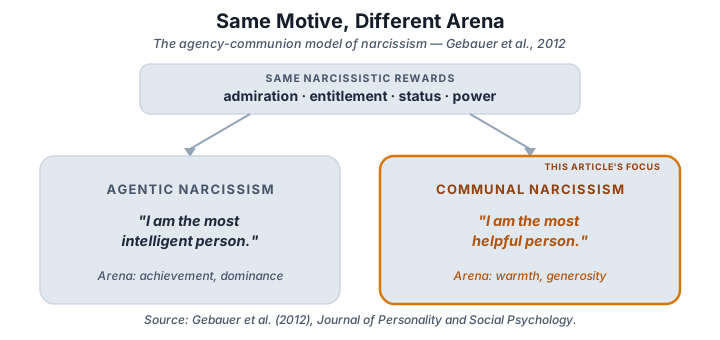
In 2012, a team led by Jochen Gebauer published the agency-communion model of narcissism in the Journal of Personality and Social Psychology, across five studies. When participants listed their grandiose self-thoughts, two distinct types emerged. Agentic: “I am the most intelligent person.” Communal: “I am the most helpful person.” Same motives, different arena.
The team built a Communal Narcissism Inventory to measure the second type and found it psychometrically sound, stable over time, and largely independent of the standard narcissism measure. Translated: you can score high on communal narcissism while looking nothing like the textbook arrogant narcissist. The grandiosity has simply been routed through casseroles, favors, volunteering, and remembered birthdays.
This is also why challenging a communal narcissist goes so badly. Their entire self-concept rests on being good. A boundary or a complaint lands as an attack on the one identity they have, rather than as information about your needs.
The gap is the tell
If a communal narcissist were simply a generous person, there would be no problem. The defining feature is the gap between the self-image and the lived experience of the people nearby.
Research captures the gap directly. In a 2017 study of adolescents in the Journal of Personality, communal narcissism was significantly related to self-reported prosocial behavior, and the same trait was associated with peer-reported aggression (Barry et al., 2017). The self-report says helper. The room says otherwise.
The gap also explains the broadcast. Help that happens without an audience does no work for the identity, so the help tends to arrive publicly, get retold often, and stay on the books. If you have noticed that every favor comes with a press release, you have noticed the mechanism.
Kindness as currency
People close to this pattern describe a running tab: “I did this for you. I did that for you. After everything I’ve done.” Inside the agency-communion model, the tab makes sense. If helping is a strategy for securing esteem and leverage, then every act of help is an investment that expects a return.
That single idea reframes a lot of confusing behavior:
- They keep score of what they give and discount what they receive. When the self-concept rests on being the most giving person, acknowledging your generosity threatens the story.
- The help often is not the help you asked for. It arrives unsolicited, oversized, or attached to strings, because it serves their need to be needed more than it serves your situation.
- Boundaries read as betrayal. From inside their narrative, your “no” rejects the good person, so the guilt arrives on schedule.
The control loop runs in four steps. Visible giving establishes a debt. The debt gets invoked when they want something. Your refusal gets reframed as a moral failing: selfish, ungrateful, cold. You comply to relieve the guilt, which confirms the debt was real and loads the next round. To everyone outside, a saint. To you, a slow accumulation of obligation with no single moment you can point to.
Why your needs do not land
The empathy research from the opening deserves a closer look. The meta-analytic review by Urbonaviciute and Hepper (2020) found narcissism, especially its grandiose aspects, linked to reduced affective empathy even where cognitive empathy stays relatively intact. A 2025 meta-analysis in Frontiers in Psychiatry covering 14 studies and 5,328 participants found the same shape: narcissism was negatively associated with affective empathy, with no significant link to cognitive empathy (Shukla & Upadhyay, 2025). They can see the lever without feeling the pull on your end.
Two further findings fill in the picture. A 2021 study of 254 adults in Frontiers in Psychiatry found vulnerable narcissism strongly tied to immature defense mechanisms, including splitting, projection, passive aggression, and devaluation, along with high psychological distress; grandiose narcissism showed no link to distress (Kampe et al., 2021). And a 2024 study in Personality and Mental Health found that the emotion dysregulation seen in narcissistic vulnerability appears to run through impaired self-mentalizing, the capacity to read your own internal states (Blay et al., 2024). Feelings that cannot be read internally arrive as floods, and the people nearby become the flood-management system.
None of this is a new idea. Kohut (1971) described pathological narcissism as an arrested development of the self. Kernberg (1975) described a defensive grandiose self built over a devalued one. Different schools, same shape; the modern studies put measurements on a picture clinicians have been drawing for fifty years.
One caution from that same literature: immature defenses are stable traits. Planning around who the person actually is works better than managing them, over-explaining, and waiting for them to grow up on their own.
How common is this
The largest U.S. epidemiological study on the question, NESARC, interviewed 34,653 adults and estimated the lifetime prevalence of narcissistic personality disorder at about 6.2%, higher in men (7.7%) than in women (4.8%) (Stinson et al., 2008). Communal narcissism as a trait is broader than the diagnosable disorder, and plenty of people who would never meet clinical criteria still run the kindness-as-currency pattern. The pattern matters more than the label, and only a qualified clinician can diagnose a personality disorder.
If you recognize this
- Separate the act from the motive, without gaslighting yourself. They did help you. The help also came with strings. Both are true, and holding both is the honest position.
- Stop arguing about the ledger. The scoreboard is kept by the other side and audited by no one. You will not win the “look at everything I do” debate, and the attempt costs you hours of your life.
- Expect boundaries to be reframed as cruelty, and hold them anyway. The surge of guilt when you say no is the control system working. It is evidence of the pattern, and it says nothing about whether your boundary was fair.
- Find outside reality-testing. The dynamic depends on the gap between their public reputation and your private experience staying private. One person who hears the specifics changes that.
- Adjust expectations rather than waiting for change. Plan around who they are rather than who you keep hoping they will become.
The “nice” narcissist confuses people because the niceness is real and it is a strategy, at the same time. If you have felt crazy for struggling with someone everyone else calls an angel, the research above describes exactly the gap you are sensing. You are not ungrateful. You are standing close enough to see both sides.
Related reading: Nobody’s Calling Her a Narcissist · Vulnerable Narcissism: What It Is and How to Recognize It · Narcissistic Mothers and Children as Props
FAQ
What is a communal narcissist? A communal narcissist pursues the core narcissistic rewards, grandiosity, esteem, entitlement, and power, through warmth and generosity rather than achievement or dominance. The agency-communion model (Gebauer et al., 2012) shows the underlying grandiosity matches the obvious narcissist’s; it is simply expressed as being the most caring, most helpful person anyone could know. The defining feature is the gap between that self-image and how the people around them actually experience them.
Can a narcissist really be nice to everyone? Yes, and that is what makes this pattern so hard to name. The kind acts are real in the sense that they happened, but they function as a strategy for securing admiration rather than an expression of concern. The tell is the contrast between the public reputation as the kindest person you know and the private experience of the people closest to them, who feel used, guilt-tripped, and exhausted.
Do I need to have left the relationship to start therapy? No. This applies whether the person is a partner, a parent, a sibling, or a friend. You can start therapy while the relationship is fully intact, while you are unsure what you want, or after it ends. A therapist’s job is to help you see the pattern clearly and decide what you want to do about it, on your timeline. If the relationship involves physical danger, contact the National Domestic Violence Hotline at 1-800-799-7233.
Sources
- Urbonaviciute, G., & Hepper, E. G. (2020). When is narcissism associated with low empathy? A meta-analytic review. Journal of Research in Personality. https://www.sciencedirect.com/science/article/abs/pii/S0092656620301252. Supports the 32,200-participant scope and the finding of reduced affective empathy with relatively intact cognitive empathy.
- Gebauer, J. E., Sedikides, C., Verplanken, B., & Maio, G. R. (2012). Communal Narcissism. Journal of Personality and Social Psychology, 103(5), 854–878. https://www.southampton.ac.uk/~crsi/Gebauer_Sedikides_Verplanken_%20Maio_2012_JPSP.pdf. Supports the agency-communion model, the agentic vs. communal self-thought examples, and the Communal Narcissism Inventory’s psychometric properties and independence from the standard narcissism measure.
- Barry, C. T., et al. (2017). Adolescent communal narcissism and peer perceptions. Journal of Personality, 85(6). https://pubmed.ncbi.nlm.nih.gov/28000930/. Supports the finding that communal narcissism related to self-reported prosocial behavior and to peer-reported aggression.
- Shukla, M., & Upadhyay, N. (2025). Cold hearts and dark minds: a systematic review and meta-analysis of empathy across dark triad personalities. Frontiers in Psychiatry. https://www.frontiersin.org/journals/psychiatry/articles/10.3389/fpsyt.2025.1546917/full. Supports the 14-study, 5,328-participant scope and the finding that narcissism was negatively associated with affective but not cognitive empathy.
- Kampe, L., Bohn, J., Remmers, C., & Hörz-Sagstetter, S. (2021). It’s Not That Great Anymore: The Central Role of Defense Mechanisms in Grandiose and Vulnerable Narcissism. Frontiers in Psychiatry, 12. https://pmc.ncbi.nlm.nih.gov/articles/PMC8226035/. Supports the 254-adult sample, the immature-defense findings for vulnerable narcissism, and the distress difference between the two presentations.
- Blay, M., et al. (2024). Association between pathological narcissism and emotion regulation: the role of self-mentalizing. Personality and Mental Health, 18(3). https://pubmed.ncbi.nlm.nih.gov/38710596/. Supports the finding that impaired self-mentalizing appears to mediate the link between narcissistic vulnerability and emotion dysregulation.
- Stinson, F. S., et al. (2008). Prevalence, correlates, disability, and comorbidity of DSM-IV narcissistic personality disorder: Wave 2 NESARC. Journal of Clinical Psychiatry, 69(7). https://www.psychiatrist.com/jcp/prevalence-correlates-disability-comorbidity-dsm-iv-narcissistic-personality-disorder-wave-2-nesarc/. Supports the 6.2% lifetime prevalence, the 7.7% and 4.8% figures by sex, and the 34,653-adult sample.
- Wink, P. (1991). Two faces of narcissism. Journal of Personality and Social Psychology, 61(4), 590–597. Framework reference for the grandiose/covert distinction; no figures drawn from it.
- Kohut, H. (1971). The Analysis of the Self; Kernberg, O. F. (1975). Borderline Conditions and Pathological Narcissism. Theoretical works cited for historical framing; no figures drawn from them.
Figures current as of July 2026.
Disclaimer
This article is for educational and informational purposes only. It does not constitute medical, clinical, legal, or therapeutic advice, and reading it does not create a therapist-client relationship with Matthew Sexton, LCSW or Mental Wealth Solutions, Inc. Although the author is a licensed clinical social worker, the content in this article is not clinical assessment, diagnosis, or treatment.
The patterns, concepts, and frameworks described here reflect published research and general clinical observations. Individual experiences vary, and what is described here may not match every reader’s situation. If you are working through the concerns described in this article, please consult a licensed mental health professional who can assess your specific circumstances.
If you are in immediate emotional crisis, you can reach the 988 Suicide & Crisis Lifeline by calling or texting 988 (US). If you are experiencing domestic violence or are in physical danger, contact the National Domestic Violence Hotline at 1-800-799-7233 or visit thehotline.org. In a life-threatening emergency, call 911.
Frequently asked questions.
- What is a communal narcissist?
- A communal narcissist pursues the core narcissistic rewards, grandiosity, esteem, entitlement, and power, through warmth and generosity rather than achievement or dominance. The agency-communion model (Gebauer et al., 2012) shows the underlying grandiosity matches the obvious narcissist's; it is simply expressed as being the most caring, most helpful person anyone could know. The defining feature is the gap between that self-image and how the people around them actually experience them.
- Can a narcissist really be nice to everyone?
- Yes, and that is what makes this pattern so hard to name. The kind acts are real in the sense that they happened, but they function as a strategy for securing admiration rather than an expression of concern. The tell is the contrast between the public reputation as the kindest person you know and the private experience of the people closest to them, who feel used, guilt-tripped, and exhausted.
- Do I need to have left the relationship to start therapy?
- No. This applies whether the person is a partner, a parent, a sibling, or a friend. You can start therapy while the relationship is fully intact, while you are unsure what you want, or after it ends. A therapist's job is to help you see the pattern clearly and decide what you want to do about it, on your timeline. If the relationship involves physical danger, contact the National Domestic Violence Hotline at 1-800-799-7233.
If this named something you're living with —
You don't have to figure it out from articles. Matthew Sexton, LCSW, NATC sees adults in therapy at his separate private practice (telehealth · NY · ME · DE · FL). Or take this piece to your own therapist — it's written to be shared.
Visit the practice