The legwork of getting to transplant.
TransplantCheck is an app for dialysis units. Patients check in, compare transplant centers and sort out their own rides. The social worker sees it all, replies, and gets a draft note.
We’re looking for pilot participantsThe patient’s side of getting to transplant, and the social worker’s whole caseload
Getting on the list is a long run of faxes, forms and calls. TransplantCheck lays it out as five steps the patient and the social worker can both see.
The patient does the part they can do from the chair. The social worker sees it and steps in where a person is needed.
Inside TransplantCheck, in under two minutes
Recorded with demo data. No real patients appear.
What TransplantCheck lets a unit do
Patients see every center
They search transplant centers by ZIP code and compare the public numbers.
The legwork moves to the patient’s phone
Rides, food and housing help are things a patient can look up from the chair.
The social worker sees it as it happens
Check-ins, calls and requests show up on the caseload, with messages both ways.
Paperwork starts as a draft
A quarterly note is drafted for the social worker to edit and sign.
How it works
Five steps, the same on the patient’s phone and on the social worker’s screen.
- BasicsOptions and living donors.
- Pick a centerCompare the public wait and success numbers.
- ReferralThe referral and the CMS-2728 form go out.
- Work-upLabs, dental, cardiac and social work.
- Active listThe committee says yes and the wait begins.
Four screens from the walkthrough.
36 seconds, with sound. Demo data.
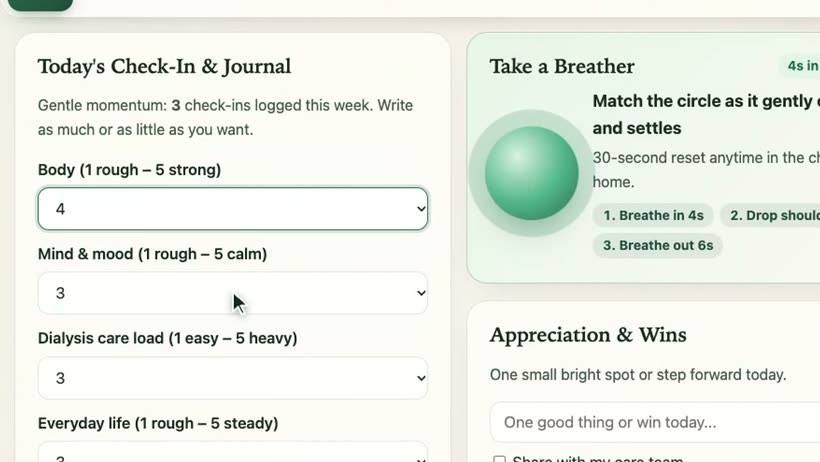 Patient | Every treatment
A daily check-in from the chair
Body, mood, dialysis load and daily life, with the patient’s own care goal at the top.
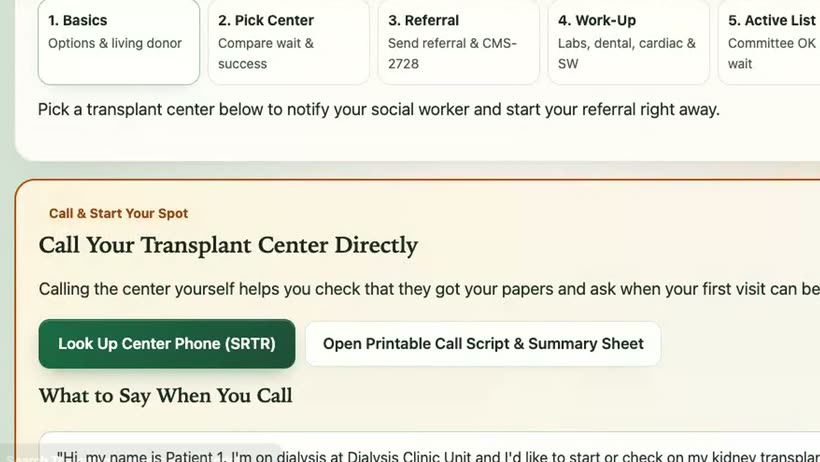 Patient | Transplant path
Compare centers, then call with a script
Search transplant centers by ZIP code, open a plain-English call script, and log the call for the care team.
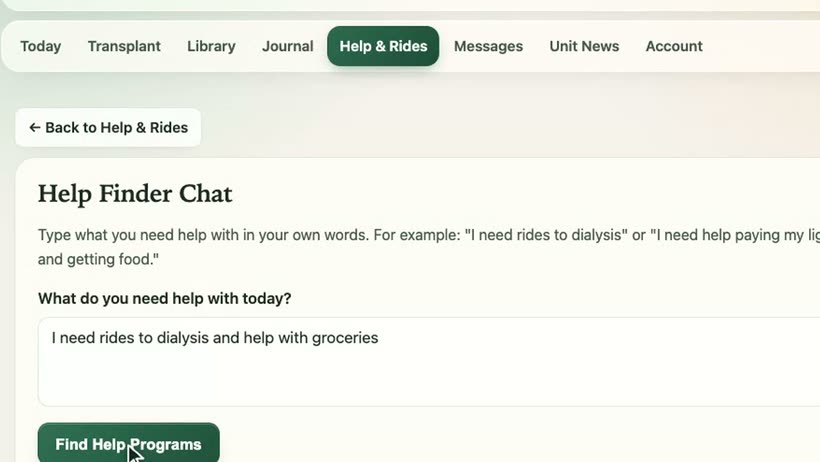 Patient | Rides and help
Rides, food and a help finder
Browse local programs or type the need in your own words, in English or Spanish. The request goes to the social worker.
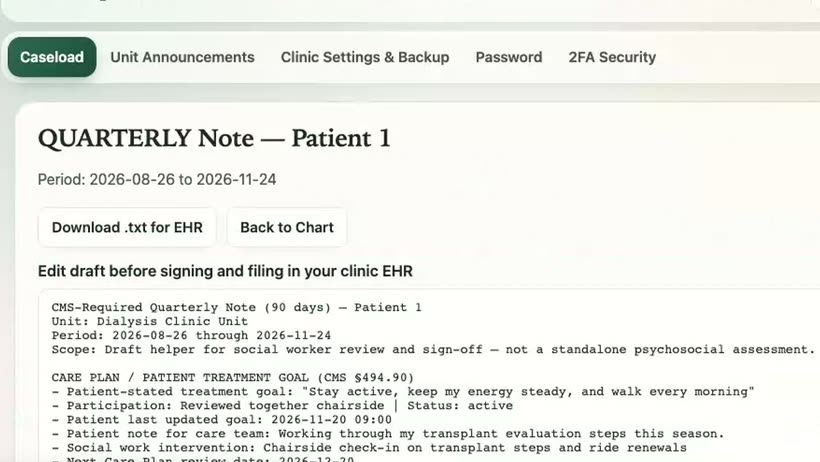 Social worker | Caseload
Messages and draft notes
Staff see each update, confirm the referral and reply from the chart. A draft quarterly note is ready to edit and sign.
How it compares
The two tools we found in this field, TxAccess from CareDx and BREEZE Transplant from MedSleuth, handle the referral. TransplantCheck sits on the other side, in the dialysis unit.
Their columns are taken from each vendor’s own pages, read 2026-11-25. “Not stated” means the page does not mention it, not that the product lacks it.
Sources: CareDx, TxAccess product page; DaVita newsroom, December 11, 2023; medsleuth.com.
They do different jobs and can sit side by side: those two move the referral, and TransplantCheck keeps the patient moving before and after it.
Why I built it
I was a dialysis social worker, and then a director of dialysis. The unit carries the weight of getting its patients to transplant, and has very little it can do to make that happen.
The referral runs through the kidney doctor. Federal rules tell the care team to pursue transplant, to give patients unbiased information, and they say a patient is free to choose any center. In my experience the referral usually went to the hospital the doctor was tied to, and the staff were not supposed to point a patient anywhere else.
One day I was covering at a clinic in Queens. A man told me he had been on a wait list for five years, and that nothing in his life was going to change. He was listed at one center. Another had a far shorter wait.
Patients should be able to see every center and choose for themselves. So TransplantCheck shows the public numbers for real transplant centers, hands the patient a script, and lets them make the call.
The other reason is time. A ride alone can cost a social worker an hour or two on the phone. The app lets patients sort out rides and food help themselves during the week.
Then the social worker gets to do what they went to school for. Sit down and ask: what was it like this week? How are we going to get a transplant?
 Matthew Sexton, LCSW
Founder, Mental Wealth Solutions
What the public record says
of people on dialysis were on the waitlist for a kidney transplant in 2024. That share has dropped by more than a third since 2014.
USRDS 2025 Annual Data Report- Federal rule
The care team must pursue transplant and track it
For a patient who is a transplant candidate, the team must make a plan for pursuing transplant, track each referral, and follow the patient’s wait-list status. 42 CFR 494.90
- Federal rule
Patients have the right to be told about transplant
Every patient has the right to be informed about all treatment options, transplant included. 42 CFR 494.70
- CMS guidance
Education must be unbiased, and the patient may choose
Staff must give unbiased education about transplant. Patients are free to pick a center other than the ones the unit normally uses, and may contact a transplant center themselves. CMS ESRD interpretive guidance, transplant tags
TransplantCheck is built for that last route. The patient searches transplant centers, sees the public numbers, and makes the call.
Trust and security
Built to HIPAA and SOC 2 technical standards. Each item here was checked in the code on 2026-11-24.
- Built
Two-factor sign-in for staff
A password and a one-time code from an authenticator app.
- Built
An audit log that shows tampering
Each entry is chained to the one before it, so a changed or missing entry shows up.
- Built
Encrypted backups
Clinic backups are encrypted with AES-256-GCM.
- Built
A small local decision model
Laya reads a help request and sorts it into one of 18 kinds of support need.
- Checked
54 automated tests
Counted in the code on 2026-11-24.
- Planned
An independent SOC 2 audit
We have not had one yet.
We’re looking for pilot participants
Tell Matthew about your unit and see whether a pilot fits.
Talk to Matthew