VibeCheck.luxury is the between-session companion that closes the most expensive gap in outpatient therapy: most of a client’s week happens without you, and you still spend the first five minutes reconstructing it before the real work can start. Clients answer a short prompt in their own words each day, and you open the next session already knowing what kind of week it was. The EMR is currently in beta; email [email protected] for more information. Shaula is a separate free local assistant.
That’s the whole idea. Here’s why it matters and how it actually works.
The Between-Session Gap Is Clinical Time You Never Bill
A typical client sees you maybe four sessions a month. That leaves the other 26 days, where the actual living happens — the fight with a partner on Tuesday, the good day on Thursday nobody mentions, the three nights of bad sleep before a session where the client shows up flat and can’t say why. None of it gets written down. All of it gets compressed into whatever they remember to bring up, filtered through however they’re feeling that hour.
Clients aren’t hiding the week. Memory is selective. Shame edits. A rough Sunday reframes everything that came before it. By the time they sit down, the midweek dip that mattered on Tuesday is hard to retrieve, and the story has already been smoothed into something session-shaped. You spend the opening minutes reverse-engineering what happened, what almost happened, and what they’re still not saying.
That’s not a rapport failure. It’s a design gap between how therapy is scheduled and how life is lived — and dropout compounds it. A widely cited meta-analysis of psychotherapy outcomes found a weighted dropout rate of 19.7%, roughly one in five clients, across nearly 84,000 people in 669 studies, with early sessions carrying a disproportionate share of that risk. A client who can’t easily convey what actually happened between visits is a client more likely to decide therapy “isn’t working” and stop showing up.
VibeCheck.luxury doesn’t fix dropout by itself. It removes one specific piece of friction: you walking in cold, and the client rebuilding two weeks from a standing start.
How VibeCheck.luxury Closes the Between-Session Gap
VibeCheck.luxury sends the client a short daily check-in. They answer in their own words — not a mood slider, not a 1-to-10 scale, not a symptom checklist. The pattern builds across the week: the day things went sideways, the day that was fine, the drift in sleep or tone the client themselves might not have connected to anything.
By the time the next session starts, you already have a shape for the week. The first question isn’t “what happened” — it’s “tell me more about Wednesday.” That’s the whole mechanic described in what VibeCheck.luxury actually is: a companion that sits in the space between sessions, not a replacement for the session itself.
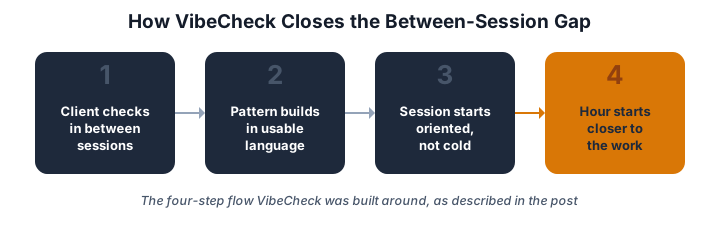
The workflow it was built for is short:
- The client checks in between sessions.
- Pattern accumulates in language you can actually use.
- You enter session oriented, not cold.
- The hour starts closer to the work.
What VibeCheck.luxury Is Not
It is not a mood tracker. Trackers ask a client to rate a feeling on a scale and chart the number — useful for some things, but they flatten a week into a line graph and tell you nothing about why. VibeCheck.luxury asks the client to describe the day in language, because language is what you actually work with in the room.
It is not a diagnostic tool. It doesn’t score anyone, doesn’t flag a diagnosis, doesn’t tell a client what’s wrong with them. It surfaces what the client already said, in the order they said it, so you can ask a better first question. The clinical judgment stays exactly where it belongs — with the clinician. That distinction is the difference between a genuinely clinician-in-the-loop tool and an AI product that just sounds clinical.
And it is not another inbox that turns you into an unpaid transcriptionist for software. Its job is narrow: keep the between-session signal intact so session time isn’t spent rebuilding the timeline from fragments.
Shaula Runs the Office, You Run the Room
Every VibeCheck.luxury seat includes Shaula, an AI office, at no additional cost. Shaula handles the administrative layer around a caseload — drafting session summaries from check-in data, organizing what came in between visits, keeping the paperwork moving.
Documentation is a real, measured burden here, not an abstraction. In Tebra’s 2025 Physician Burnout Survey of private-practice providers, mental health clinicians reported the highest rate of mental fatigue of any specialty surveyed, and 23% named documentation and charting as their single biggest driver of burnout. Shaula exists to take a bite out of that specific number.
It is governed, not autonomous. Shaula drafts; it doesn’t finalize. It organizes; it doesn’t message a client on its own. Every note it produces sits in front of you for review, edit, and signature before it becomes part of the record. That’s a deliberate design constraint, not a limitation of the technology — the arm acts, the clinician signs. For the fuller argument on why that governance model matters more than raw capability, see how scribe governance should actually work in mental health tools.
Clinicians are already moving this way on their own. The American Psychological Association’s 2025 Practitioner Pulse Survey found that 29% of practitioners now use AI at least monthly, up from 11% the year before — a nearly threefold jump in a single year — and 42% now say AI can meaningfully reduce administrative burden, up from 33% in 2024. VibeCheck.luxury and Shaula are built for clinicians who want that reduction without handing clinical judgment to a model.
Clinician-Built Is the Moat
Matthew Sexton, LCSW, NATC, built VibeCheck.luxury for his own clients — not as a hypothetical product spec, but as a tool he needed to run his own practice better. That’s the difference between software built by engineers guessing at what a caseload needs and software built by someone who was carrying one. The workflow, the language on the check-in prompt, the shape of what you see at the top of a session — all of it came out of an actual practice, not a whiteboard. That’s the case laid out at length in why clinician-built AI tools have a real advantage.
Most therapy tech fails one of two ways: it optimizes for consumer engagement metrics that don’t map to clinical judgment, or it promises automation that quietly moves decisions away from the person with the license. VibeCheck.luxury is built the other way — AI present as infrastructure inside a governed workflow, not an unsupervised co-therapist and not a black-box “insight engine” that tells you what the case really is. When we say AI interactions, we mean exactly that: support that speeds orientation and pattern recognition, inside a workflow you still run.
Where the Data Lives
Client check-in data is sensitive, and it should be treated that way by default. There’s no such thing as “HIPAA-certified” software — no certifying body issues that label, whatever a vendor’s homepage claims. What VibeCheck.luxury can say plainly: it runs on HIPAA-eligible architecture, with executed Business Associate Agreements in place, and a SOC 2 audit currently in progress. None of that is marketing gloss; it’s the actual, checkable state of the infrastructure.
The bigger question for most therapists shopping AI tools isn’t the acronym on a compliance page — it’s who owns the data once it’s in the system, and what happens to it if you leave the platform. That’s worth asking of every vendor a practice considers, not just VibeCheck.luxury. The full breakdown is in who actually owns therapy data on AI platforms.
Current status: EMR beta
The VibeCheck.luxury EMR is currently in beta. Pricing is not publicly listed; email [email protected] for more information.
That’s a deliberate departure from the model most practice-management and EHR platforms run — a base fee plus add-on modules plus per-seat scaling that turns into a spreadsheet exercise before you get to actually using the thing. If you’re assembling a broader private practice AI stack for 2026, price clarity matters as much as the feature list.
Getting Started
Setup is three steps: go to vibecheck.luxury, set up a clinician seat, invite clients. The client gets a daily check-in prompt. You walk into every session already knowing what kind of week it was. You don’t need a six-week implementation project to find out whether between-session language helps your caseload.
VibeCheck.luxury is for licensed clinicians who carry outpatient caseloads with real space between contacts, who want client language rather than another dashboard, who won’t outsource clinical judgment to an autonomous system, and who care about HIPAA-eligible architecture and executed BAAs more than compliance adjectives. It’s not for anyone hunting a free tier, a diagnostic shortcut, or a consumer wellness app rebadged for therapy.
If documentation and cold-open sessions are the two things eating the most out of your week, this is built to address both — the check-in closes the between-session gap, and Shaula, included free, takes a piece of the paperwork. It’s worth reading what your EHR isn’t doing for you as a transcriptionist if the admin burden is the sharper pain point right now.
See VibeCheck.luxury, or book a call to walk through setup for a specific caseload.
Sources
- Swift, J.K. & Greenberg, R.P. (2012). “Premature Discontinuation in Adult Psychotherapy: A Meta-Analysis.” Journal of Consulting and Clinical Psychology, 80(4), 547–559. Weighted dropout rate of 19.7% (95% CI 18.7–20.7%) across 669 studies and 83,834 clients. https://eric.ed.gov/?id=EJ992545
- Tebra, “Why EHR documentation is the leading cause of physician burnout,” The Intake, 2025 Physician Burnout Survey. Mental health clinicians reported the highest rate of mental fatigue among specialties surveyed; 23% cited documentation/charting as their primary burnout driver. https://www.tebra.com/theintake/ehr-emr/how-documentation-became-top-cause-of-physician-burnout
- American Psychological Association, “AI in the therapist’s office: Uptake increases, caution persists,” APA Monitor, March 2026, reporting results of the 2025 Practitioner Pulse Survey. 29% of practitioners use AI at least monthly (up from 11% in 2024); 42% say AI can help reduce administrative burden (up from 33% in 2024). https://www.apa.org/monitor/2026/03/ai-reshaping-therapy
If you're the therapist here.
Your clients get 4 sessions a month. The other 26 days they're on their own. VibeCheck.luxury is the between-session companion that carries those days back to you — clients check in daily, and you walk in already knowing what kind of week it was. Built by Matthew Sexton, LCSW, NATC.