
The FDA has authorized more than 1,400 AI-enabled medical devices. Radiology accounts for over 1,100 of them — AI tools that read chest X-rays, flag suspicious masses on mammograms, detect bleeding on CT scans. Cardiology has another 125 or so. Neurology has roughly 66. Orthopedics, ophthalmology, dermatology, pathology — all have cleared AI tools in the market.
Mental health has zero.
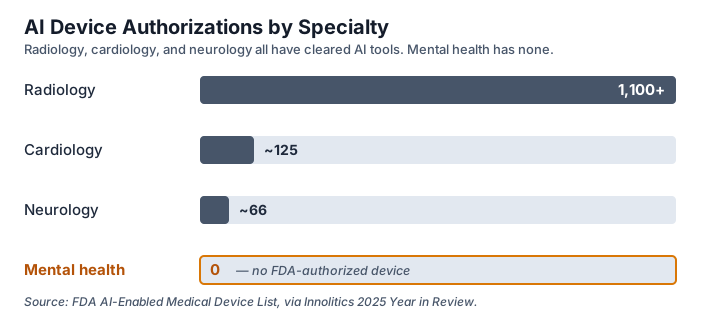
Not one AI-enabled medical device has received FDA authorization for a mental health indication. Not a diagnostic tool, not a clinical decision-support system, not a risk assessment algorithm. The FDA Digital Health Advisory Committee flagged the absence as a patient safety concern at its November 2025 meeting — clinicians and patients are already using AI for mental health support without any regulatory guardrail on what those tools do or how accurate they are.
Quick answer: AI radiology tools sailed through FDA clearance by the hundreds; mental health received zero AI device authorizations. The regulatory frameworks built for physical-output devices do not fit tools that make probabilistic inferences about internal states, clinical validation is expensive, and the one high-profile company that engaged the pathway seriously — Woebot — shut down its consumer app in June 2025, naming regulatory cost as a central reason. Meanwhile the FDA’s January 2026 wellness-exemption expansion lets AI chatbots operate outside device oversight as long as they avoid disease-specific claims. The result is a two-tier market: rigorous review for tools seeking clinical claims, none for the wellness lane where most mental health AI products live.
The Math of Who Gets Cleared
The FDA’s AI-enabled medical device authorization list, tracked by Innolitics and published in its 2025 year-in-review, shows the accumulation of clearances across specialties clearly — 295 authorizations in 2025 alone. Radiology entered first and has dominated since: the specialty that produces interpretable images — X-rays, CTs, MRIs — fit naturally into the FDA’s existing substantial equivalence framework, because there was a clear predicate (the radiologist reading the image) and a measurable output (diagnostic accuracy on a defined set of image types).
That framework works well when the device produces a number, a flag, or a classification on a defined physical input. It works less well when the device is trying to do what mental health AI tools do: infer depression severity from speech patterns, assess suicide risk from conversational content, detect anxiety from physiological proxies. The output is probabilistic, context-dependent, and tied to internal states that are not directly observable. The FDA does not have a well-established clearance pathway for tools that work this way.
The result is not that mental health AI tools do not exist — they proliferate, as consumer wellness apps and employer-purchased platforms. The result is that none of them have gone through the regulatory review that would establish whether they are safe and effective for clinical use. The distinction is not semantic. A cleared device has demonstrated something. An uncleared wellness app has demonstrated that it can be downloaded.
What the November 2025 Committee Actually Asked For
The Digital Health Advisory Committee’s November 6, 2025 meeting convened specifically on generative AI-enabled digital mental health medical devices, with an agenda organized around a concrete hypothetical: a prescription LLM therapy chatbot for adults with major depressive disorder. What would it take to authorize one?
The committee’s answers sketch where the regulatory floor is being set. Reliable mechanisms to detect and escalate acute safety concerns, including suicidal ideation. Labeling that is transparent about a tool’s autonomy and the human oversight it requires. Postmarket surveillance with mandatory adverse event reporting. And an adjunct-to-clinician framing — AI as a tool that assists a clinician who remains accountable, not a standalone practitioner.
None of this is binding yet. But advisory committee positions have a track record of becoming FDA guidance, and the direction is consistent: clinician oversight is the standard the agency is pointing toward for any generative AI mental health tool seeking the cleared-device category.
Two Months Later, the FDA Widened the Unregulated Lane
On January 6, 2026, the FDA expanded the general wellness exemption: AI health tools that avoid disease-specific claims fall outside medical device oversight. Two months after the advisory committee sketched a supervised-AI standard, the agency widened the lane that requires no supervision.
The effect is a two-tier market. Tools seeking clearance for clinical claims face the rigorous, expensive path the committee described. Tools that stay inside general wellness — avoiding diagnostic language while collecting sensitive mental health data and offering mental health-adjacent support — face no FDA review, no escalation requirements, and no adverse event reporting. Most AI mental health products on the market today live in that second tier.
| Requirement | FDA-cleared path | General-wellness lane |
|---|---|---|
| Safety evidence | Required | None |
| Human escalation protocol | Expected (advisory) | None |
| Adverse-event reporting | Required | None |
| FDA oversight | Yes | None |
| Where most products sit | Few | Most |
The two lanes explain the market. The rigorous path is expensive and nearly empty; the unregulated lane is cheap and crowded, and it is where sensitive mental health data is being collected with no clinical evidence standard behind it.
What the Woebot Shutdown Tells Us
On June 30, 2025, Woebot Health shut down its consumer-facing mental health chatbot after eight years and $123 million in funding — one of the most prominent and longest-running mental health AI products. Woebot had received FDA Breakthrough Device Designation in 2021, a designation that speeds review for devices treating serious conditions where existing therapies are inadequate. The designation signaled FDA recognition of AI’s potential in behavioral health. It did not save the product.
Founder Alison Darcy told STAT News the shutdown was driven largely by the cost and difficulty of meeting FDA requirements for marketing authorization, compounded by the arrival of large language models for which the agency has no clear regulatory path. The Breakthrough designation was designed for a version of AI the field has largely moved past. LLM-based conversational tools are harder to evaluate under existing clearance pathways, and the cost of building the clinical evidence to bridge that gap changes the business case entirely.
Woebot was the company that tried to do this correctly. It published peer-reviewed research, engaged regulators, and built clinical safeguards into the product from the start. It could not sustain the economics of that approach while unregulated competitors operated in the wellness lane with none of the compliance overhead. A company with designation, funding, and years of data engaged the pathway seriously and still closed the product. That says something about the pathway, not just the company.
The Regulatory Vacuum for Mental Health AI and Who Fills It
A 2025 peer-reviewed analysis published in npj Mental Health Research (Nature) documented the regulatory situation clearly: fewer than 20 non-AI digital mental health devices have received any FDA authorization in the agency’s entire history. The authors described the current state as a regulatory vacuum — a space where clinical-grade tools are essentially absent from the authorized market, leaving patients and clinicians to choose among consumer wellness products that carry no clinical evidence standard at all.
The vacuum does not sit empty. It gets filled by whatever is available. Mental health chatbots, AI therapy supplements, automated emotional wellness check-ins purchased by HR departments — these products are in clinical use, or close enough to clinical use that the distinction matters. They are being used by clinicians who want to offer something, by employers who need to offer something, and by patients who cannot access something that is actually regulated.
The research on what fills the vacuum is not reassuring. A Brown University study presented at the AAAI/ACM Conference on AI, Ethics and Society in October 2025 found that large language models — GPT, Claude, Llama — systematically violate mental health ethics standards across 15 risk categories, including mishandling crisis situations, reinforcing negative self-beliefs, and deceptive empathy. The APA issued a health advisory in November 2025 stating that current AI tools lack sufficient evidence of safety or effectiveness for mental health care. And the WHO’s March 2026 guidance on AI ethics in health — more than 40 recommendations — called for clear escalation pathways in cases involving severe distress or risk of self-harm, and for development that involves mental health experts and people with lived experience alongside AI designers.
The advisory committee’s patient-safety framing is correct but incomplete. This is also a care quality concern, an accountability concern, and a parity concern. When radiology AI goes through rigorous review and mental health AI operates as a wellness category, the implicit message is that the accuracy of a diagnostic tool matters more in one context than the other. That message is wrong, and it is structural.
Why Parity Has Not Arrived Here Either
Mental health parity has been federal law since 2008, and commercial insurers have been in violation of it consistently enough that the Kennedy Forum published an index of those violations in April 2026 — finding that Aetna, BlueCross BlueShield, Cigna, and UnitedHealthcare paid less for outpatient mental health care than for medical and surgical care in all 43 states examined.
The regulatory gap in AI device authorization is a different system with the same underlying logic. Cardiovascular AI gets development investment, clinical trial pipelines, and a regulatory pathway that has been worked out through 125 successful authorizations. Mental health AI gets a framework that does not fit it, a reimbursement structure that cannot yet pay for cleared tools even if they existed, and a clinical validation cost that the market has not figured out how to absorb.
The STAT News report from June 30, 2026, in which the FDA’s digital health leader hinted at coming policy updates, is the most recent signal that this is on the agency’s radar. The FDA advisory committee named the gap. What changes and how fast is not yet clear — but the conversation has started.
That conversation will go faster with pressure. What actually creates regulatory pressure is the clinical community making the case that mental health AI deserves the same investment in clear, workable pathways that radiology got. And what creates that case is a field that refuses to accept “wellness app” as a permanent category for tools that are already being used in clinical contexts.
What Comes After the Gap Is Named
The FDA’s coming policy update — whatever shape it takes — will probably not produce 1,100 mental health AI clearances overnight. The validation infrastructure does not yet exist the way it does in radiology. But it can produce a starting framework: a defined path for risk stratification of mental health AI tools, a set of evidentiary standards that map to how these tools actually work, and a reimbursement signal that makes clinical-grade development financially viable.
I want that to happen because the tools that do not exist are tools that could meaningfully expand access. The therapist shortage is real. Wait times are real. AI tools that can support clinical care — triage, symptom monitoring, session preparation, outcome tracking — could do real good if they are held to a standard that establishes whether they work. Right now they are in the market without that standard.
The convergence is already there. In 2025 and 2026, the FDA advisory committee, the APA, and the WHO each landed on the same structural answer: AI assists a supervised clinician, and the clinician holds accountability. For clinicians evaluating any AI mental health product, the question that matters most: who reviews what the tool produces before it reaches a client, and who is professionally accountable when it is wrong. Full disclosure of my stake: I build in this space, and Mental Wealth Solutions’ VibeCheck.luxury is designed around that supervised structure.
The framework is being written now; what gets decided in the next 18 months will shape who controls AI in the therapy room for the decade after. The gap is not a technical failure. Every other specialty that has cleared AI tools faced the same foundational problem — novel technology, uncertain regulatory fit, high validation cost. They built the infrastructure anyway. Mental health has not, because the investment and the regulatory will were not there. Naming the gap is the necessary first step. The second step is refusing to treat it as normal.
FAQ
Has the FDA approved any AI tools for mental health?
No. As of early 2026, zero AI-enabled medical devices have received FDA authorization specifically for mental health indications, out of more than 1,400 total AI device authorizations. Radiology accounts for roughly 1,100 of those. The FDA Digital Health Advisory Committee flagged this gap as a patient safety concern at its November 2025 meeting.
Why hasn’t the FDA cleared any AI mental health devices?
The FDA’s existing regulatory frameworks were built around devices that produce a measurable physical output — an image, a lab value, a physiological reading. Mental health AI tools make probabilistic, context-dependent inferences about internal states, which do not map cleanly onto those frameworks. The clinical validation burden is also high and expensive. When Woebot closed its consumer app in June 2025, its founder cited regulatory cost and the gap between existing frameworks and modern LLM-based tools as central reasons.
What is the difference between a cleared mental health app and an uncleared one?
A cleared device has demonstrated safety and efficacy for a specific indication through the FDA’s regulatory process. An uncleared app is sold as a wellness tool or general consumer product with no clinical evidence standard. The distinction matters because cleared devices carry an evidence standard that establishes whether the tool works; wellness apps carry none.
What did the FDA say about mental health AI at the November 2025 advisory committee?
At its November 6, 2025 meeting, the FDA’s Digital Health Advisory Committee called for reliable mechanisms to detect and escalate acute safety concerns including suicidal ideation, transparent labeling about a tool’s autonomy and required human oversight, and postmarket surveillance with mandatory adverse event reporting. It endorsed an adjunct-to-clinician framing and flagged the absence of any authorized AI mental health tool as a patient safety concern. These positions are advisory, not binding rule.
What is the FDA’s general wellness exemption and why does it matter?
On January 6, 2026, the FDA expanded its general wellness exemption: AI health tools that avoid disease-specific claims fall outside medical device oversight. Chatbots in this lane face no FDA review — no safety evidence, no escalation protocols, no adverse event reporting. Most consumer mental health AI products currently operate there.
Sources
-
FDA AI-Enabled Medical Device List — Innolitics 2025 Year in Review. innolitics.com
-
FDA Digital Health Advisory Committee — November 6, 2025 Meeting Materials. fda.gov
-
STAT News — “FDA digital health leader hints at coming AI policy updates,” June 30, 2026. statnews.com
-
STAT News — “Woebot Therapy Chatbot Shuts Down,” July 2, 2025. statnews.com
-
STAT News — “FDA Pulls Back Oversight of AI-Enabled Devices, Wearables,” January 6, 2026. statnews.com
-
Torous, J. et al. (2025). “The regulatory vacuum for AI-based mental health tools.” npj Mental Health Research (Nature). nature.com
-
Brown University — AI mental health ethics study, October 21, 2025. brown.edu
-
APA — Health Advisory on Generative AI Chatbots in Mental Health, November 2025. apa.org
-
WHO — Ethics and Governance of Artificial Intelligence for Health, March 25, 2026. who.int
-
The Kennedy Forum Mental Health Parity Index, via AHA News, April 16, 2026. aha.org
-
Orrick / Hogan Lovells — FDA Digital Health Regulatory Outlook 2026. hldataprotection.com
Disclaimer
This article is for educational and informational purposes only. It does not constitute medical, clinical, legal, or therapeutic advice, and reading it does not create a therapist-client relationship with Matthew Sexton, LCSW or Mental Wealth Solutions, Inc. Although the author is a licensed clinical social worker, the content in this article is not clinical assessment, diagnosis, or treatment.
FDA regulatory status, device clearance counts, and AI policy guidance are subject to change. The information here reflects publicly available data and reporting as of mid-2026. Nothing here is a substitute for reviewing current FDA guidance, consulting a regulatory affairs professional, or confirming the authorization status of any specific product directly with the FDA.
If you are in immediate emotional crisis, you can reach the 988 Suicide & Crisis Lifeline by calling or texting 988 (US). If you are experiencing domestic violence or are in physical danger, contact the National Domestic Violence Hotline at 1-800-799-7233 or visit thehotline.org. In a life-threatening emergency, call 911.
Frequently asked questions.
- Has the FDA approved any AI tools for mental health?
- No. As of early 2026, zero AI-enabled medical devices have received FDA authorization specifically for mental health indications, out of more than 1,400 total AI device authorizations. Radiology accounts for roughly 1,100 of those. The FDA Digital Health Advisory Committee flagged this gap as a patient safety concern at its November 2025 meeting.
- Why hasn't the FDA cleared any AI mental health devices?
- The FDA's existing regulatory frameworks were built around devices that produce a measurable physical output — an image, a lab value, a physiological reading. Mental health AI tools make probabilistic, context-dependent inferences about internal states, which do not map cleanly onto those frameworks. The clinical validation burden is also high and expensive. When Woebot closed its consumer app in June 2025, its founder cited regulatory cost and the gap between existing frameworks and modern LLM-based tools as central reasons.
- What is the difference between a cleared mental health app and an uncleared one?
- A cleared device has demonstrated safety and efficacy for a specific indication through the FDA's regulatory process — either 510(k) clearance (showing substantial equivalence to a predicate device) or De Novo classification (a new pathway for novel low-to-moderate risk devices). An uncleared app is sold as a wellness tool or general consumer product. The distinction matters because cleared devices carry an evidence standard; wellness apps carry none.
- What did the FDA say about mental health AI at the November 2025 advisory committee?
- At its November 6, 2025 meeting, the FDA's Digital Health Advisory Committee called for reliable mechanisms to detect and escalate acute safety concerns including suicidal ideation, transparent labeling about a tool's autonomy and required human oversight, and postmarket surveillance with mandatory adverse event reporting. It endorsed an adjunct-to-clinician framing and flagged the absence of any authorized AI mental health tool as a patient safety concern. These positions are advisory, not binding rule.
- What is the FDA's general wellness exemption and why does it matter?
- On January 6, 2026, the FDA expanded its general wellness exemption: AI health tools that avoid disease-specific claims fall outside medical device oversight. Chatbots in this lane face no FDA review — no safety evidence, no escalation protocols, no adverse event reporting. Most consumer mental health AI products currently operate there.
If you're the therapist here.
Your clients get 4 sessions a month. The other 26 days they're on their own. VibeCheck.luxury is the between-session companion that carries those days back to you — clients check in daily, and you walk in already knowing what kind of week it was. Built by Matthew Sexton, LCSW, NATC.