Clinicians spend about 13.5 hours a week on documentation, and roughly two hours in the medical record for every hour of direct patient care, according to a time-and-motion study in the Annals of Internal Medicine. A 2025 study of nearly 9,700 clinicians tied that after-hours charting to significantly higher burnout (Academic Medicine). The cause is not weak time management. It is software built for billing and compliance instead of clinical work — an EHR that has quietly turned the clinician into its unpaid transcriptionist. The fix is not working faster, and it is not handing the session to a chatbot. It is documentation that drafts itself from the session for the clinician to review and sign, on data the clinician owns.
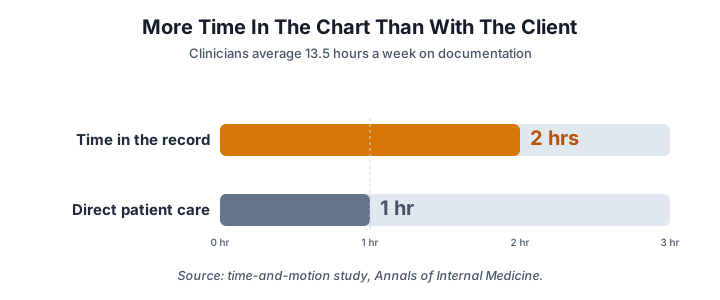
The behavioral-health numbers run worse than the cross-specialty averages. Solo practitioners report five to ten hours a week on documentation alone, most of it finished outside scheduled hours, and in survey after survey documentation is named the single biggest driver of burnout, ahead of caseload and ahead of pay. None of that is a discipline problem. It is a record-keeping system built to extract labor from the person using it.
How the record-keeping system got inverted
A practice’s electronic record was supposed to do one thing — hold the clinical truth so the clinician could find it, reason from it, and bill against it. Somewhere along the way the priorities flipped. Most behavioral-health systems are designed around what the payer and the compliance auditor need to see, not around the clinician’s hour. The note is a long sequence of clicks because the click trail is the audit trail. The form forgets your work because state persistence was never the point. The reporting is thin because the product’s job was capture, not insight.
The result is a tool that is technically “complete” and experientially hostile. Clinicians say it plainly in the public reviews of these systems: I write my notes in Word and paste them in, because the EHR is slower. That sentence should end a product. A clinician maintaining a shadow record in a Word document is telling you, in the clearest possible terms, that the system meant to hold their work is worse at it than a blank page.
And the part nobody advertises until you try to leave: when the relationship sours — a private-equity acquisition, a surprise price increase, a feature you depended on getting moved behind a higher tier — the data is held hostage. Clinicians have described being asked to pay to export their own patient records. The record that should make a practice portable becomes the thing that traps it.
The two bad answers to EHR documentation burnout, and why both miss
When the documentation problem gets named, two solutions tend to get sold. Both are wrong, and they are wrong in instructive ways.
The first bad answer is work faster. Buy the macros, the templates, the dictation tool bolted onto the same click-heavy form. This treats a structural problem as a personal one. It asks the clinician to absorb a design failure through sheer effort, which is exactly how 62 percent of behavioral-health clinicians end up describing their burnout as moderate to severe, with administrative work named as the driver.
The second bad answer is let the AI do the therapy. This is the venture pitch — the access problem is huge, clinicians are scarce, so replace the clinician with a model. It is the loudest idea in the room and the one practicing clinicians trust least, for good clinical reasons I have written about in detail over on the VibeCheck field notes: what therapists actually want from AI, and why it isn’t a chatbot therapist. The short version is that change happens inside a human relationship, an agreeable model collides with the parts of therapy that require challenge rather than affirmation, and a tool that quietly ships the most vulnerable forty-five minutes of a person’s life to a system the clinician cannot see breaks the one asset the whole enterprise runs on — trust. This is no longer just clinical opinion: in 2025, licensed psychologists reviewing real chatbot exchanges documented systematic over-validation of users’ beliefs, and the American Psychological Association issued a formal health advisory on the use of generative-AI chatbots for mental health.
The pain is real. Both of the popular cures make it worse.
The answer that actually fits the work
There is a narrower, more boring version of AI that does fit, and it is the one the evidence supports. Used as a scribe rather than a therapist, AI drafts the note from a consented session record so the clinician edits and signs instead of composing from a blank page. Studies of ambient documentation tools — including a 2025 multi-system study of more than 1,400 clinicians published in JAMA Network Open — report real reductions in documentation time, after-hours charting, and self-reported burnout when the tool is implemented well. The direction is consistent even where the size varies.
But a tool earning its place in a practice has to clear a higher bar than “it drafts text.” Three conditions, in order:
The clinician signs. The model produces a starting point that shows its reasoning and the source line it drew from; the licensed clinician reviews, corrects, and attests. The clinician is the author of every clinical artifact, never a rubber stamp on machine output. Governed, not autonomous — the work can be drafted by software, but the judgment and the signature stay human. That is not a feature toggle. It is the legal and clinical spine of doing this responsibly.
The data stays yours. Protected health information has to run on infrastructure under a Business Associate Agreement appropriate for PHI — that is regulation, not a preference — and the harder question is who controls it. The right architecture keeps a practice’s own clinical material inside infrastructure the practice controls, never resells it, and never uses it to train a model. Privacy stops being fine print and becomes a reason to choose the tool.
Leaving is free. A record built on a portable standard, exported on demand, with no ransom at the door. The system should make a practice more portable, not less. If a vendor can hold your data hostage, every other promise it makes is conditional.
What this is really about
The documentation crisis is usually discussed as a wellness problem — clinician burnout, work-life balance, resilience. It is also, quietly, an economic one. Every unpaid hour of charting is margin walking out of an independent practice, and the systems that created the problem are increasingly owned by the same consolidators who would prefer the independent clinician didn’t stay independent. The corporate platforms that run the back office tend, in exchange, to take a piece of the client relationship, the data, and the economics of the practice itself.
So the question underneath “why does my EHR make me chart all night” is bigger than software ergonomics. It is whether the tools a clinician depends on are built to keep them independent — owning their record, their clients, and their evenings — or to slowly absorb the practice into someone else’s marketplace.
That is the gap worth building for: a practice platform that does the administrative labor so the clinician can do the therapy, under the clinician’s own signature, on data the clinician owns, in a practice the clinician keeps. The note should write itself. The clinician should still be the one who signs it. And the hour after the last client logs off should belong to the clinician again.
That is the thing we are building toward. And here is the call, said plainly: the practice that wins the next decade will not be the one that grinds the most hours. It will be the one that stops doing unpaid data entry and takes those hours back. The software that hands them back is coming, and it is being built by someone who had to write the 9pm note too.
Frequently asked questions.
- Why do therapists spend so much time on documentation?
- Most behavioral-health EHRs were designed around billing and compliance capture, not the clinician's time. Notes are manual and click-heavy, forms do not persist state well, and reporting is weak — so the work spills into evenings. Clinicians now average about 13.5 hours a week on documentation, and surveys rank charting as the single biggest contributor to therapist burnout.
- Will AI replace therapists for writing notes?
- No. The credible use of AI here is narrow: it drafts the note from a consented session record so the clinician edits and signs, rather than composing from a blank page. The clinician stays the author and signer of every clinical artifact. AI as the therapist is a different thing entirely, and the clinical evidence does not support it.
- Is it safe to use AI with protected health information in a practice?
- Only when the protected health information runs on infrastructure covered by a Business Associate Agreement appropriate for PHI. Most consumer chat tools are not. A practice should also ask who controls the data, whether it is ever used to train a model, and whether the clinician can take their record and leave without paying a ransom.
If you're the therapist here.
Your clients get 4 sessions a month. The other 26 days they're on their own. VibeCheck is the between-session companion that carries those days back to you — clients check in daily, and you walk in already knowing what kind of week it was. Built by Matthew Sexton, LCSW, NATC.