New York Tracks Parity. Why Not Protect the Therapy Hour?
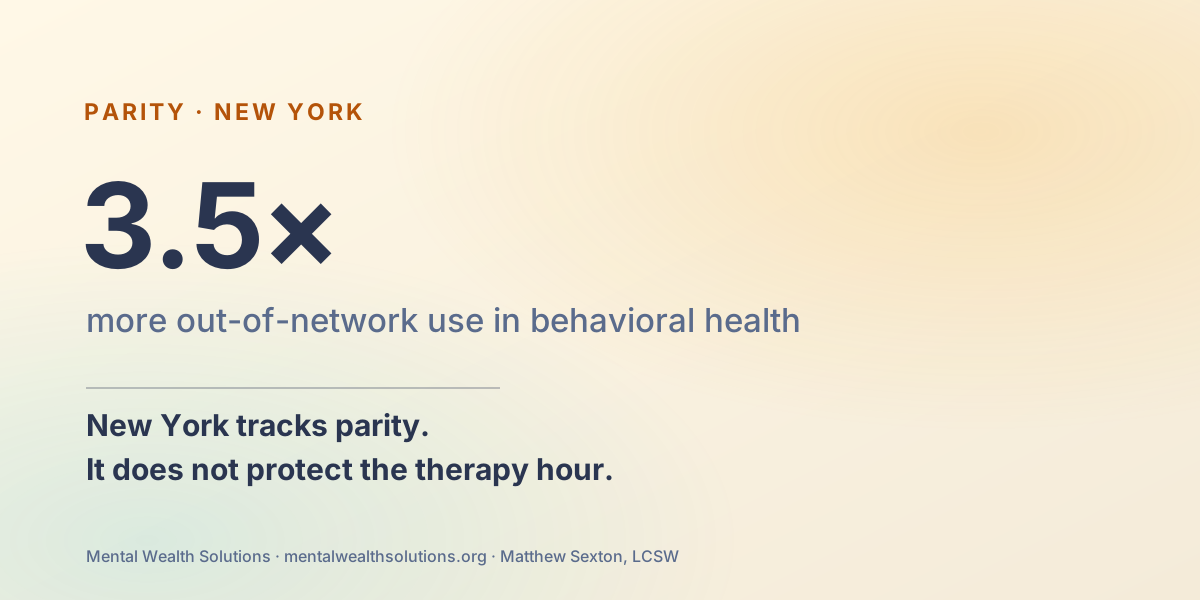
A 22-million-member study found behavioral-health patients used out-of-network care 3.5 times more often. New York tracks parity, but does not specifically protect CPT 90837.
From the earlier archive. This article’s original writing is retained and has not been fact-checked as part of our current review. Product references may reflect an earlier version; see current solutions for today’s status.
By Matthew Sexton, LCSW
Quick answer: New York requires insurers to report mental-health parity information, including data about utilization review, networks, and reimbursement. But I found no New York protection that does what Illinois now does: specifically require coverage of medically necessary CPT 90837 while limiting disproportionate documentation and audit practices. That gap matters because a commercial-claims study covering 22 million people found patients used out-of-network behavioral-health clinicians 3.5 times more often than medical and surgical clinicians. New York is measuring parts of an access problem without directly protecting one of the services caught inside it.
The fight sounds microscopic. One billing code. Three minutes between a 52-minute session and a 55-minute session.
It is not microscopic to the person trying to stay in therapy.
CPT 90837 represents psychotherapy lasting 53 minutes or longer. Insurers can identify it in claims, compare its use across clinicians, ask for records, downcode it, seek recoupment, or change the contracted payment. When those policies make in-network therapy harder to sustain, the cost moves. The therapist absorbs it, the patient pays out of pocket, or the patient loses the clinician.
New York has spent years building a parity-reporting system. The next step should be more concrete: protect the therapy hour from rules that single it out merely because it is visible and expensive.
New York can see the parity problem without stopping this version of it
New York Insurance Law §343 requires reports on mental-health and substance-use parity. The reports include information about utilization review, network adequacy, and reimbursement comparisons (New York Insurance Law §343). State regulations also say a plan’s reimbursement methodology for mental-health and substance-use benefits cannot be more stringent than the methodology applied to substantially all medical and surgical benefits in the same classification (New York Department of Financial Services).
Those are meaningful tools. They can expose broad disparities and give regulators a basis to ask whether a plan is treating behavioral health differently.
They are not the same as a rule that names 90837.
A parity report can show a reimbursement gap after the system produces it. A general parity standard can support an enforcement case. A code-specific protection tells the insurer in advance: medically necessary 53-minute psychotherapy cannot be treated as a suspicious exception by default.
That distinction is the opening Illinois used.
Illinois wrote the protection New York has not
Illinois Public Act 104-0446 takes effect for covered state-regulated commercial plans beginning in 2027. The law requires coverage of medically necessary CPT 90837. It also says plans cannot impose more onerous documentation requirements or audit 90837 more frequently than other psychotherapy codes (Illinois Public Act 104-0446).
The legislation did not appear by magic. Thresholds says it spearheaded the effort (Thresholds). NASW-Illinois summarized the bill, mobilized members, and made the access argument directly (NASW-Illinois).
Illinois moved from “mental health should be equal” to a testable set of duties. Cover this medically necessary service. Do not demand uniquely burdensome paperwork for it. Do not audit it more frequently merely because it is 90837.
That is what enforceable specificity looks like.
Insurers have been squeezing the therapy hour for decades
The current code structure dates to 2013. It defines 90834 as 38 through 52 minutes and 90837 as 53 minutes or longer (American Psychiatric Association). The financial pressure is older.
A peer-reviewed review found that managed behavioral-health organizations reduced reimbursement for 50-minute psychotherapy by approximately 14% for psychiatrists, 14% for psychologists, and 9% for master’s-level clinicians between 1993 and 1999. The same review described care management and provider profiling as part of a system that reduced private behavioral-health costs by an estimated 30% to 48% (National Library of Medicine).
The vocabulary changed. The business problem did not. A therapy session is a repeated unit of expense. A payer that shortens, reprices, or intensifies review of that unit can reduce claims spending at scale.
This is why I resist explanations that make the clinician sound greedy for using the longer code. The code follows time. The insurer’s scrutiny follows money.
I previously explained the broader design problem in The 53-Minute Problem. The New York issue is narrower: we have enough evidence to know the therapy hour is under pressure, yet our public policy still addresses it mostly through general parity machinery.
Hospitals and platforms enter the same market with more leverage
Independent clinicians do not negotiate in the same position as hospital systems or large platforms.
GAO reported that at least 47% of physicians were affiliated with or employed by hospital systems in 2024, up from under 30% in 2012. Its review found hospital-physician consolidation often increased commercial prices and generally did not improve quality. GAO also explained that acquired practices may use an acquiring entity’s typically higher negotiated rates and that larger systems may have greater bargaining leverage (GAO).
Behavioral-health pricing shows enormous room for negotiation. A 2026 JAMA Network Open study analyzed 8,517 hospital-negotiated prices for 90837 across 980 hospitals. The median was $223, with the middle half spanning $155 to $382. Median negotiated prices ranged from $174 for UnitedHealthcare to $339 for Cigna in the study’s hospital sample (JAMA Network Open).
That study does not prove hospital ownership caused the price differences. It does prove the market is not operating from one objective valuation of 53 minutes of psychotherapy.
Platforms offer clinicians a smaller version of collective scale. Alma says clinicians credential under its tax identification number to access enhanced rates (Alma). Headway says its team negotiates with plans and keeps a variable percentage of session payments (Headway). Those models can expand network participation, but they also place an intermediary between clinician and contract. I explored that tradeoff in The Marketplace Tax.
The structural difference is plain. Large systems bargain over rates. Independent clinicians are more likely to receive a fee schedule and an audit letter.
Patients pay when independent clinicians lose the long game
RTI International examined claims for 22 million people with commercial insurance from 2019 through 2021. Behavioral-health patients used out-of-network clinicians 3.5 times more often than medical and surgical patients. For psychologists, the disparity was 10.6 times. RTI found no improvement in the overall out-of-network disparity between 2013 and 2021 (RTI International).
Out-of-network use can mean choice. It can also mean the network did not contain a viable option. The difference matters to a patient with a deductible, a family trying to find a specialist, or an employee whose benefit looks generous until nobody nearby accepts it.
When an insurer reduces the value of a longer session, the immediate transaction is between payer and clinician. The downstream transaction is between clinician and patient. The clinician shortens care when clinically appropriate, absorbs the loss, leaves the network, joins a larger intermediary, or stops taking insurance. None of those choices reliably improves access.
That is why lower behavioral-health reimbursement than medical and surgical care is not a trade-association complaint. It is network design.
The organizations publicly pushing back
The advocacy exists, but it is scattered.
In June 2026, the American Psychiatric Association and American Psychological Association Services sent a joint letter to Aetna objecting to a planned reimbursement change affecting clinicians working through Alma. Among the changes was paying 90837 at the same rate as 90834. The organizations asked Aetna to pause implementation, explain its methodology, and examine parity implications. Aetna later partially reversed the 90837/90834 consolidation (joint letter).
PsiAN has directly opposed 90837 audits and collected clinician reports to identify payer patterns (PsiAN). National NASW maintains reimbursement resources, including guidance about 90837 and payer overpayment demands (NASW). In Illinois, Thresholds, NASW-Illinois, and other advocates turned the issue into law.
What about NASW-NY?
NASW-NY has earned credibility on parity. It supported New York’s 2018 parity reporting legislation (NASW-NY). But its published 2026 priorities focus on school social-worker ratios, loan forgiveness, paid placements, and unethical AI in therapy. The page does not list CPT 90837 or commercial reimbursement (NASW-NY 2026 priorities).
That is a statement about the public page, not the private calendar. It would be unfair to infer that no conversations are happening. It is fair to say New York clinicians looking for a visible, code-specific campaign cannot currently point to one there.
A New York therapy-hour bill should be specific
New York does not need another resolution saying mental health matters. It needs a rule that can be tested against a claim, audit, and contract.
A serious proposal would:
- Require covered state-regulated commercial plans to cover medically necessary CPT 90837.
- Prohibit automatic downcoding based only on utilization patterns.
- Bar documentation demands that are more onerous than those applied to other psychotherapy codes.
- Bar disproportionate audit frequency based solely on lawful 90837 use.
- Require advance notice and a meaningful explanation for material reimbursement changes.
- Publish payer-level complaint and enforcement patterns while protecting patient privacy.
- Create a timely appeal process before recoupment becomes final.
Federal law and self-funded employer plans complicate the reach of any state reform. That is a reason to draft carefully, not a reason to do nothing.
New York already has the reporting framework. NASW-NY already has parity history. Illinois already supplied a legislative model. APA organizations already supplied a recent example of direct payer advocacy. The missing ingredient is not evidence. It is a public coalition willing to name the therapy hour.
FAQ
Does New York law protect CPT 90837? New York has mental-health parity reporting and reimbursement-methodology protections, but I found no Illinois-style state law that specifically requires coverage of medically necessary CPT 90837 while limiting disproportionate documentation and audit practices.
What did Illinois do about CPT 90837? Illinois enacted Public Act 104-0446. Beginning in 2027, covered state-regulated commercial plans must cover medically necessary 90837 and cannot impose more onerous documentation or more frequent audits than they use for other psychotherapy codes.
Who is advocating against 90837 restrictions? Recent public advocacy includes a 2026 joint challenge to Aetna by the American Psychiatric Association and American Psychological Association Services, PsiAN’s audit campaign, and the coalition behind Illinois reform, including Thresholds and NASW-Illinois.
Is NASW-NY advocating for 90837 protections? NASW-NY has a history of supporting parity reform, but its public 2026 priorities do not name CPT 90837 or commercial reimbursement. That public record cannot tell us whether private advocacy is occurring.
Sources
- New York Insurance Law §343, mental-health parity reports. nysenate.gov
- New York Department of Financial Services, mental-health parity regulations. dfs.ny.gov
- Illinois Public Act 104-0446, 90837 coverage, documentation, and audit provisions. ilga.gov
- RTI International, commercial-network disparities across 22 million members. rti.org
- U.S. Government Accountability Office, health-care consolidation, 2025. gao.gov
- JAMA Network Open, hospital-negotiated prices for CPT 90837, 2026. jamanetwork.com
- American Psychiatric Association and American Psychological Association Services, joint letter to Aetna, June 4, 2026. psychiatry.org
- NASW-NY, 2026 public legislative priorities. naswny.socialworkers.org
Sources and public advocacy pages checked July 30, 2026.
Disclaimer
This article is for educational and informational purposes only. It does not constitute medical, clinical, legal, or therapeutic advice, and reading it does not create a therapist-client relationship with Matthew Sexton, LCSW or Mental Wealth Solutions, Inc. Although the author is a licensed clinical social worker, the content in this article is not clinical assessment, diagnosis, or treatment.
CPT rules, parity obligations, payer contracts, reimbursement methods, and state insurance laws vary by plan, jurisdiction, and time and may change after publication. The policy comparison here is based on the cited public laws and advocacy materials and is not a coverage determination or legal opinion. Consult current plan documents, regulators, professional advisers, or qualified counsel for a specific matter.
If you are in immediate emotional crisis, you can reach the 988 Suicide & Crisis Lifeline by calling or texting 988 (US). If you are experiencing domestic violence or are in physical danger, contact the National Domestic Violence Hotline at 1-800-799-7233 or visit thehotline.org. In a life-threatening emergency, call 911.
Frequently asked questions
- Does New York law protect CPT 90837?
- New York has mental-health parity reporting and reimbursement-methodology protections, but I found no Illinois-style state law that specifically requires coverage of medically necessary CPT 90837 while limiting disproportionate documentation and audit practices.
- What did Illinois do about CPT 90837?
- Illinois enacted Public Act 104-0446. Beginning in 2027, covered state-regulated commercial plans must cover medically necessary 90837 and cannot impose more onerous documentation or more frequent audits than they use for other psychotherapy codes.
- Who is advocating against 90837 restrictions?
- Recent public advocacy includes a 2026 joint challenge to Aetna by the American Psychiatric Association and American Psychological Association Services, PsiAN's audit campaign, and the coalition behind Illinois reform, including Thresholds and NASW-Illinois.
- Is NASW-NY advocating for 90837 protections?
- NASW-NY has a history of supporting parity reform, but its public 2026 priorities do not name CPT 90837 or commercial reimbursement. That public record cannot tell us whether private advocacy is occurring.