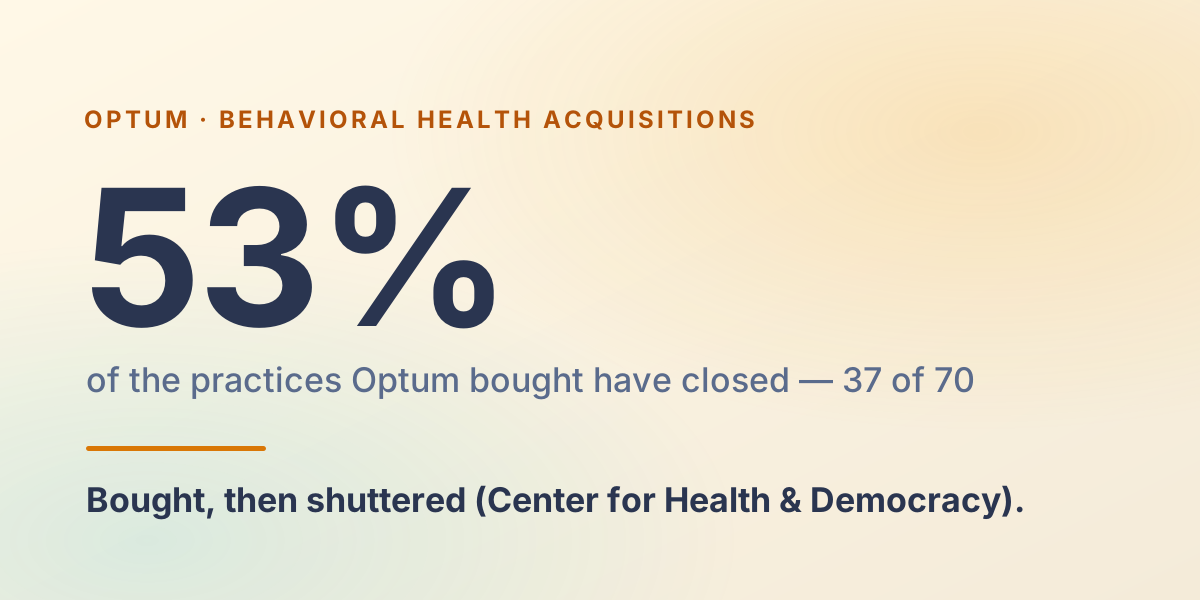
A July 2026 investigation from journalist Wendell Potter’s Center for Health & Democracy found that 37 of 70 outpatient behavioral health companies acquired by UnitedHealth Group’s Optum division, 53%, have since closed entirely or closed at least one office. Counted by individual location, 108 of 216 sites tied to those deals, about half, shut down across 21 states (HEALTH CARE un-covered, July 2026).
Quick answer: A single investigative report, not a government audit, found that Optum has closed more than half of the outpatient behavioral health practices it bought, and about half of the physical locations tied to those deals. The number comes from one source and hasn’t been independently confirmed by a second outlet, but it lines up with confirmed closures in New Jersey and Oregon, and with a business pattern, buy the practice, then shrink or shut it, that shows up across health care more broadly.
Optum has spent more than a decade buying therapy practices, psychiatric groups, and addiction treatment centers, building what became the largest employer of mental health clinicians in the country. The pitch was always stability: bigger backing, better systems, more access. The new numbers ask a plainer question. What happened to the places it already bought?
What Did the Investigation Actually Find?
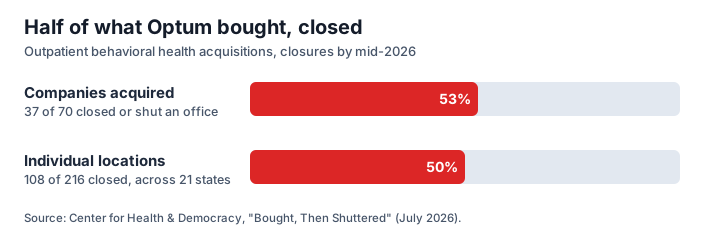
Potter’s investigation, published on his HEALTH CARE un-covered newsletter under his nonprofit the Center for Health & Democracy, reviewed 70 outpatient behavioral health entities that UnitedHealth or Optum acquired and found 37 of them, 53%, had closed entirely or closed at least one office by mid-2026 (HEALTH CARE un-covered, July 2026).
Break it down by physical address instead of by company, and the pattern holds. Of 216 individual locations tied to those 70 deals, 108 had closed, spread across 21 states. New Jersey accounted for the largest share of those location closures, according to the same report.
The report is titled “Bought, Then Shuttered,” and the title states the finding plainly. In a large share of these cases, acquisition preceded closure instead of the expansion it was sold as.
What Did UnitedHealth Buy in the First Place?
UnitedHealth’s Optum division bought outpatient behavioral health companies aggressively for years, including Refresh Mental Health, a chain of roughly 300 locations across 37 states, in a deal with private equity firm Kelso & Company that closed in March 2022 (Axios, March 24, 2022).
The Refresh deal is one anchor point for understanding scale. It folded dozens of independently branded therapy and psychiatry practices, most still carrying their original names, into Optum’s national behavioral health network in a single transaction. Deals like it are how Optum grew into the country’s largest employer of mental health clinicians within a few years, mostly through acquisition rather than hiring from scratch.
None of that is new information on its own. What Potter’s investigation adds is a look at what happened after the ink dried, at practices years into Optum ownership rather than at the moment the deal was announced.
New Jersey and Portland: The Closures Nobody Disputes
Two closures outside Potter’s dataset are independently documented. Optum ended all behavioral health services in New Jersey, laying off 572 employees and closing roughly 90 offices, effective November 30, 2025, according to state WARN Act filings (Behavioral Health Business, Nov 5, 2025; NJBIZ, Nov 2025).
That statewide exit is a separate event from the New Jersey closures counted inside Potter’s 108-location figure, and the two numbers shouldn’t be merged into one. But they point in the same direction. New Jersey went, in the space of a few years, from a state where Optum was actively acquiring outpatient behavioral health practices to a state where it does not offer them at all.
In Portland, Oregon, Optum closed a clinic in February 2026 that had operated under its ownership for several years after the original acquisition, according to local reporting (Willamette Week, Feb 11, 2026). Patients who had built years of continuity with a therapist there had to restart that relationship somewhere else, if they could find somewhere else with an opening.
Why Buy a Clinic Only to Close It?
The acquisitions were rarely about the clinic on the sign. A behavioral health practice brings a patient roster, a set of insurance contracts, and a physical footprint in a market Optum wants. Once those transfer into Optum’s larger network, the original office becomes one of several ways to deliver on the same contracts, and the least efficient one is usually the first to go.
Roll-up acquisitions across health care tend to follow a familiar arithmetic. A large buyer purchases many small practices, consolidates the expensive parts to duplicate, billing, HR, compliance, the EHR license, into shared systems, then closes or merges the physical locations that overlap or underperform. Patients and contracts often move to teletherapy, a nearby office, or a different clinician entirely. The name a patient trusted doesn’t always survive the process, even when the underlying business relationship does.
I’ve written before about what happened once it became clear that Optum and UnitedHealthcare share a parent company: the insurer that decides what gets paid for and the provider group delivering the care both report to UnitedHealth Group. Closures like these look like a second-order effect of that same structure. When one parent controls both sides, a clinic’s survival depends less on whether patients need it and more on whether it’s the cheapest way left to serve the contract.
How Solid Is This Number?
The 53% closure figure comes from a single investigative source, Potter’s Center for Health & Democracy, and no independent tier-1 or tier-2 outlet had replicated the specific 37-of-70 or 108-of-216 counts as of this writing. That doesn’t make the number wrong. It does mean readers should treat it as one investigation’s finding, not an audited or government-verified figure.
It’s worth being precise here, because there’s a real, adjacent Senate connection that’s easy to conflate with this one. A year earlier, in July 2025, the same nonprofit published “The Sunlight Report,” the first public accounting of UnitedHealth Group’s roughly 2,700 subsidiaries and affiliates, built from state insurance filings (The American Prospect, July 16, 2025). Senator Bernie Sanders referenced that earlier report at a Senate HELP Committee hearing on health care affordability. That hearing addressed UnitedHealth’s corporate sprawl broadly. It did not cover, and predates by roughly a year, the specific closure numbers in the 2026 investigation.
Two different reports, a year apart, from the same source, about related but distinct questions. One reached the Senate floor. The other, so far, hasn’t. Getting that distinction right matters more than the headline.
What Actually Protects Continuity of Care?
The clearest protection against a surprise closure is knowing who owns a practice before you start, not after a letter arrives. Independent, clinician-owned practices don’t face the same roll-up-and-close pattern documented in Potter’s report, because there’s no parent company weighing whether a location is still worth keeping open once a deal has been fully absorbed.
Ownership is usually knowable, though the industry doesn’t make it easy to find. A practice’s name rarely changes when it’s acquired, which is exactly what makes acquisitions hard to spot from the outside. Ask directly: is this practice independently owned, or part of a larger group? Has it been acquired in the last few years? A clinician who can’t or won’t answer that plainly is telling you something on its own.
I’ve also written about what tends to happen when private equity buys a therapy practice, and the pattern rhymes with what Potter documented in Optum’s insurer-owned deals: staffing changes first, then billing changes, and sometimes, years later, the office itself closes. None of that is a reason to avoid a practice that’s been acquired. It’s a reason to ask the question early, while you still have options, instead of learning the answer from a closure notice taped to the door.
FAQ
Did the Senate investigate UnitedHealth for closing behavioral health clinics? No. The 53% closure figure comes from a July 2026 investigation by journalist Wendell Potter’s Center for Health & Democracy, not a Senate committee. A different, earlier report from the same source was discussed at a 2025 Senate HELP Committee hearing, but that report covered UnitedHealth’s subsidiary structure, not clinic closures.
How many behavioral health clinics has Optum closed? An investigation found that 37 of 70 outpatient behavioral health companies UnitedHealth and Optum acquired, 53%, have closed entirely or closed at least one office, and 108 of 216 individual locations, about half, shut down across 21 states (HEALTH CARE un-covered, July 2026).
Is this closure number confirmed by another news outlet? Not yet. As of this writing, no independent tier-1 or tier-2 outlet has separately verified the 37-of-70 or 108-of-216 figures; they come from a single investigative newsletter. Two independently documented closures, in New Jersey and Portland, support the broader pattern the investigation describes.
What happened to Optum’s behavioral health services in New Jersey? Optum ended all behavioral health services in New Jersey, laying off 572 employees and closing roughly 90 offices, effective November 30, 2025, according to state WARN Act filings (Behavioral Health Business, Nov 5, 2025).
How can I find out if my therapy practice has been acquired? Ask the practice directly whether it’s independently owned or part of a larger group, and whether ownership has changed in recent years. Acquisitions rarely change the name on the door, so the practice’s own answer, not its signage, is the most reliable source.
Sources
- Wendell Potter / HEALTH CARE un-covered (Center for Health & Democracy), “Bought, Then Shuttered: What UnitedHealth…”, July 2026.
- Axios, “Optum to acquire Refresh Mental Health”, March 24, 2022.
- The American Prospect, “UnitedHealth Has 2,694 Subsidiaries and Affiliates”, July 16, 2025.
- Behavioral Health Business, “Optum to Lay Off 572 in New Jersey, Cease Behavioral Health Services in the State”, Nov 5, 2025.
- NJBIZ, “Optum layoffs: NJ medical, clinic closures”, Nov 2025.
- Willamette Week, “A Few Years After Purchase, Health Care Giant Optum Closes Longstanding Portland Clinic”, Feb 11, 2026.
Disclaimer
This article is for educational and informational purposes only. It does not constitute medical, clinical, legal, or therapeutic advice, and reading it does not create a therapist-client relationship with Matthew Sexton, LCSW or Mental Wealth Solutions, Inc.. Although the author is a licensed clinical social worker, the content in this article is not clinical assessment, diagnosis, or treatment.
The closure and acquisition figures described here come from a single investigative source published in July 2026, along with independently documented events in New Jersey and Oregon. Corporate ownership, closures, and network status change over time and vary by state and by clinic. Nothing here is a claim about the current status of any specific practice. If you want to know who owns a particular clinic or whether a closure affects your care, confirm directly with the practice, your insurer, or your state’s department of health.
If you are in immediate emotional crisis, you can reach the 988 Suicide & Crisis Lifeline by calling or texting 988 (US). If you are experiencing domestic violence or are in physical danger, contact the National Domestic Violence Hotline at 1-800-799-7233 or visit thehotline.org. In a life-threatening emergency, call 911.
Frequently asked questions.
- Did the Senate investigate UnitedHealth for closing behavioral health clinics?
- No. The 53% closure figure comes from a July 2026 investigation by journalist Wendell Potter's Center for Health & Democracy, not a Senate committee. A different, earlier report from the same source was discussed at a 2025 Senate HELP Committee hearing, but that report covered UnitedHealth's subsidiary structure, not clinic closures.
- How many behavioral health clinics has Optum closed?
- An investigation found that 37 of 70 outpatient behavioral health companies UnitedHealth and Optum acquired, 53%, have closed entirely or closed at least one office, and 108 of 216 individual locations, about half, shut down across 21 states (HEALTH CARE un-covered, July 2026).
- Is this closure number confirmed by another news outlet?
- Not yet. As of this writing, no independent tier-1 or tier-2 outlet has separately verified the 37-of-70 or 108-of-216 figures; they come from a single investigative newsletter. Two independently documented closures, in New Jersey and Portland, support the broader pattern the investigation describes.
- What happened to Optum's behavioral health services in New Jersey?
- Optum ended all behavioral health services in New Jersey, laying off 572 employees and closing roughly 90 offices, effective November 30, 2025, according to state WARN Act filings (Behavioral Health Business, Nov 5, 2025).
- How can I find out if my therapy practice has been acquired?
- Ask the practice directly whether it's independently owned or part of a larger group, and whether ownership has changed in recent years. Acquisitions rarely change the name on the door, so the practice's own answer, not its signage, is the most reliable source.
Want to discuss this for your program?
Book a 30-min conversation. We'll walk you through deployment, the BAA, and what your rollout looks like in production.
Book a 30-min conversation