A federal judge in Missouri denied Anthem’s motion to dismiss a mental health parity lawsuit on June 15, 2026, which means the case moves forward instead of ending before a jury or a judge ever looks at the facts. (Missouri Lawyers Media, July 14, 2026) On its own, that’s a procedural ruling. In context, it’s a second data point confirming a legal theory the Ninth Circuit set out two years earlier, and that context is the actual story.
Quick answer: A father suing Anthem and his employer’s health plan over a denied outdoor behavioral health placement for his minor son cleared a motion to dismiss on June 15, 2026, sending both his ERISA and mental health parity claims to discovery. It is not the first parity case to get this far. Courts have applied a consistent legal standard since the Ninth Circuit’s April 2024 ruling in Ryan S. v. UnitedHealth Group, and federal regulators reached a $28 million settlement over mental health network adequacy with Kaiser just four months before this ruling. Parity law is starting to show up in outcomes, not just in the statute book.
What Did the Court Actually Decide in Paul P. v. Anthem?
Chief U.S. District Judge Stephen R. Clark ruled that both the ERISA wrongful-denial claim and the Mental Health Parity Act claim against Anthem are plausible enough to proceed, rejecting Anthem’s bid to end the case early. (Missouri Lawyers Media, July 14, 2026) The case is Paul P. v. Anthem Blue Cross and Blue Shield, No. 4:25-cv-00991-SRC, filed in the U.S. District Court for the Eastern District of Missouri. (Justia Dockets & Filings)
The underlying facts are specific. Paul P., an employee of Edward D. Jones & Co., sued on behalf of his minor son, identified in court filings as “B.P.,” after Anthem denied reimbursement for an outdoor behavioral health treatment program covering co-occurring mental health and substance use conditions. Edward Jones and the health plan itself were named as co-defendants alongside Anthem. (Missouri Lawyers Media, July 14, 2026)
That last detail matters more than it looks. A parity lawsuit naming the employer’s plan, not just the insurer, is a reminder that self-funded employer plans carry legal exposure too. We’ve written before about how much of that exposure runs through ERISA’s employer-plan structure, which is worth understanding if your coverage comes through a large employer rather than an individually purchased plan.
No dollar figure has been confirmed for what the family is seeking or what the treatment cost. The ruling that survived is about whether the case can continue, not about what Anthem owes.
Why Did the Parity Claim Survive When So Many Get Dismissed?
The court let the parity claim through on an “as-applied” theory: the family didn’t have to show Anthem’s plan documents flatly excluded mental health coverage, only that Anthem applied more restrictive limits to mental health claims than to comparable medical claims in practice. (Missouri Lawyers Media, July 14, 2026) That distinction is the whole ballgame for parity litigation.
For years, insurers could point to plan language that looked neutral on its face, no explicit carve-out for mental health, and get parity claims dismissed before discovery ever started. An as-applied theory shifts the question from what the plan says to what the insurer actually does when a mental health claim lands on a reviewer’s desk. That’s a harder thing for a company to argue away in a motion to dismiss, because it turns on facts, not just contract language.
This is the same reasoning the Ninth Circuit used two years earlier. In Ryan S. v. UnitedHealth Group, decided April 11, 2024, the court held that a plaintiff only needs to plausibly allege a more restrictive review process for mental health and substance use claims than for medical claims, not a categorical denial, to survive dismissal. (9th Cir. opinion, April 11, 2024) Missouri isn’t in the Ninth Circuit. The fact that a federal judge in a different circuit reached a compatible result is exactly why this ruling is worth watching.
Is This an Isolated Win, or Part of a Trend?
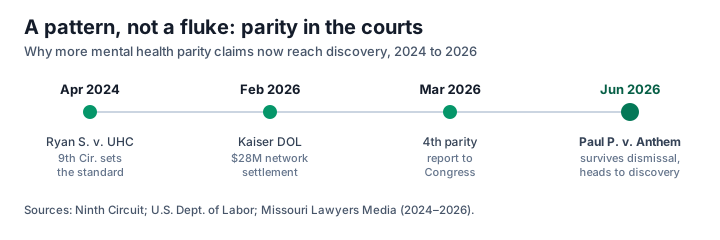
It’s part of a trend, and treating it as a one-off actually undersells what’s happening. Since April 2024, the legal theory that let this case proceed has shown up in a Ninth Circuit precedent, a $28 million Department of Labor settlement, and a federal report documenting rising enforcement activity, all pointing the same direction.
The Department of Labor’s Employee Benefits Security Administration announced a $28 million settlement with Kaiser Foundation Health Plan on February 10, 2026, over Kaiser’s failure to maintain adequate in-network access to mental health and substance use providers. The settlement included $28.3 million in member reimbursement plus a $2.8 million penalty. (U.S. Department of Labor, February 10, 2026) That’s a regulatory action, not a court case, but it targets the same underlying problem: a network that looks adequate on paper and isn’t reachable in practice.
Regulators are also asking more questions before anyone gets to court. The Tri-Agencies, the Department of Labor, HHS, and Treasury, published their fourth annual MHPAEA Report to Congress on March 3, 2026, covering enforcement activity from August 2023 through July 2025. During that period, the DOL and CMS each requested more than 40 comparative analyses from health plans to check whether mental health limits matched medical limits. (Crowell & Moring, March 3, 2026) Forty-plus requests from each agency in two years is a low number in absolute terms, but it’s evidence regulators are actively pulling the same documents plaintiffs’ lawyers now cite in court filings. We’ve covered Georgia’s parallel enforcement wave and Connecticut’s action against all five of its major carriers if you want the state-level side of this same pattern.
Put those three pieces together and Paul P. v. Anthem stops looking like an outlier. It looks like a family that happened to file suit in a moment when the legal groundwork for this kind of claim had already been laid by other courts and other agencies.
What Happens Next for the Family, and for Everyone Else?
What’s confirmed is narrow: the mental health parity claim survives dismissal, so the case proceeds to discovery as a matter of ordinary civil procedure. No source has detailed what specific documents or testimony discovery will cover, and it would be getting ahead of the record to guess. (Missouri Lawyers Media, July 14, 2026)
Surviving a motion to dismiss is not a finding that Anthem broke the law. It’s a finding that the family’s allegations, if true, would be enough to establish a violation, which is a much lower bar. Anthem can still win at summary judgment or at trial. But discovery is where the internal review criteria, denial letters, and comparison data that plaintiffs need actually become visible, and that visibility is the part parity law has struggled to deliver for over a decade.
What Should You Do If Your Plan Denied Mental Health Treatment?
If a commercial insurer denied coverage for mental health or substance use treatment, the parity law gives you a specific complaint pathway, separate from the standard appeal, that’s worth using even if you never file a lawsuit. We laid out the concrete steps in how to file a mental health parity complaint.
The single most useful thing a family can do early is ask, in writing, how the insurer would have handled a comparable medical or surgical claim. That’s the exact comparison the Ryan S. and Paul P. courts both said matters. If the answer doesn’t match what happened to your mental health claim, you have the beginning of the same as-applied argument that got this case to discovery.
None of this changes what a family goes through waiting for a treatment approval while a child needs care now. But a legal standard that regulators and multiple courts are now applying the same way is a real thing to point to, not just a statute that sits on paper while insurers write around it.
FAQ
What is the Paul P. v. Anthem mental health parity lawsuit about? A father sued Anthem Blue Cross and Blue Shield, along with his employer Edward D. Jones & Co. and its health plan, after Anthem denied reimbursement for outdoor behavioral health treatment his minor son needed for co-occurring mental health and substance use conditions. (Missouri Lawyers Media, July 14, 2026)
Did the court rule that Anthem violated mental health parity law? No. On June 15, 2026, Chief U.S. District Judge Stephen R. Clark denied Anthem’s motion to dismiss, meaning the parity claim is plausible enough to proceed to discovery. That’s a procedural win, not a verdict, and Anthem has not been found liable for anything. (Missouri Lawyers Media, July 14, 2026)
Is this the first mental health parity case to survive a motion to dismiss? No. The Ninth Circuit’s Ryan S. v. UnitedHealth Group ruling from April 11, 2024 set out the legal theory courts are now applying consistently, and the Department of Labor reached a $28 million settlement with Kaiser over mental health network adequacy in February 2026. (9th Cir., April 2024; U.S. DOL, February 2026)
What does “as-applied” mean in a mental health parity lawsuit? It means plaintiffs don’t have to prove a plan explicitly excludes mental health coverage on paper. They have to plausibly allege the insurer applied stricter limits to mental health claims in practice than to comparable medical or surgical claims. That’s the theory that got the Anthem case past dismissal. (Missouri Lawyers Media, July 14, 2026)
Is this the same lawsuit as the Anthem Collins class action settlement? No. Paul P. v. Anthem is a separate, individual case in the Eastern District of Missouri decided in 2026. The Collins case is a different residential-treatment class action against Anthem in the Eastern District of New York. Don’t confuse the two.
Sources
- Justia Dockets & Filings, Paul P. v. Anthem Blue Cross and Blue Shield, No. 4:25-cv-00991-SRC — docket, U.S. District Court for the Eastern District of Missouri.
- Missouri Lawyers Media, Missouri Mental Health Parity Act, Anthem lawsuit (July 14, 2026) — ruling details, case facts, legal reasoning.
- U.S. Court of Appeals for the Ninth Circuit, Ryan S. v. UnitedHealth Group, Inc., No. 22-55761 (decided April 11, 2024) — precedent on pleading standard for parity claims.
- U.S. Department of Labor, EBSA news release on the Kaiser Foundation Health Plan settlement (February 10, 2026) — $28 million settlement over network adequacy.
- Crowell & Moring LLP, Tri-Agencies Release Fourth Mental Health Parity Report to Congress (March 3, 2026) — enforcement activity summary, comparative analysis requests.
Disclaimer
This article is for educational and informational purposes only. It does not constitute medical, clinical, legal, or therapeutic advice, and reading it does not create a therapist-client relationship with Matthew Sexton, LCSW or Mental Wealth Solutions, Inc.. Although the author is a licensed clinical social worker, the content in this article is not clinical assessment, diagnosis, or treatment.
Court rulings, litigation status, and the interpretation of mental health parity law described here reflect the record as of publication and may change as this and other cases proceed. Nothing here is legal advice or a substitute for consulting a licensed attorney about a specific denied claim, plan, or lawsuit. Case outcomes vary, and what is described here may not match your situation.
If you are in immediate emotional crisis, you can reach the 988 Suicide & Crisis Lifeline by calling or texting 988 (US). If you are experiencing domestic violence or are in physical danger, contact the National Domestic Violence Hotline at 1-800-799-7233 or visit thehotline.org. In a life-threatening emergency, call 911.
Frequently asked questions.
- What is the Paul P. v. Anthem mental health parity lawsuit about?
- A father sued Anthem Blue Cross and Blue Shield, along with his employer Edward D. Jones & Co. and its health plan, after Anthem denied reimbursement for outdoor behavioral health treatment his minor son needed for co-occurring mental health and substance use conditions. (Missouri Lawyers Media, July 14, 2026)
- Did the court rule that Anthem violated mental health parity law?
- No. On June 15, 2026, Chief U.S. District Judge Stephen R. Clark denied Anthem's motion to dismiss, which means the parity claim is plausible enough to proceed to discovery. That's a procedural win, not a verdict. Anthem has not been found liable for anything yet. (Missouri Lawyers Media, July 14, 2026)
- Is this the first mental health parity case to survive a motion to dismiss?
- No, and treating it that way undersells the real trend. The Ninth Circuit's Ryan S. v. UnitedHealth Group ruling from April 11, 2024 set out the legal theory courts are now applying consistently, and the Department of Labor reached a $28 million settlement with Kaiser over mental health network adequacy in February 2026. (9th Cir., April 2024; U.S. DOL, February 2026)
- What does 'as-applied' mean in a mental health parity lawsuit?
- It means the plaintiffs don't have to prove the plan explicitly excludes mental health treatment on paper. They have to plausibly allege the insurer applied stricter limits to mental health claims in practice than to comparable medical or surgical claims. That's the theory that got the Anthem case past dismissal. (Missouri Lawyers Media, July 14, 2026)
- Is this the same lawsuit as the Anthem Collins class action settlement?
- No. Paul P. v. Anthem is a separate, individual case in the Eastern District of Missouri decided in 2026. The Collins case is a different residential-treatment class action against Anthem in the Eastern District of New York. Don't confuse the two; they involve different courts, different plaintiffs, and different claims.
If you're the therapist here.
Your clients get 4 sessions a month. The other 26 days they're on their own. VibeCheck is the between-session companion that carries those days back to you — clients check in daily, and you walk in already knowing what kind of week it was. Built by Matthew Sexton, LCSW, NATC.