The Benefits Manager's Blind Spot: Mental Health ROI Nobody Is Measuring
Employers cannot measure mental-health benefit value with enrollment and claims alone. A defensible scorecard follows the path from awareness to care, outcomes, and financial impact.
From the earlier archive. This article’s original writing is retained and has not been fact-checked as part of our current review. Product references may reflect an earlier version; see current solutions for today’s status.
Quick answer: Only 31% of benefits decision-makers in a 2025 EBRI survey said they collected or received information about out-of-network mental-health use, and 48% reported receiving appointment wait-time data (EBRI, October 10, 2025). Employers cannot calculate honest mental health benefits ROI from enrollment, claims, or a provider-directory count when they cannot see whether employees successfully reached care.
Purchasers are already asking for more. In a 2025 Business Group on Health survey of 131 employers, 94% said they were increasing expectations that vendor partners produce outcomes, and every surveyed employer included mental health in its well-being strategy (Business Group on Health, May 20, 2025). That survey does not represent every U.S. employer or prove that rigorous measurement is common. It shows how firmly outcomes have entered the purchasing conversation.
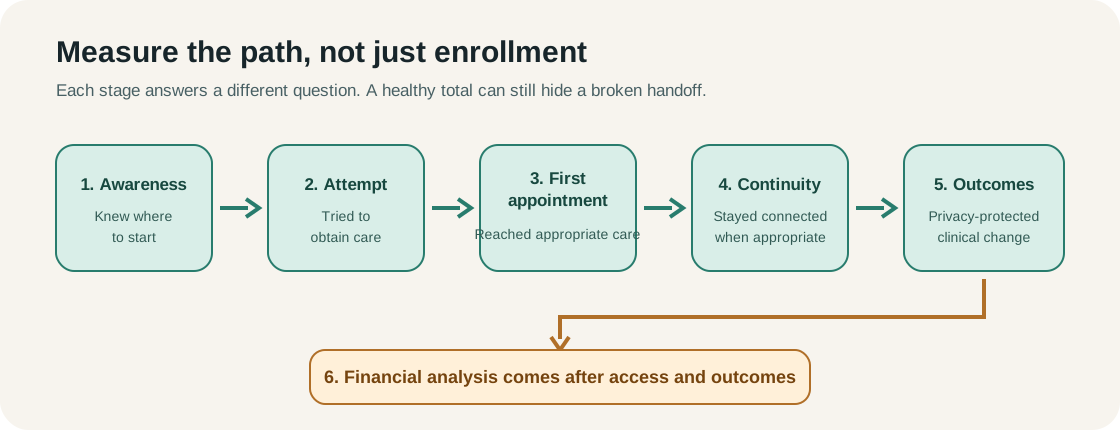
A useful scorecard follows the employee’s path: awareness, attempted access, a completed first appointment, continuity, experience, privacy-protected clinical outcomes, and financial impact. Each stage answers a different question. Blending them into one engagement total lets a healthy-looking dashboard conceal a broken care pathway.
The blind spot begins with convenient numbers
Benefit reports tend to start with what the vendor and commercial insurance company already have: eligible lives, registrations, searches, calls, claims, sessions, and a provider-directory total. Those numbers describe supply or activity. None proves that an employee obtained appropriate care.
Someone can register and never find a clinician. A search can return a long list while no one on it accepts new patients. A claim proves that a bill entered the system, but says little about the failed calls before the visit or the people who stopped trying. Even completed sessions do not show whether care was affordable, suitable, or connected long enough to help.
Reporting incentives reinforce the gap. A vendor paid to increase engagement will emphasize engagement. A commercial insurer responsible for network access may emphasize directory size. The employee carries the friction between those categories.
The EAP utilization problem is one version of this failure. Awareness campaigns ask employees to work harder at navigating a pathway the purchaser has not fully measured. Benefits leaders need to see where the pathway loses people before asking people to try again.
Measure the care funnel
A mental-health benefit can exist on paper and fail during use. Its measurement system should follow the sequence of care.
1. Eligibility and awareness. Establish who can use the benefit and who knows how to begin. A 2025 NAMI/Ipsos probability sample of 2,376 full-time U.S. workers found that 53% knew how to access mental-health care through employer-sponsored insurance (NAMI and Ipsos, February 27, 2025). Knowing how is an early access measure, not confirmation of an appointment.
2. Attempted access. Count searches, calls, referrals, appointment requests, intake starts, and abandoned attempts separately. A person who found no accepting clinician should not disappear from the report because no claim followed.
3. Successful connection. Track the share of people who tried and completed a first appointment with an appropriate clinician. Pair that conversion rate with the median and distribution of time to care; an average can hide a smaller group waiting much longer.
A 2025 peer-reviewed secret-shopper study shows why completion matters. Researchers examined 8,306 mental-health counselor listings from Pennsylvania’s ACA Marketplace. Among 2,152 listings fully verified by phone, 65.2% had at least one inaccuracy, and appointments were available from 321, or 14.9%, with a mean 33.2-day wait (Haeder and Zhu, September 1, 2025). This was not a national employer-plan audit. Its rates should stay attached to that sample. The scoped lesson is that a directory entry does not establish realized access.
4. Continuity in care. Among employees who begin, measure whether they remain connected for the clinically appropriate plan. Avoid one session target for every person. The report should reveal early drop-off, disrupted referrals, and avoidable gaps without turning a clinical decision into a purchasing quota.
5. Employee experience. Ask about navigation, out-of-pocket cost, respect, cultural and language fit, and willingness to use the pathway again. EBRI reported that 80% of surveyed decision-makers said their organizations survey employees or dependents about benefit satisfaction. Satisfaction adds information, but it cannot replace verified access or outcomes.
The funnel supplies a denominator at every stage. “Ten thousand provider searches” means little until a purchaser can see how many produced a call, a suitable appointment, and a completed visit.
Clinical outcomes need privacy and precision
Employers should demand aggregate evidence that care is monitored while staying away from identifiable records. They do not need an individual’s screening score, diagnosis, or treatment notes to evaluate a vendor.
NCQA’s HEDIS Measurement Year 2025 descriptions separate depression screening and follow-up, PHQ-9 monitoring, and response or remission. The response/remission measure looks for a follow-up score within 120 to 240 days after an elevated score and reports follow-up, response, and remission separately (NCQA, August 1, 2024). These are health-plan quality measures, not a complete employer ROI formula, but the distinctions are useful.
Screening, follow-up, improvement, and remission are separate events. A vendor report should preserve them in privacy-protected aggregate form and include deterioration, escalation, and adverse events where appropriate.
In EBRI’s employer survey, 66% said their health plan or mental-health vendor promoted and rewarded systematic behavioral-health measurement such as the PHQ-9 or GAD-7. That answer does not establish consistent collection, completion rates, clinical improvement, or employer receipt of useful aggregate results. It gives purchasers a starting point for better questions: what is measured, when is it repeated, how is missing follow-up handled, what share of eligible episodes has usable data, and what happens when a measure shows deterioration?
Financial ROI comes after access and outcomes
Financial analysis needs the full program cost, a defined time period, an appropriate comparison, and reported uncertainty. Medical spending, absence, disability, and retention may belong in the model, but each needs a clear denominator and defensible method. A change after launch does not automatically belong to the benefit.
A 2025 JAMA Network Open retrospective matched-cohort study followed 13,990 employees and dependents across seven employers. Annual behavioral-health care use increased from 8.3% before an enhanced program launched to 12.2% afterward, a 3.9-percentage-point absolute increase and a 47.0% relative increase. In the year after a behavioral-health diagnosis, the program was associated with $1,070 in savings per participant and an ROI of 1.9 times program cost (Hawrilenko et al., February 5, 2025).
The finding applies to the program studied. The design was nonrandomized and may have selection bias. Most authors were Spring Health employees and equity holders. Those limitations prevent a category-wide promise while preserving a useful method: define the intervention and its total cost, compare like populations over a stated window, report absolute and relative changes, and disclose who performed the analysis.
Mental health is already a major employer cost concern. Benefits leaders can respond by requiring evidence tied to the benefit actually purchased, rather than importing an ROI number from a different population and program.
Put the scorecard into the contract
Reporting requirements work better when they are settled before renewal. Define what counts as an attempt, successful connection, completed first appointment, and continuity. Require wait-time distributions, new-patient acceptance, out-of-network use, out-of-pocket burden, referral completion, and privacy-protected clinical reporting. Financial claims should include methods, comparison groups, uncertainty, and conflicts of interest.
Ask the vendor to show the handoffs. How many people knew where to start, tried, completed a first appointment, and remained connected? How long did connection take? Missing data, abandoned searches, unresolved referrals, and exclusions belong in the result.
The contract also needs an action for a missed target. The response might be a network audit, a corrective plan, a navigation change, or a purchasing decision. Otherwise measurement becomes another annual description of a problem employees still have to solve.
This shifts workplace communication away from telling employees to use what the company bought and toward employer responsibility for whether the pathway works. It also addresses what employers get wrong about mental health at work: placing the burden of navigation on the person seeking care.
Covered was never the same as cared for. A contract that follows failed handoffs and requires corrective action can measure the distance between them.
FAQ
How should employers measure mental-health benefits ROI?
Start by measuring the path from eligibility and awareness to attempted access, a completed first appointment, continuity, employee experience, and privacy-protected clinical outcomes. Calculate financial ROI separately using full program costs, a defined comparison group, a stated time window, and uncertainty.
Is mental-health benefit utilization the same as ROI?
No. Utilization shows that a service was used. ROI requires a defined investment and a defensible estimate of financial return. Utilization also cannot show by itself whether employees found timely, appropriate care or improved.
What is the most useful mental-health access metric for employers?
A strong core metric is the share of employees who try to obtain care and complete a first appointment with an appropriate provider, paired with the median and distribution of time to that appointment. Segment results only when employees’ privacy is protected.
Should employers receive employee PHQ-9 or GAD-7 scores?
Employers should not receive identifiable clinical scores. Clinical reporting should be privacy-protected and aggregated, with follow-up completion, response, remission, deterioration, and escalation kept distinct.
Do mental-health benefits always produce a positive financial return?
No universal return is established. One 2025 matched-cohort study reported an association between a specific enhanced program and an ROI of 1.9 times program cost, but the study was nonrandomized, program-specific, and had material vendor conflicts.
Sources
- Employee Benefit Research Institute, 2025 Employer Survey on Mental Health Benefits, October 10, 2025
- Business Group on Health, 2025 Employer Well-being Strategy Survey Executive Summary, May 20, 2025
- National Alliance on Mental Illness and Ipsos, workplace mental-health poll, February 27, 2025
- Haeder and Zhu, mental-health counselor directory secret-shopper study, September 1, 2025
- National Committee for Quality Assurance, HEDIS Measurement Year 2025 Measure Descriptions, August 1, 2024
- Hawrilenko et al., JAMA Network Open matched-cohort study, February 5, 2025
Disclaimer
This article is for educational and informational purposes only. It does not constitute medical, clinical, legal, or therapeutic advice, and reading it does not create a therapist-client relationship with Matthew Sexton, LCSW or Mental Wealth Solutions, Inc. Although the author is a licensed clinical social worker, the content in this article is not clinical assessment, diagnosis, or treatment.
Mental-health benefit designs, vendor reporting, privacy requirements, and financial analyses vary by employer, health plan, jurisdiction, and over time. The measurement concepts described here reflect general research and quality-measure frameworks and may not fit every organization or workforce. Employers should consult qualified benefits, privacy, legal, actuarial, and clinical professionals about their specific circumstances.
If you are in immediate emotional crisis, you can reach the 988 Suicide & Crisis Lifeline by calling or texting 988 (US). If you are experiencing domestic violence or are in physical danger, contact the National Domestic Violence Hotline at 1-800-799-7233 or visit thehotline.org. In a life-threatening emergency, call 911.
Frequently asked questions
- How should employers measure mental-health benefits ROI?
- Start by measuring the path from eligibility and awareness to attempted access, a completed first appointment, continuity, employee experience, and privacy-protected clinical outcomes. Calculate financial ROI separately using full program costs, a defined comparison group, a stated time window, and uncertainty.
- Is mental-health benefit utilization the same as ROI?
- No. Utilization shows that a service was used. ROI requires a defined investment and a defensible estimate of financial return. Utilization also cannot show by itself whether employees found timely, appropriate care or improved.
- What is the most useful mental-health access metric for employers?
- A strong core metric is the share of employees who try to obtain care and complete a first appointment with an appropriate provider, paired with the median and distribution of time to that appointment. Results should be segmented only when employees' privacy is protected.
- Should employers receive employee PHQ-9 or GAD-7 scores?
- Employers should not receive identifiable clinical scores. Clinical reporting should be privacy-protected and aggregated, with follow-up completion, response, remission, deterioration, and escalation kept distinct.
- Do mental-health benefits always produce a positive financial return?
- No universal return is established. One 2025 matched-cohort study reported an association between a specific enhanced program and an ROI of 1.9 times program cost, but the study was nonrandomized, program-specific, and had material vendor conflicts.