Starting September 1, 2026, Blue Cross Blue Shield of Michigan requires an SA modifier on every incident-to claim billed for a pre-licensed clinician, and those claims immediately lose eligibility for value-based (PGIP) reimbursement. By March 1, 2027, any clinician eligible to enroll on their own must bill under their own NPI, or the claim drops to 80% of the professional fee schedule (Michigan State Medical Society, 2026; Michigan State Medical Society, 2026; NASW-Michigan practice alert, 2026). The modifier is the small print. The real story is what it does to the pipeline of new therapists the state needs.
Quick answer: BCBS Michigan is phasing out incident-to reimbursement for pre-licensed clinicians in office-based settings. An SA modifier and lost PGIP eligibility take effect September 1, 2026, and a full billing overhaul, own-NPI enrollment or an automatic drop to 80% of the fee schedule, lands March 1, 2027. Private practices that rely on incident-to revenue to employ associate therapists will find that revenue cut just as the state’s behavioral health workforce shortage is projected to widen.
What Is BCBS Michigan Actually Changing?
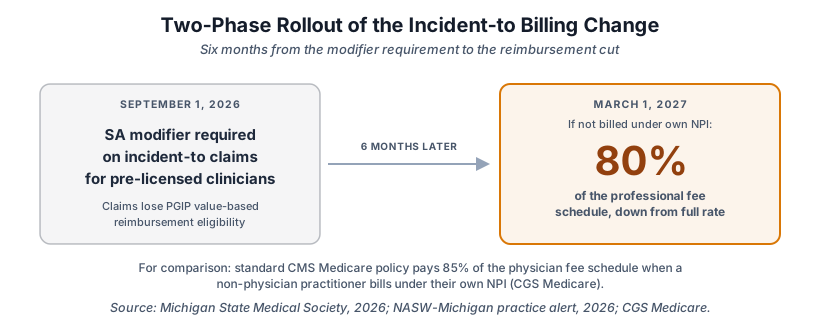
The change happens in two phases, and the details matter more than the headline. Phase one, September 1, 2026: practices must append an SA modifier to incident-to claims for pre-licensed clinicians, and those claims stop counting toward BCBSM’s Physician Group Incentive Program value-based reimbursement (Michigan State Medical Society, 2026).
Phase two, March 1, 2027, is the one that actually reshapes a practice’s finances. Any clinician who is independently eligible to enroll with BCBSM must bill claims under their own NPI from that date forward. If a practice keeps billing an eligible clinician’s work under a supervising provider’s NPI instead, incident-to claims for that work reimburse at just 80% of the professional fee schedule, down from the full rate the practice bills today (Michigan State Medical Society, 2026; cross-confirmed by Michigan State Medical Society, 2026 and NASW-Michigan practice alert, 2026).
For context on how steep that cut is: under standard CMS incident-to policy, a non-physician practitioner billing under their own NPI is reimbursed at 85% of the physician fee schedule (CGS Medicare, a CMS Medicare Administrative Contractor). BCBSM’s 80% penalty rate for practices that don’t restructure billing is a deeper cut than that federal benchmark, applied by a commercial insurer to clinicians who, in many cases, aren’t eligible to enroll under their own NPI at all.
Who Loses Reimbursement Under the New Rule?
The clinicians hit hardest are the ones without an independent path to enrollment. Students and trainees, LLMSWs, LLPCs, LLMFTs, and temporary limited licensed psychologists working in office-based or private-practice settings lose incident-to eligibility after March 1, 2027 (NASW-Michigan practice alert, 2026).
There’s a carve-out worth naming honestly. The same pre-licensed clinicians can still bill incident-to in facility-based settings, hospitals, outpatient psychiatric centers, and FQHCs (NASW-Michigan practice alert, 2026). That’s real. It also means the settings where most Michiganders actually meet a therapist for the first time, a small group or solo private practice, are precisely the settings where this pathway is closing.
Think about who that group is. It’s the associate therapist a year out of grad school, seeing clients under supervision while they log the hours their license requires. Private practices have historically covered that clinician’s salary partly through incident-to billing. Take that revenue away in an office setting and the math on keeping them employed gets a lot harder.
Why Does BCBS Michigan Say It’s Doing This?
BCBSM frames the change as a transparency fix, not a cost fix. The insurer says the goal is to align reimbursement with a clinician’s actual licensure and participation status, according to its own provider communications (BCBSM MIBlueDaily, “Why We Are Updating Our Incident-to Policy,” 2026). That’s the stated rationale, in the insurer’s own words, and it deserves to be reported as exactly that: a stated rationale, not an independently audited one.
What’s missing from that framing is any public accounting of the downstream effect. BCBSM hasn’t published an estimate of how many pre-licensed clinicians or practices this touches, or what happens to appointment availability once the incentive to carry associate therapists shrinks. Transparency describes what the claim form will say. It doesn’t describe what happens to the person who can no longer get an appointment.
The On-Ramp Is Closing Right When the Workforce Needs It Most
Here’s the part that should worry anyone who has tried to book a first therapy appointment in the last year. A University of Washington analysis of HRSA’s State of the Behavioral Health Workforce, 2024 projects a national shortage of roughly 51,000 social workers and 128,200 mental health counselors by 2037 (WWAMI Rural Health Research Center, July 2025).
Every one of those future clinicians starts as a pre-licensed one. The license requires supervised hours before independence, and someone has to pay that clinician’s salary during the wait. Incident-to billing has financed part of that stretch in office settings. Remove it, and a practice has three options: absorb the loss, stop hiring associates, or push training into facility settings that may lack the capacity to take them.
None of those options grows the pipeline. All three shrink it, at the exact moment HRSA’s own numbers say the state and the country can least afford a shrinking pipeline. This isn’t a story about burned-out therapists leaving, the shortage that’s already well documented. It’s a story about the door closing on the people who were supposed to replace them.
How Michigan Clinicians Are Pushing Back
NASW-Michigan isn’t waiting to see how this plays out. The chapter has formed a coalition with the Michigan Mental Health Counselors Association to press the issue with BCBSM and state policymakers (NASW-Michigan practice alert, 2026). That’s a fast, formal response for a policy that hasn’t even reached its second phase yet.
Detroit media picked it up early. ClickOnDetroit ran an access-concerns piece on June 8, 2026, and a follow-up on June 29, 2026, covering psychiatric nurse practitioner offices worried about where their patients go once incident-to reimbursement drops (ClickOnDetroit, June 8, 2026). A Michigan practice, Inspired Healing Therapy, published its own clinician- and client-facing explainer on July 7, 2026, a sign that patients were already asking questions before their own practices could get ahead of it (inspiredhealingtherapy.com/blog, 2026). Clinicians are also comparing notes in professional forums, on which practices plan to absorb the cost and which plan to stop taking new associates.
What This Means for Employers and Patients
Two effects should show up before the March 2027 deadline even lands. First, wait times: if practices scale back on associate therapists, the appointment pipeline narrows in exactly the settings, small private practices, where most people first reach out. Second, disruption: patients already working with a pre-licensed clinician may get reassigned mid-treatment if their practice can’t sustain that role financially, a continuity-of-care problem separate from access.
Employers offering behavioral health benefits in Michigan should ask their network partners a direct question: does this change touch the in-network clinicians employees are actually seeing. A benefit that looks unchanged on paper can still shrink in practice if the clinicians behind it become unaffordable to employ. It’s the same access-architecture problem, coverage on paper isn’t the same as a person reachable in a chair, just on the supply side instead of demand.
FAQ
What is the BCBS Michigan incident-to billing change? BCBSM requires an SA modifier on incident-to claims for pre-licensed clinicians starting September 1, 2026, and removes those claims from value-based reimbursement. By March 1, 2027, eligible clinicians must bill under their own NPI, or the claim drops to 80% of the fee schedule (Michigan State Medical Society, 2026; Michigan State Medical Society, 2026).
Which clinicians in Michigan lose incident-to billing? Students, trainees, LLMSWs, LLPCs, LLMFTs, and temporary limited licensed psychologists in office-based or private-practice settings lose eligibility after March 1, 2027. They may still bill incident-to in hospitals, outpatient psychiatric centers, and FQHCs (NASW-Michigan practice alert, 2026).
Why is BCBS Michigan making this change? BCBSM says it’s meant to improve transparency and align reimbursement with actual licensure and participation status (BCBSM MIBlueDaily, “Why We Are Updating Our Incident-to Policy,” 2026). That’s the insurer’s own stated reason; it hasn’t published an impact estimate for affected practices or patients.
How does this compare to Medicare’s incident-to rules? Under standard CMS policy, a non-physician practitioner billing under their own NPI is reimbursed at 85% of the physician fee schedule (CGS Medicare, a CMS Medicare Administrative Contractor). BCBSM’s 80% rate for non-compliant incident-to claims is steeper than that federal benchmark.
Is anyone pushing back on the BCBS Michigan policy? Yes. NASW-Michigan has formed a coalition with the Michigan Mental Health Counselors Association (NASW-Michigan practice alert, 2026). ClickOnDetroit covered the story twice in June 2026, and a Michigan practice published its own explainer on July 7, 2026.
Sources
- Michigan State Medical Society (MSMS), “BCBSM Announces Changes to Incident-to Billing Policy”, 2026, cross-confirmed by Yeo & Yeo, 2026. SA modifier, PGIP eligibility, and March 1, 2027 own-NPI/80% mechanics.
- Michigan State Medical Society (MSMS), Michigan State Medical Society, 2026, 2026. Cross-confirms the timeline and affected clinician categories.
- NASW-Michigan practice alert, NASW-Michigan practice alert, 2026, 2026. Affected licensure categories, facility-setting carve-out, and the coalition with the Michigan Mental Health Counselors Association.
- BCBSM’s MIBlueDaily provider channel, “Why We Are Updating Our Incident-to Policy”, 2026. The insurer’s own stated rationale.
- ClickOnDetroit, ClickOnDetroit, June 29, 2026, June 8 and June 29, 2026. Local access-concern and psychiatric-NP-office coverage.
- Inspired Healing Therapy blog, inspiredhealingtherapy.com/blog, July 7, 2026. Practice-level explainer for clinicians and clients.
- Centers for Medicare & Medicaid Services, CGS Medicare, a CMS Medicare Administrative Contractor, current policy. Neutral rate benchmark: the 85% incident-to reimbursement rate for non-physician practitioners billing under their own NPI.
- WWAMI Rural Health Research Center, University of Washington, Interstate Occupational Licensure Arrangements to Expand Access to Behavioral Health Services, July 2025, citing HRSA’s State of the Behavioral Health Workforce, 2024. Projected 2037 shortages of roughly 51,000 social workers and 128,200 mental health counselors.
Disclaimer
This article is for educational and informational purposes only. It does not constitute medical, clinical, legal, or therapeutic advice, and reading it does not create a therapist-client relationship with Matthew Sexton, LCSW or Mental Wealth Solutions, Inc. Although the author is a licensed clinical social worker, the content in this article is not clinical assessment, diagnosis, or treatment.
BCBSM’s incident-to billing requirements, effective dates, and affected licensure categories may be updated or clarified after publication. Practices and clinicians should confirm current requirements directly with BCBSM, MSMS, or NASW-Michigan, and consult a billing compliance professional or qualified counsel about their specific circumstances.
If you are in immediate emotional crisis, you can reach the 988 Suicide & Crisis Lifeline by calling or texting 988 (US). If you are experiencing domestic violence or are in physical danger, contact the National Domestic Violence Hotline at 1-800-799-7233 or visit thehotline.org. In a life-threatening emergency, call 911.
Frequently asked questions.
- What is the BCBS Michigan incident-to billing change?
- Starting September 1, 2026, Blue Cross Blue Shield of Michigan requires an SA modifier on incident-to claims for pre-licensed clinicians and removes those claims from value-based (PGIP) reimbursement eligibility. By March 1, 2027, enrollment-eligible clinicians must bill under their own NPI, or the claim reimburses at 80% of the professional fee schedule (Becker's Payer Issues, 2026; MSMS; NASW-Michigan).
- Which clinicians in Michigan lose incident-to billing?
- Students and trainees, LLMSWs, LLPCs, LLMFTs, and temporary limited licensed psychologists working in office-based or private-practice settings lose incident-to eligibility after March 1, 2027. The same clinicians may still bill incident-to in facility-based settings, including hospitals, outpatient psychiatric centers, and FQHCs (MSMS/NASW-Michigan practice alert, 2026).
- Why is BCBS Michigan making this change?
- BCBSM says the change is meant to improve transparency and align reimbursement with a clinician's actual licensure and participation status (BCBSM MIBlueDaily, 2026). The insurer has not published data showing how many pre-licensed clinicians or practices will be affected.
- How does this compare to Medicare's incident-to rules?
- Under standard CMS policy, a non-physician practitioner billing under their own NPI, instead of the supervising physician's, is reimbursed at 85% of the physician fee schedule (cms.gov). BCBSM's 80% rate for affected incident-to claims is a steeper cut than that federal benchmark.
- Is anyone pushing back on the BCBS Michigan policy?
- Yes. NASW-Michigan has formed a coalition with the Michigan Mental Health Counselors Association (NASW-Michigan practice alert, 2026). Local practices and Detroit media, including two ClickOnDetroit reports in June 2026, have raised access and continuity-of-care concerns.
Want to discuss this for your program?
Book a 30-min conversation. We'll walk you through deployment, the BAA, and what your rollout looks like in production.
Book a 30-min conversation