By Matthew Sexton, LCSW, NATC
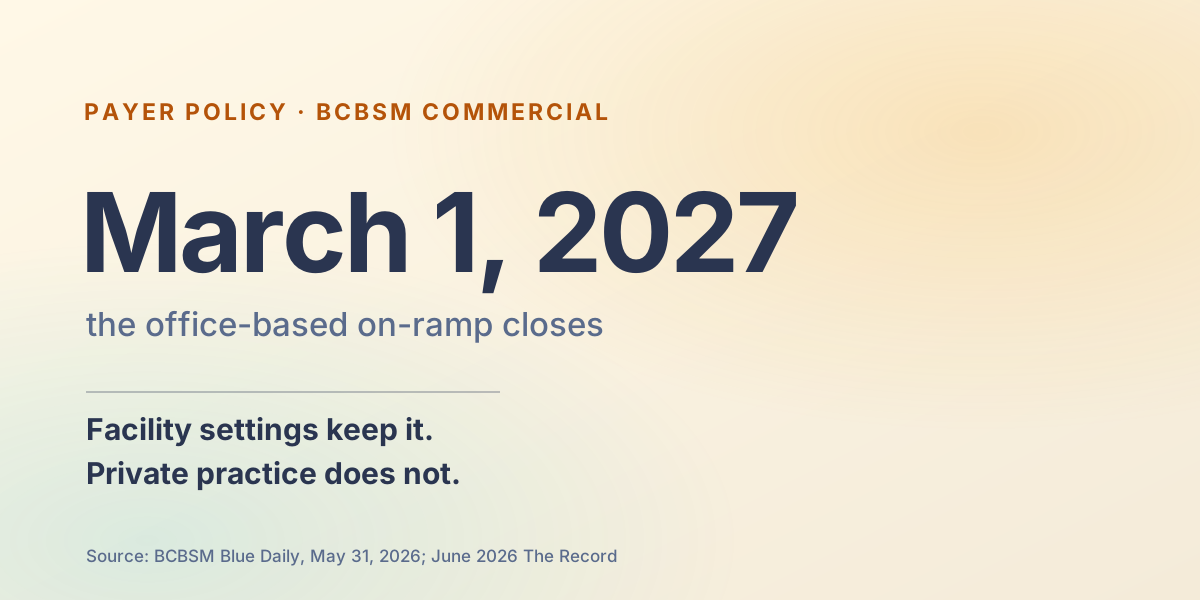
Quick answer: Blue Cross Blue Shield of Michigan is changing incident-to billing in two phases on its BCBSM commercial and BCN commercial business. Beginning September 1, 2026, incident-to claims from practitioners eligible to enroll directly must carry modifier SA, and those claims stop qualifying for value-based reimbursement. Beginning March 1, 2027, limited licensed clinicians lose incident-to reimbursement in professional and office settings, while fully licensed providers eligible for direct participation must bill under their own NPI or receive 80% of the applicable rate. Nothing is cut off today, and the March change is not a blanket cutoff: incident-to remains reimbursable in facility-based settings such as hospitals, outpatient psychiatric centers, and community health centers. The private-practice payment route closes. The facility route stays open.
The change arrives in two phases, six months apart
In late May 2026, formalized in the June 2026 The Record, BCBSM announced an update to its incident-to billing policy. The payer states the purpose on its own Blue Daily channel: to “ensure members receive the best possible care from fully licensed providers while allowing students, trainees and other limited-licensed professionals to be paid for services authorized and overseen by fully licensed providers in facility-based settings.”
Phase one begins September 1, 2026. Incident-to claims submitted by practitioners who are eligible to enroll directly must carry modifier SA, and those claims become ineligible for value-based reimbursement, including the Physician Group Incentive Program (Yeo & Yeo, June 2, 2026, citing the June 2026 The Record).
Phase two begins March 1, 2027. Limited licensed social workers, limited licensed professional counselors, limited licensed marriage and family therapists, and temporary limited licensed psychologists lose incident-to eligibility in office and professional settings, along with students, trainees, and physicians in graduate medical education (Michigan State Medical Society, June 11, 2026).
The scope is narrower than the headlines suggested. The change touches BCBSM commercial and BCN commercial only. Medicare Plus Blue, BCN Advantage, anesthesia, dental, laboratory, pharmacy, and urgent care sit outside it. Several provider types keep billing incident-to with no change at all: registered nurses, dieticians, physical and occupational therapy assistants, behavioral health technologists, community health workers, and peer support specialists.
It is also not a first. BCBSM’s own document says the update “will align our policy with the one we have in place for medical trainees” and “aligns the Blue Cross policy with Blue Care Network and Medicare Advantage policies.” Two of the payer’s own product lines already worked this way. Any account of this as an unprecedented crackdown is contradicted by the payer’s published rationale.
Michigan’s licensing rule and the payer’s enrollment rule point in opposite directions
Read two documents next to each other and the contradiction is mechanical rather than rhetorical.
First, the path to full licensure. Michigan’s Master’s Social Work Licensing Guide requires 4,000 hours of supervised post-master’s experience over a minimum of two years, and adds the decisive condition: those hours must be earned while the clinician holds an active limited license. The limited-license period is not a side door. It is the required door.
Second, enrollment. Limited licensed social workers, professional counselors, marriage and family therapists, and temporary limited licensed psychologists are “not eligible for direct participation” with BCBSM (NASW-Michigan Chapter practice alert, 2026).
Through February 28, 2027, incident-to billing has been the bridge between those two facts: services delivered by the limited licensed clinician, billed under the supervising fully licensed provider’s NPI. Stripped of adjectives, the sequence now reads:
- State licensure requires thousands of supervised hours earned on the limited license.
- The state’s largest commercial payer does not allow that license to enroll directly.
- The office-based billing route that made those supervised hours payable on that payer ends on a published date.
- Facility settings keep a payable path. Private-practice office settings do not.
This is why “reimbursement ends for pre-licensed therapists” is too broad, and why “the private-practice on-ramp closes” is accurate. A limited licensed clinician can still work and be billed within the retained facility route. What disappears is the commercial incident-to route in an office.
The volume of supervised preparation is not unique to Michigan. Texas requires at least 3,000 hours of supervised practice for the LCSW, including at least 100 hours of supervisory sessions, over no fewer than 24 months (Texas Behavioral Health Executive Council). Minnesota requires a minimum of 4,000 hours of post-graduate supervised experience for the LMFT (Minnesota Board of Marriage and Family Therapy). Those requirements do not determine how any commercial insurer pays for the work. They do show that an extended supervised period is built into multiple professional pathways, which makes the payer question the same everywhere: who pays for those hours, under whose NPI, in which setting.
No verifiable data exists on how many clinicians leave before completing the limited-license period. That gap is worth stating rather than filling. What is documented is the rule conflict itself.
BCBSM calls it a quality decision, and its opponents call it an access cut
BCBSM frames the change as clinical, not financial. Dr. Amy Milewski, the insurer’s associate chief medical officer, put it directly to Bridge Michigan: “This was not a cost decision, this was a quality-of-care decision.”
Opposition organized quickly, and its numbers are equally specific. A Change.org petition started by Tamera Lagalo on June 8, 2026 collected 4,335 verified signatures. Named opponents include Chris DeBoer, president of the Michigan Mental Health Counselors Association, the NASW-Michigan Chapter, and the Michigan State Medical Society, which opened a “Share Your Experience” intake on the policy.
Local reporting put practice-level numbers on it. At Kalamazoo Child and Family Counseling, founder Jeff LaPonsie estimated roughly 200 families affected (WWMT, June 10, 2026). At The Truism Center, founder Robb Kornoelje pointed to roughly 250 clients (Bridge Michigan). At WillowsEdge Counseling, clinical counselor David Sniderman said about 42% of patients see limited-license counselors and more than half of practice revenue comes through BCBSM (ClickOnDetroit, June 8, 2026).
These are attributed practice-level reports, not statewide projections. They explain the opposition’s position without establishing the payer’s motive, and the payer’s stated rationale does not answer the practices’ operational concern. Both belong in the record. Neither cancels the other.
BCBSM commercial holds approximately 70% of Michigan’s commercial insurance market. Coverage and advocacy materials place the change in a state with roughly 230 to 245 designated behavioral health shortage areas; WWMT reported 244 and the petition cited 233, and the two figures have not been reconciled against a single federal count.
The 80% rule may be the bigger-dollar half of the same policy
The second change in the same policy has nothing to do with limited licenses, and depending on how a group is staffed, it may move more money.
Practitioners eligible for direct participation must submit claims under their own NPI by March 1, 2027. Those who keep billing incident-to with modifier SA after that date are reimbursed at 80% of the applicable rate and do not qualify for value-based reimbursement.
That reaches every fully licensed provider sitting on a group billing structure, whether the arrangement exists for credentialing lag, panel convenience, or historical habit. It is a credentialing and enrollment project with a hard date, not a supervision-model project. Waiting until early 2027 to start re-enrollment is how a group discovers the 80% rate in production claims instead of in a planning memo.
Enrollment runs through the same credentialing infrastructure payers use to verify who a provider is. On who controls that data, see our analysis of CAQH, DataSpring, and payer ownership. An automatic reduction applied to claims that miss a new formatting requirement follows familiar mechanics; we covered the pattern in insurer downcoding as an invisible pay cut.
Federal Medicare policy moved the other way in 2023 and 2024
Hold the CMS record next to the 2027 cutoff.
In the CY2023 Medicare Physician Fee Schedule final rule, issued November 1, 2022, CMS added an exception at 42 CFR 410.26 allowing behavioral health services furnished by auxiliary personnel under general rather than direct supervision. Analysis of the rule ties the change to increased behavioral health need and workforce shortages (Baker Donelson).
In the CY2024 rule, issued November 2, 2023, CMS made marriage and family therapists and mental health counselors eligible to enroll in Medicare and bill for services effective January 1, 2024. Addiction, alcohol, and drug counselors meeting the mental health counselor requirements may enroll in that category, with parallel alignment for rural health clinics and federally qualified health centers.
The comparison is chronological, not motivational. Federal policy loosened one behavioral health supervision standard in 2023 and added two enrollable provider categories in 2024. A commercial plan holding roughly 70% of one state’s commercial market narrows an office-based route in 2027 while retaining the facility route, and says it is aligning with its own Medicare Advantage and Blue Care Network policies. Those are documented directions from different programs. The record does not explain why they differ beyond each organization’s stated rationale.
The usable management point is narrower: Medicare’s direction in 2023 and 2024 is not a guarantee that commercial incident-to stays open in office settings. Commercial policy moves on its own calendar.
Practices outside Michigan should read their own incident-to language now
This is not a Michigan story that ends at the state line. BCBSM’s own document says the change matches rules already operating on two of its other product lines. If two plan types in one state already worked this way, a similar rule may already sit in a contract you have not reread lately.
Read your incident-to language before a bulletin arrives. Pull the behavioral health incident-to sections for every commercial plan you accept. Look for setting limits, license-type lists, modifier requirements, reimbursement percentages, and value-based program exclusions.
Inventory license status and setting together. For each limited or provisionally licensed clinician, note the license type, the expected full-licensure date, the primary service setting, and which payers dominate that caseload. This change is setting-specific. A hospital outpatient department and a private office are not the same risk bucket.
Treat a new modifier mandate as the early warning. Modifier SA lands six months before the office cutoff and the own-NPI rule. When a payer introduces a modifier on incident-to claims and strips value-based eligibility from them, that is often the visible tell that a stricter phase is already scheduled.
Separate the two problems. The 80% penalty hits clinicians who can enroll directly. The office cutoff hits clinicians who cannot. One is a credentialing sprint. The other is a supervision-setting and payer-mix redesign. Conflating them produces the wrong workplan.
Clinicians in New York, New Jersey, and Connecticut work under their own supervision and billing rules; for regional context see therapist session rates in NY, NJ, and CT. For what a state-level rule looks like next to a single insurer’s internal policy, compare Illinois’s downcoding law and who it covers. And for how payer statements of intent hold up over time, see the prior authorization pledge one year on.
Limited-license hours exist because state boards require them. Incident-to exists because payers built a billing path for services delivered under a supervising enrollment. When those two systems stop meeting in the office setting, the failure is structural. Neither clients nor early-career therapists wrote either rulebook.
If your practice bills incident-to for limited licensed clinicians on any payer, a policy review now costs less than a retroactive rate adjustment later. Book a call to walk through your payer mix.
What changes, for whom, and when
| Change | Who it affects | Effective date |
|---|---|---|
| Modifier SA required on incident-to claims; those claims lose value-based reimbursement and PGIP eligibility | Practitioners eligible to enroll directly with BCBSM | September 1, 2026 |
| Office-based incident-to ends; facility-based settings keep it | LLMSW, LLPC, LLMFT, TLLP, students, trainees, graduate medical education physicians | March 1, 2027 |
| Must bill under own NPI, or be reimbursed at 80% of the applicable rate with no value-based reimbursement | Fully licensed providers eligible for direct participation | March 1, 2027 |
| No change to incident-to eligibility | RNs, dieticians, PT and OT assistants, behavioral health technologists, community health workers, peer support specialists | Not applicable |
Compiled from BCBSM Blue Daily (May 31, 2026) and Yeo & Yeo (June 2, 2026). Applies to BCBSM commercial and BCN commercial lines only.
FAQ
Is BCBSM ending all reimbursement for pre-licensed therapists? No. Beginning March 1, 2027, limited licensed clinicians lose incident-to reimbursement only in professional and office settings on BCBSM and BCN commercial lines. Facility-based settings such as hospitals, outpatient psychiatric centers, and community health centers keep the incident-to route. Nothing has changed yet as of today.
What changes on September 1, 2026? Incident-to claims from practitioners who are eligible to enroll directly must carry modifier SA. Those claims become ineligible for value-based reimbursement, including the Physician Group Incentive Program. The modifier requirement arrives six months before the March 2027 changes, which makes it the visible early signal of the second phase.
What happens if a fully licensed provider keeps billing incident-to after March 1, 2027? Providers eligible for direct participation who continue billing incident-to with modifier SA are reimbursed at 80% of the applicable rate and do not qualify for value-based reimbursement. This applies regardless of why the group billing structure exists.
Why can pre-licensed clinicians not simply enroll with the insurer directly? Limited licensed social workers, professional counselors, marriage and family therapists, and temporary limited licensed psychologists are not eligible for direct participation with BCBSM. Michigan separately requires 4,000 supervised hours earned while holding that limited license. The enrollment bar and the hour requirement together are what made the office-based incident-to route load-bearing until it closes.
Sources
- BCBSM, “Why We Are Updating Our Incident-to Policy,” Blue Daily, May 31, 2026. bcbsm.mibluedaily.com
- Yeo & Yeo CPA, “BCBSM, BCN Announce Changes to Incident-to Billing Policy,” June 2, 2026, citing the June 2026 The Record. yeoandyeo.com
- Michigan State Medical Society, “BCBSM Announces Changes to Incident Billing Policy,” June 11, 2026. msms.org
- Michigan State Medical Society, “Share Your Experience” intake. msms.org
- NASW-Michigan Chapter, practice alert on the incident-to policy change, 2026. nasw-michigan.org
- Bridge Michigan, “Michigan Blue Cross to limit mental health benefit; will thousands lose care?” June 11, 2026. bridgemi.com
- WWMT, local impact reporting, June 10, 2026. wwmt.com
- ClickOnDetroit/WDIV, practice exposure reporting, June 8, 2026. clickondetroit.com
- Change.org petition, started June 8, 2026; signature count cited as a fact about the petition. change.org
- Michigan LARA, Master’s Social Work Licensing Guide, revised October 7, 2024. michigan.gov
- Texas Behavioral Health Executive Council, supervision FAQs. bhec.texas.gov
- Minnesota Board of Marriage and Family Therapy, supervision requirements. mn.gov
- CMS, CY2023 Medicare Physician Fee Schedule final rule fact sheet, November 1, 2022. cms.gov
- CMS, CY2024 Medicare Physician Fee Schedule final rule fact sheet, November 2, 2023. cms.gov
- Baker Donelson, 2023 Physician Fee Schedule final rule analysis. bakerdonelson.com
- Medical Economics, overview of the BCBSM incident-to overhaul, June 2026. medicaleconomics.com
Disclaimer
This article is policy and business analysis for practice owners and clinicians. It is not legal, tax, billing, or clinical advice, and it is not a guarantee of coverage or payment. Payer policies, state licensing rules, and CMS regulations change. Verify current requirements against your own payer manuals, your state licensing board, and primary CMS publications before changing supervision models, enrollment status, or claims submission.
Frequently asked questions.
- Is BCBSM ending all reimbursement for pre-licensed therapists?
- No. Beginning March 1, 2027, limited-licensed clinicians lose incident-to reimbursement only in professional and office settings on BCBSM and BCN commercial lines. Facility-based settings such as hospitals, outpatient psychiatric centers, and community health centers keep the incident-to route.
- What changes on September 1, 2026?
- Incident-to claims from practitioners who are eligible to enroll directly must carry modifier SA. Those claims become ineligible for value-based reimbursement, including the Physician Group Incentive Program. The modifier requirement arrives six months before the March 2027 changes.
- What happens if a fully licensed provider keeps billing incident-to after March 1, 2027?
- Providers eligible for direct participation who continue billing incident-to with modifier SA are reimbursed at 80% of the applicable rate and do not qualify for value-based reimbursement.
- Why can pre-licensed clinicians not simply enroll with the insurer directly?
- Limited licensed social workers, professional counselors, marriage and family therapists, and temporary limited licensed psychologists are not eligible for direct participation with BCBSM. Michigan separately requires 4,000 supervised hours earned while holding that limited license. The enrollment bar and the hour requirement are what made the office-based incident-to route load-bearing.
Want to discuss this for your program?
Book a 30-min conversation. We'll walk you through deployment, the BAA, and what your rollout looks like in production.
Book a 30-min conversation