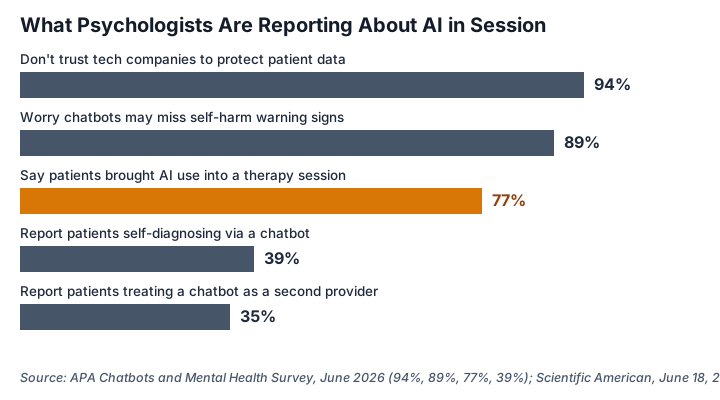
Seventy-seven percent of psychologists say their patients have already brought AI into the room, using a chatbot for support or engagement in ways that surfaced in session, according to APA’s Chatbots and Mental Health Survey, released June 16, 2026 (APA, 2026). That’s not a fringe behavior anymore. That’s most of the caseload, most of the week, for most clinicians. And the same survey found the field still hasn’t given those clinicians a way to work with it.
Quick answer: 77% of psychologists report patients using AI for mental health support, and the gap isn’t the technology, it’s the training. APA itself flagged this exact need eight months earlier, in a November 2025 advisory that told health systems to train clinicians on AI. The survey came back in June 2026 and found the training still hadn’t happened. This is a support-gap story. The patients aren’t the problem. The system that left clinicians unequipped is.
What did the APA survey actually find?
The headline number is 77%: that share of surveyed psychologists said patients had used AI for support, engagement, or something related that came up in a session (APA, June 16, 2026). The survey fielded 1,242 respondents between April 9 and April 26, 2026, which makes it one of the larger recent snapshots of what’s actually happening inside sessions, not what people assume is happening.
Underneath that top-line number sit three more specific findings. Nearly 2 in 5 psychologists, 39%, said they had patients who self-diagnosed using an AI chatbot, despite the fact that these tools were never built to interpret psychological tests or issue a diagnosis (APA, 2026). About a third of psychologists, 35%, described patients treating a chatbot as an additional or auxiliary provider, something closer to a second therapist than a search engine (Scientific American, June 18, 2026).
None of that means patients are doing something wrong. People reach for whatever is available at 2 a.m. when a session is a week away. The finding that should worry the field isn’t that patients are using AI. It’s that 89% of psychologists worried chatbots “may inadvertently encourage self-harm,” tied to specific instances of AI failing to recognize crisis or warning signs their patients brought up in the technology (APA, June 16, 2026). That’s a clinician watching a real risk unfold in real time, with no protocol for how to respond to it.
Were clinicians actually warned this was coming?
Yes, and that’s the part of this story that doesn’t get repeated enough. APA’s own November 2025 Health Advisory on generative AI chatbots and wellness apps recommended that health systems and professional groups “train clinicians on AI, bias, data privacy, and responsible use” (APA Health Advisory, November 2025). That’s not a vague nod to the future. That’s the profession’s own governing body naming the exact gap, eight months before its own survey confirmed the gap was still open.
So this isn’t a story about a surprise. It’s a story about a warning that sat on a shelf. APA told the system what to build. The system, meaning the health networks, training bodies, and licensing boards that actually control clinician education, didn’t build it. Then APA went and measured the result, and the result was 77% of psychologists managing something they were told eight months earlier they’d need training for and still don’t have.
I’ve sat across from patients who mention an app the way they’d mention a friend’s advice, matter-of-fact, no shame in it. The instinct to reach for something between sessions makes complete sense; it’s what’s missing on the clinician’s side of that moment that’s the actual gap. We were warned. We didn’t train for it. Now we’re finding out what that costs in the room.
What’s the trust gap patients and clinicians are both sitting inside?
There’s a real split in this survey, and it’s worth keeping the two halves separate instead of blending them into one scary number. First, 94% of psychologists said they do not trust tech companies to protect patients’ private mental health data, and 77% of those felt that distrust strongly (APA, June 16, 2026). That’s a data-privacy finding. It’s about who holds the transcript of someone’s worst week and what happens to it.
Second, and separately, a different 94% of psychologists said today’s chatbots cannot treat conditions with an appropriate amount of nuance (APA, June 16, 2026). That’s a clinical-capability finding, not a privacy one. Two different 94% figures, two different failure modes, and conflating them makes the survey sound like one giant red flag instead of two specific, addressable ones.
Here’s what both numbers point to together: clinicians don’t distrust their patients for using these tools. They distrust the infrastructure around the tools, on both the data side and the clinical side, and they’ve had almost no formal channel to say so before now. A survey isn’t a protocol. It’s a temperature check. The temperature is high.
Have any states already stepped in?
A couple have, and it’s worth naming briefly since it shows the legislative track is already moving faster than the training track. Illinois’ WOPR Act, signed August 4, 2025, bars AI systems from independently providing or advertising therapy without licensed-clinician oversight, with civil penalties up to $10,000 per violation (Illinois General Assembly, HB 1806 full text). Nevada’s AB 406, effective July 1, 2025, bars AI from claiming to provide professional mental health care, with civil penalties up to $15,000 per violation (Nevada Legislature, AB 406 full text).
Those laws draw a legal line around who can claim to be a therapist. They don’t answer the question this survey raises, which is what a licensed human therapist is supposed to do when a real patient, mid-session, describes a real conversation they had with a chatbot the night before. Two states legislated the boundary. Nobody yet built the training that lives inside it.
What would actually close this gap?
Nothing in this survey suggests banning the behavior or scaring patients away from tools they’ve already found useful. What it points to is far more boring and far more fixable: give clinicians a working framework for the conversation that’s already happening. That means training on how to ask about AI use the way we ask about any other coping tool, how to spot the difference between supplemental support and a self-diagnosis gap, and how to respond when a patient describes a chatbot missing a crisis signal.
It also means health systems and training programs treating APA’s own November 2025 recommendation as a task list instead of a talking point. The advisory named data privacy, bias, and responsible use as the three training pillars. None of that requires new legislation. It requires someone actually funding and scheduling the training APA already said was needed, eight months before the survey proved it still wasn’t happening.
FAQ
How many psychologists say patients are using AI in therapy? 77% of surveyed psychologists said patients had used AI for support, engagement, or a related purpose that came up in session, according to APA’s Chatbots and Mental Health Survey, fielded April 9-26, 2026 with 1,242 respondents and released June 16, 2026.
Are chatbots missing signs of a mental health crisis? 89% of psychologists in the same APA survey worried that chatbots may inadvertently encourage self-harm, tied to specific instances of AI failing to recognize crisis or warning signs, per APA’s June 16, 2026 release.
Do patients trust AI companies with their mental health data? Not according to their clinicians. 94% of psychologists said they do not trust tech companies to protect patients’ private mental health data, and 77% of those felt that distrust strongly, per the APA survey released June 16, 2026.
Were clinicians actually warned about this before the survey came out? Yes. APA’s own November 2025 Health Advisory on generative AI chatbots recommended training clinicians on AI, bias, data privacy, and responsible use, roughly eight months before this survey confirmed most clinicians still don’t have that training.
Have any states passed laws on AI and therapy? Yes. Illinois’ WOPR Act, signed August 2025, bars AI systems from independently providing or advertising therapy without licensed-clinician oversight, fines up to $10,000 per incident. Nevada’s AB 406, effective July 2025, bars AI from claiming to provide professional mental health care, penalties up to $15,000.
Sources
- American Psychological Association, Chatbots and Mental Health Survey press release (June 16, 2026) — 77% patient AI use, 89% self-harm concern, 39% self-diagnosis, both 94% findings (data trust and clinical nuance).
- Forbes, Patients Are Bringing AI Into Therapy. Therapists Aren’t Ready (July 9, 2026) — corroborating figures on patient AI use in session.
- Scientific American, 1 in 3 psychologists say their patients use AI as a second therapist (June 18, 2026) — 35% of psychologists reporting patients using AI as an auxiliary or “second therapist.”
- American Psychological Association, Health Advisory: Chatbots and Wellness Apps (November 2025) — recommendation to train clinicians on AI, bias, data privacy, and responsible use.
- Illinois General Assembly, full text of HB 1806 (the WOPR Act) — signed August 4, 2025, bars unsupervised AI therapy provision, civil penalty up to $10,000 per violation.
- Nevada Legislature, full text of Assembly Bill No. 406 (83rd Session, 2025) — effective July 1, 2025, civil penalty up to $15,000 per violation.
Disclaimer
This article is for educational and informational purposes only. It does not constitute medical, clinical, legal, or therapeutic advice, and reading it does not create a therapist-client relationship with Matthew Sexton, LCSW or Mental Wealth Solutions, Inc.. Although the author is a licensed clinical social worker, the content in this article is not clinical assessment, diagnosis, or treatment.
Survey findings, state laws, and clinical training standards referenced here reflect the sources cited at time of publication and may change. This is not a substitute for confirming current requirements with a licensing board, employer, or qualified counsel, and nothing here should be read as guidance for how any specific clinician should respond to a specific patient disclosure. If you are a clinician navigating a patient’s AI use in session, consult your supervision structure, ethics board, or state licensing guidance for your specific circumstances.
If you are in immediate emotional crisis, you can reach the 988 Suicide & Crisis Lifeline by calling or texting 988 (US). If you are experiencing domestic violence or are in physical danger, contact the National Domestic Violence Hotline at 1-800-799-7233 or visit thehotline.org. In a life-threatening emergency, call 911.
Frequently asked questions.
- How many psychologists say patients are using AI in therapy?
- 77% of surveyed psychologists said patients had used AI for support, engagement, or a related purpose that came up in session, according to APA's Chatbots and Mental Health Survey, fielded April 9-26, 2026 with 1,242 respondents and released June 16, 2026.
- Are chatbots missing signs of a mental health crisis?
- 89% of psychologists in the same APA survey worried that chatbots may inadvertently encourage self-harm, tied to specific instances of AI failing to recognize crisis or warning signs, per APA's June 16, 2026 release.
- Do patients trust AI companies with their mental health data?
- No. 94% of psychologists said they do not trust tech companies to protect patients' private mental health data, and 77% of those felt that distrust strongly, according to the APA survey released June 16, 2026.
- Were clinicians warned about this before the survey came out?
- Yes. APA's own November 2025 Health Advisory on generative AI chatbots recommended that health systems and professional groups train clinicians on AI, bias, data privacy, and responsible use, roughly eight months before this survey confirmed most clinicians still don't have that training.
- Have any states passed laws on AI and therapy?
- Yes. Illinois' WOPR Act, signed August 2025, bars AI systems from independently providing or advertising therapy without licensed-clinician oversight, with fines up to $10,000 per incident. Nevada's AB 406, effective July 2025, bars AI from claiming to provide professional mental health care, with penalties up to $15,000.
If you're the therapist here.
Your clients get 4 sessions a month. The other 26 days they're on their own. VibeCheck is the between-session companion that carries those days back to you — clients check in daily, and you walk in already knowing what kind of week it was. Built by Matthew Sexton, LCSW, NATC.