AI Agent Workspace: What Block's Buzz Actually Ships
Block released Buzz on July 21, 2026: every human and AI agent holds its own key, every action is signed. The approval gates are still being built.
From the earlier archive. This article’s original writing is retained and has not been fact-checked as part of our current review. Product references may reflect an earlier version; see current solutions for today’s status.
Matthew Sexton, LCSW, NATC — licensed clinical social worker and founder of Mental Wealth Solutions, Inc., which builds AI tooling for clinicians.
On July 21, 2026, Block, Inc. released an open-source workspace called Buzz in which every participant, human or AI agent, holds its own cryptographic keypair and every action lands in a signed record. It is the first widely watched product I have seen that can answer the question that decides whether anyone can safely hand work to a machine: who did this, and under whose authority. Now that question has an answer, in shipping software, under an Apache 2.0 license.
Quick answer: the thing standing between a small-practice owner and actually delegating work to AI is governance. Knowing who did what, under whose authority, and being able to stop it. Buzz matters because it is the clearest example yet of an agent workspace treating identity and an audit trail as primitives rather than features, shipped by Block, Inc. on July 21, 2026. The remaining piece is the brake. Buzz’s own README lists workflow approval gates as still being integrated. Identity, audit trail, human approval. Those three together are the shape of the thing worth waiting for, and two of them just arrived.
One disclosure first. Mental Wealth Solutions, Inc. builds AI tooling for clinicians, so I am not a neutral observer of agent infrastructure. I find this direction exciting partly because I am building inside it.
Right now, you are the integration layer
Ask a practice owner why AI has not touched her admin pile and you almost never hear that the model is not smart enough. You hear some version of this: I opened it, I was not sure what to ask it, and keeping the whole thing straight took longer than doing the work myself.
Both halves of that are real, and neither one is a competence problem.
Start with the asking. Getting what you actually want out of a model is a skill, it is unevenly distributed, and nobody sat any of us down and taught it. No manual came with the tab. People who spend their whole day inside these tools have built up a feel for how to frame a request and how to steer when an answer drifts sideways. Everyone else is working it out alone, in a text box, in the ten minutes between clients. Nobody should have to become a prompt engineer to get a superbill out the door.
Then the harder half. Say you do know how to ask. You still end up with a chat window in one tab, your notes tool in another, a billing spreadsheet in a third, and the calendar somewhere behind all of it. You pull something out of the first, paste it into the second, explain the situation from scratch because the second one has never heard of the first, then carry that result to the third by hand. Every handoff between those windows is you. Every piece of context that moves between them moves because you moved it, and you are the only one holding the sequence in your head while a client waits.
Delegation means handing off a task and having the coordination happen without you. What most owners have instead is a set of tools that each do one step and a person stitching them together all day. You are the middleware.
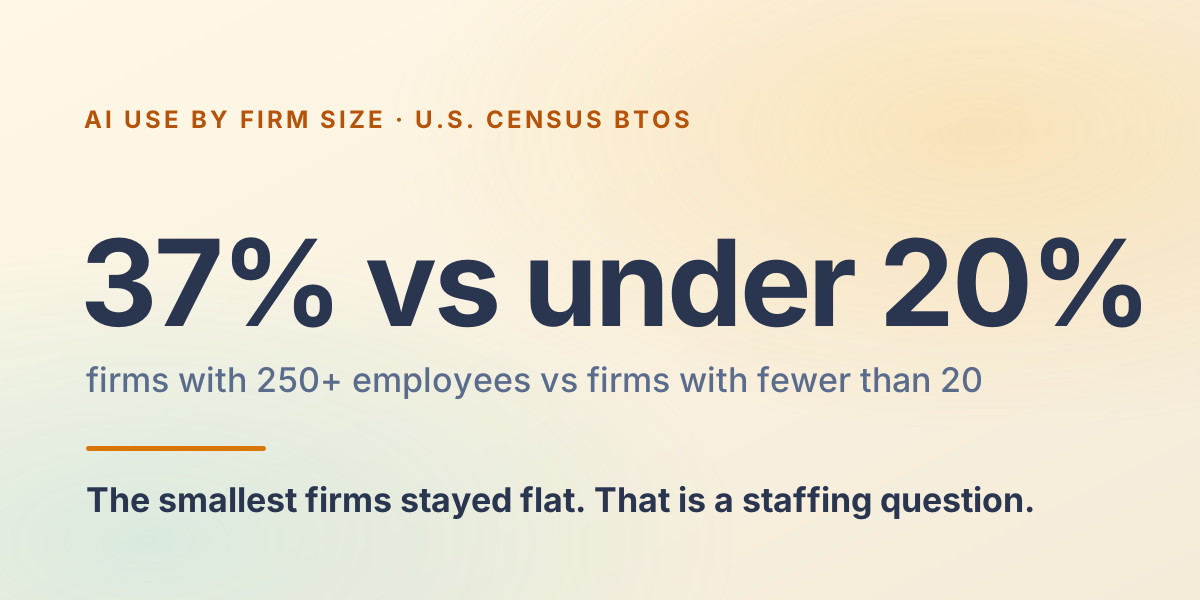
Here is the number that shows how unevenly that lands. The U.S. Census Bureau’s Business Trends and Outlook Survey, covering December 14, 2025 through May 3, 2026, found 37% of firms with 250 or more employees reporting current AI use, and 32% of firms with 100 to 249 employees. Firms with fewer than 20 employees came in under 20%, and that figure did not change significantly across the entire period. Firms with four or fewer employees were also under 20%.
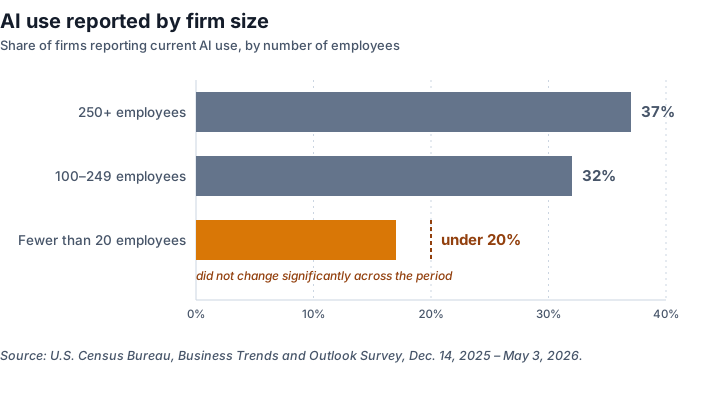
Read that as a staffing question rather than a technology question. A 400-person company can assign someone to be the integration layer. Somebody there owns the tooling, learns how to ask, wires the pieces together, and writes down how it works so the next person can follow it. A four-person practice has no such person. The owner is that person, on top of a full caseload, which is why the smallest firms stayed flat while everyone above them climbed.
This is the problem an agent workspace is built to solve, and it is why the Buzz architecture is worth understanding even if you would never run it yourself. Agents that share a channel, a thread, and a signed record can pass work to each other without a human retyping context between windows. The coordination becomes the software’s job. What is left for the owner is the part only she can do, which is deciding what should happen and approving it before it does. Block has not finished that last piece yet, and I will come back to it.
What Block actually released
Buzz is a workspace where people and software agents sit in the same channels. It handles threads, direct messages, canvas editing, media, full-text search, and an audit log. It also handles git, which means code repositories, patches, and code review live in the same place as the conversation. Underneath, it runs as a Nostr relay implementing the protocol specifications for authentication and for git events, with every event cryptographically signed. Block published all of it under Apache 2.0 and put the source on GitHub.
Two corrections belong here, because the coverage got both wrong and the errors are easy to repeat.
Buzz is a Block product. Jack Dorsey is Block’s CEO and announced it on his own account, which is why a lot of headlines read as though he built it. Block’s own release quotes Bradley Axen, Head of AI Capabilities at Block, as the company voice on the project. Attributing the thing to Dorsey personally is press shorthand.
The second correction concerns goose, an AI agent framework that several launch stories still describe in the present tense as Block’s. Block originated goose, then contributed it to the Linux Foundation’s Agentic AI Foundation, announced December 9, 2025, alongside Anthropic’s Model Context Protocol and OpenAI’s AGENTS.md. The old github.com/block/goose address now resolves to aaif-goose/goose. Block gave it away seven months before Buzz launched.
Both details point the same direction. A company that hands its agent framework to a neutral foundation and then ships its workspace under Apache 2.0 is making a consistent argument. Axen states it plainly: “Every company is going to need a place where humans and agents work together. The question is whether that place is proprietary or open.”
Why the architecture is the news
Strip away the protocol vocabulary and Buzz makes three design decisions a solo practice owner will recognize, because they are what you would demand of any new hire.
Every worker has a name that belongs to them. In Buzz, each participant, human or agent, holds a cryptographic keypair that is theirs rather than the platform’s. Decrypt described the consequence in its launch coverage: an agent’s identity, history, and reputation can travel across any compatible system. Translate that into practice terms. The agent that drafted your intake summaries for six months has a track record you could carry with you if you left the vendor. Compare that to how it works today, where a tool’s history dies inside the tool.
Every worker has a defined scope. Block’s release describes agents with cryptographic identities, defined permissions, and the ability to participate in workflows, posting, reviewing code, and running approved automations. Permissions is the word doing the work there. An agent with permission to draft is a very different employee from an agent with permission to send.
Everything anyone does gets written down and signed. This is the audit log, and it is the piece most consumer AI tools skip. When an agent changes something in Buzz, the change is attributable to a specific key. Nobody reconstructs the story afterward from memory and screenshots.
Those three ideas are what generalize. Whatever the eventual interface looks like for someone running a six-person practice, it needs these bones underneath it, and Buzz is the first widely watched product I have seen that starts from that premise rather than arriving at it after an incident.
The last piece is the brake
Buzz’s README is unusually candid about what ships and what does not. Mobile clients for iOS and Android are in development, huddle lifecycle events are incomplete, and workflow approval gates are listed as infrastructure that exists, with integration ongoing. The README says plainly that the project is not finished, which is a healthy thing for 0.x software to say. The current release is v0.4.25, published July 24, 2026, and the repository was created March 6, 2026 and carried 638 open issues as of July 25, 2026.
An approval gate is the moment an agent stops and asks. It is where a human signs before an action leaves the building. Every delegation a practice owner would actually want runs through it. Draft this and let me approve before it goes out. Prepare this and wait. Flag this and stop.
This is the seam where the owner is supposed to stand. If the coordination between agents becomes the software’s job, the human stops being the thing that carries context from window to window and becomes the thing that says yes. That is a much smaller job, and it is the only part of the work that requires her. Take away the gate and the role collapses back into supervision after the fact, which is where we already are.
Identity and the audit trail answer the question after the fact. The gate lets you decide before it. It makes sense that the record came first, because you cannot build a meaningful approval step until you know who is asking and what they are asking to do.
So the unfinished gate reads to me as a roadmap rather than a red flag. The hard architectural work is done and public, and the remaining piece is the one that converts this from something engineering teams run into something a six-person practice could run.
— Matthew Sexton, LCSW, NATC
When it lands, it lands in the open rather than inside one vendor’s product.
What “decentralized” is doing in the coverage
Dorsey described Buzz as model-agnostic, decentralized, self-sovereign, and open source, and the coverage ran with all four. Three hold up as stated. The fourth needs a footnote.
Each Buzz workspace runs on a single relay, which the project’s own repository calls its single source of truth. Portable identity across systems is genuine and it is the part worth caring about, but a decentralized network of relays serving a given workspace is not what ships today. Keep that distinction, because “decentralized” in a sales conversation can mean anything from a real federation to a single server with a good protocol on top of it.
Can non-technical users live in an AI agent workspace today?
A lot of people are going to read the Buzz headlines and expect something the software does not yet do.
Buzz’s shipped primitives are git patches, repository events, code review, and a JSON-in JSON-out command-line tool the README describes as designed for agent use. Its workflow automation is written in YAML. Self-hosting starts at Docker and a Rust toolchain and ends at a production deployment running Postgres, Redis and MinIO. Its docs directory holds files on multi-tenant relay conformance, git on object storage, push-gateway deployment, and MCP-driven hooks, every one of them protocol or infrastructure documentation. There is no end-user guide in there at all.
The agent integrations point the same way. SiliconANGLE reports that Buzz connects Claude Code, OpenAI Codex and goose through the Agent Client Protocol, an open standard for integrating coding agents. Coding agents. That is who it serves today.
Nobody at Block claims otherwise. Block frames the target as companies currently splitting their work across Slack and GitHub. TechCrunch describes the audience as startups already running AI agents, and notes the product remains in early stages, which makes full migration premature. The “usable by people who don’t code” story is one readers and headline writers supply, and holding Block to a promise it never made would miss what it did do.
The zero-install path is real. Signed installers ship for macOS, Windows and Linux, and there is a free hosted beta at buzz.xyz, currently a near-empty landing page inviting people to test the early stages. Block has disclosed no pricing for the hosted service. So you can install Buzz today without opening a terminal, and find a workspace organized around code review on the other side.
That sequence is ordinary. Version control, containers, and continuous deployment all started as developer-only machinery and became things a small business consumes without seeing the internals. Governance primitives for agents look to be on the same path.
Why the adoption headlines keep missing this
If the Census figures surprised you, a different number has been doing the rounds. The U.S. Chamber of Commerce reported in August 2025 that 58% of small businesses used generative AI in 2025, up from 40% in 2024 and 23% in 2023, from a survey of 3,870 U.S. small businesses with fewer than 250 employees conducted June 6 to 26, 2025.
Both numbers are honest. They measure different things. The Chamber counts whether a business has used any generative AI tool at all; Census asks whether it used AI in any business function in the past two weeks, which is a use-it-in-the-work standard rather than a tried-it-once standard. The distance between those two definitions is roughly the distance between opening a chat window and actually getting the admin pile handled. That gap is where a lot of owners get sold a story about universal adoption, buy something, and then stop opening it.
| U.S. Census Bureau (BTOS) | U.S. Chamber of Commerce | |
|---|---|---|
| Headline number | 37% of firms with 250+ employees; under 20% of firms with fewer than 20 | 58% of small businesses |
| What it counts | AI use in any business function in the past two weeks | Whether the business has used any generative AI tool at all |
| Reference period | December 14, 2025 – May 3, 2026 | Surveyed June 6–26, 2025 |
| Trend | The under-20-employee figure did not change significantly across the period | Up from 40% in 2024 and 23% in 2023 |
The Federal Reserve Bank of San Francisco found the same shape and named the reasons. In a research brief drawing on the 2024 Small Business Credit Survey, nearly 40% of small business respondents were using or planning to use AI. The barriers named were policy and regulatory limitations, the financial cost of appropriate tools, time and capacity constraints tied to staff training and system upgrades, and knowledge gaps around implementation. Non-adopters cited concerns about accuracy and intellectual property, the centrality of human interaction to their business model, or no perceived applicability. That survey year is 2024, so it predates the current agent wave and reads as background rather than a snapshot of this month.
Time, training, capacity, knowing how to implement it. Every one of those describes somebody being asked to be the integration layer without the hours to do it. That is what this architecture is aimed at.
The three-part test to judge every AI tool you get pitched
You do not have to install Buzz to get value out of it. The useful part is the standard it sets, which you can apply tomorrow to anything a vendor puts in front of you.
- Does the agent have its own identity, separate from mine? If it acts under your login, the record says you did it. Ask what the agent’s own credential is and where its actions are attributed.
- Is there an audit trail I can open myself? A log you have to request from support is a compliance artifact. A log you can read is a control.
- Can I require my approval before it acts, and is that shipped today? This is the one that separates a demo from a tool you can delegate to. Buzz’s README is direct about where that feature stands. Ask whether your vendor’s roadmap is that honest.
One follow-up once those three are answered: if you leave, what comes with you? The history, the configuration, the record of what the agent did. Portable identity is the idea Buzz is testing, and every vendor should now have an answer to it.
For clinicians the stakes sharpen further, because the rules are already arriving. As I documented in the state patchwork of AI therapy laws, a growing number of states now attach responsibility for AI outputs to the licensed professional rather than to the vendor. If you carry the responsibility, you need all three: the identity, the record, and the approval step. That is what the license now requires of you.
Where this is going
The next few years of handing work to AI are going to look like an org chart you can audit. Named workers, human and machine, with scoped permissions, a signed record of every action, and a human signature before anything consequential leaves the building. Block just shipped the first real version of the first three, in the open, and said out loud which part is still being built. That last part is the one to insist on. Anyone selling you a finished agent today without all four is selling most of a system and describing it as all of it.
We build VibeCheck.luxury on that ordering, which is a bias you should weigh. The human signs, then the work moves. Governed, never autonomous. If you want to talk through what this means for how your practice hands off work, book a call.
FAQ
What is Buzz, and who made it? Buzz is an open-source workspace where people and AI agents share channels, threads, git repositories and YAML-defined workflows. It was released by Block, Inc., the parent company of Square and Cash App, on July 21, 2026, under the Apache 2.0 license. Block’s CEO Jack Dorsey announced it publicly, but Block’s own release quotes Bradley Axen, Head of AI Capabilities, as the company spokesperson on the project. The repository was created March 6, 2026 and the software is still at version 0.x, with 638 open issues as of July 25, 2026.
Can a non-technical person use an AI agent workspace like Buzz today? Installing it is easy; living in it is not, yet. Signed desktop installers ship for macOS, Windows and Linux, and there is a free hosted beta at buzz.xyz, so getting in requires no terminal. But the features that ship today are developer primitives: git patches, code review, a JSON-in JSON-out command-line tool described as designed for agent use, and a self-hosted deployment built on Docker, Postgres, Redis and MinIO. The project’s entire docs directory is protocol and infrastructure documentation with no end-user guide, and its named agent integrations are coding agents. No source at Block, on buzz.xyz, or in the launch coverage claims non-technical accessibility. The architecture is the part that generalizes; the interface will follow it.
Why do workflow approval gates matter so much? An approval gate is the point where an agent stops and waits for a human to say yes before it acts. Identity and audit logs answer who did what, after the fact. The gate is what lets you decide before the fact. For a practice owner or employer, that is the difference between reviewing a mistake and preventing one, which is why it is the piece that turns this architecture into something a small business can actually use. Buzz’s README lists approval gates as infrastructure that exists with integration still ongoing, so it is on the roadmap rather than in the release.
Is Buzz actually decentralized? Partly, and the distinction is worth keeping straight. Identity is genuinely portable: every participant holds a cryptographic keypair that belongs to them rather than to the platform, so an agent’s history can travel to any Nostr-compatible system. But each workspace runs on a single relay that the project’s own repository calls its single source of truth. Portable identity is real. A decentralized relay network per workspace is not what ships today, and the launch coverage tends to blur those two things together.
Sources
- Introducing Buzz: where humans and agents work together, Block, Inc. (July 21, 2026). The launch announcement, the agent-identity and permissions framing, and the Bradley Axen quote on proprietary versus open.
- block/buzz README, Block, Inc. (fetched July 25, 2026). Shipped features, the Nostr relay architecture, the self-hosting prerequisites, and the list of unshipped items including workflow approval gates.
- block/buzz repository and its API metadata (fetched July 25, 2026). Apache 2.0 license, repository created March 6, 2026, 638 open issues. Latest release v0.4.25, published July 24, 2026.
- Block launches Buzz, open-source workspace for humans and AI agents, SiliconANGLE (July 21, 2026). The Agent Client Protocol integrations with Claude Code, Codex and goose, described as coding agents, plus the free hosted beta at buzz.xyz and the absence of disclosed pricing.
- Jack Dorsey is taking on Slack with Buzz, a group chat platform for teams and their AI agents, TechCrunch (July 21, 2026). Dorsey’s framing of the product and the observation that it remains in early stages.
- Jack Dorsey’s Block launches Buzz, a Nostr-based Slack and GitHub rival for AI agents, Decrypt (July 22, 2026). Portable keypair identity, and the single-relay-per-workspace caveat citing the project’s own repository.
- block/buzz docs directory contents, GitHub API (fetched July 25, 2026). Every documentation file is protocol or infrastructure material; no end-user guide.
- Linux Foundation announces the formation of the Agentic AI Foundation (announced December 9, 2025). Block contributed goose to the new foundation; the block/goose repository address now resolves to
aaif-goose/goose. - Businesses’ use of AI varies by size, U.S. Census Bureau, Business Trends and Outlook Survey, reference period December 14, 2025 to May 3, 2026. 37% for firms with 250-plus employees, under 20% and flat for firms with fewer than 20 employees.
- U.S. Chamber’s latest Empowering Small Business report, U.S. Chamber of Commerce C_TEC (August 18, 2025). 58% generative-AI use in 2025, up from 40% and 23%. Sample of 3,870 small businesses surveyed June 6-26, 2025, per IPWatchdog’s coverage of the same report.
- AI adoption in small businesses: evidence from the 2024 Small Business Credit Survey, Federal Reserve Bank of San Francisco (July 2026), with related commentary in AI and small businesses (March 2026). Nearly 40% using or planning to use AI; barriers of cost, time, training and knowledge. Underlying survey year is 2024.
Disclaimer
This article is for educational and informational purposes only. It does not constitute medical, clinical, legal, or therapeutic advice, and reading it does not create a therapist-client relationship with Matthew Sexton, LCSW or Mental Wealth Solutions, Inc. Although the author is a licensed clinical social worker, the content in this article is not clinical assessment, diagnosis, or treatment.
Software versions, shipped features, licensing terms, and vendor roadmaps change quickly, and everything described here reflects what was publicly documented on July 25, 2026. Buzz is 0.x software under active development, so features described here as still being integrated may ship, change shape, or be dropped after this article is published. Verify the current state of any tool against its own documentation before you rely on it, and confirm anything touching client records or professional obligations with your licensing board, your compliance advisors, and qualified counsel.
If you are in immediate emotional crisis, you can reach the 988 Suicide & Crisis Lifeline by calling or texting 988 (US). If you are experiencing domestic violence or are in physical danger, contact the National Domestic Violence Hotline at 1-800-799-7233 or visit thehotline.org. In a life-threatening emergency, call 911.
Frequently asked questions
- What is Buzz, and who made it?
- Buzz is an open-source workspace where people and AI agents share channels, threads, git repositories and YAML-defined workflows. It was released by Block, Inc., the parent company of Square and Cash App, on July 21, 2026, under the Apache 2.0 license. Block's CEO Jack Dorsey announced it publicly, but Block's own release quotes Bradley Axen, Head of AI Capabilities, as the company spokesperson on the project. The repository was created March 6, 2026 and the software is still at version 0.x, with 638 open issues as of July 25, 2026.
- Can a non-technical person use an AI agent workspace like Buzz today?
- Installing it is easy; living in it is not, yet. Signed desktop installers ship for macOS, Windows and Linux, and there is a free hosted beta at buzz.xyz, so getting in requires no terminal. But the features that ship today are developer primitives: git patches, code review, a JSON-in JSON-out command-line tool described as designed for agent use, and a self-hosted deployment built on Docker, Postgres, Redis and MinIO. The project's entire docs directory is protocol and infrastructure documentation with no end-user guide, and its named agent integrations are coding agents. No source at Block, on buzz.xyz, or in the launch coverage claims non-technical accessibility. The architecture is the part that generalizes; the interface will follow it.
- Why do workflow approval gates matter so much?
- An approval gate is the point where an agent stops and waits for a human to say yes before it acts. Identity and audit logs answer who did what, after the fact. The gate is what lets you decide before the fact. For a practice owner or employer, that is the difference between reviewing a mistake and preventing one, which is why it is the piece that turns this architecture into something a small business can actually use. Buzz's README lists approval gates as infrastructure that exists with integration still ongoing, so it is on the roadmap rather than in the release.
- Is Buzz actually decentralized?
- Partly, and the distinction is worth keeping straight. Identity is genuinely portable: every participant holds a cryptographic keypair that belongs to them rather than to the platform, so an agent's history can travel to any Nostr-compatible system. But each workspace runs on a single relay that the project's own repository calls its single source of truth. Portable identity is real. A decentralized relay network per workspace is not what ships today, and the launch coverage tends to blur those two things together.