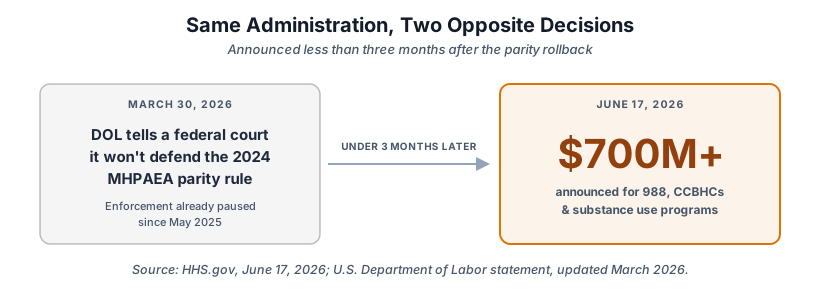
On June 17, 2026, HHS Secretary Robert F. Kennedy Jr. announced more than $700 million in new behavioral health investments — $238.6 million for the 988 Suicide and Crisis Lifeline, $223.1 million for Certified Community Behavioral Health Clinics, and $80 million for substance use programs. Less than three months before that press conference, on March 30, 2026, the same administration filed in federal court that it would no longer defend the 2024 MHPAEA rule — the regulation that would have required commercial insurers to stop applying tighter restrictions to mental health care than they apply to physical health care.
Two announcements. Two completely different problems. And only one of them threatened the financial interests of the commercial insurance industry.
Quick answer: The $700M funds crisis infrastructure — 988, community clinics, SUD services. These are real and worth funding. But they run in a parallel system from the commercial insurance market where most Americans actually try to access mental health care. The access problem most people experience is not a shortage of crisis hotlines. It’s that their insurer denies or delays routine outpatient therapy while facing no enforcement consequence for doing so. The DOL’s decision to abandon the 2024 MHPAEA rule is what would fix — or refuses to fix — that problem. The $700M doesn’t touch it.
What the $700 Million in Mental Health Funding Actually Covers
Let me be clear: I’m not against any of these programs. The 988 Lifeline received more than 8 million contacts in 2025. CCBHCs serve anyone who walks in regardless of ability to pay or insurance status. These are legitimate public health investments.
But understanding what these programs do reveals exactly what they don’t do.
The $238.6 million for 988 funds a crisis response system. You call when you’re in acute distress — suicidal, overwhelmed, in the middle of something that can’t wait. It is not a pathway to ongoing therapy. It is a floor, not a ceiling.
The $223.1 million for CCBHCs funds community mental health clinics that serve, by design, people who have fallen through every other gap — people without insurance, people experiencing homelessness, people with serious mental illness who have nowhere else to go. CCBHCs are an essential safety net. They are also, by structure, a downstream intervention. You end up at a CCBHC when the rest of the system has already failed you.
The $80 million for substance use prevention and treatment is critical work. It is also largely focused on crisis-level intervention rather than the routine behavioral health care that prevents crises from occurring.
None of these programs address the question most working Americans with commercial insurance are actually asking: Why does my plan require prior authorization for therapy and then deny it? Why does my insurer pay my therapist 40% less than it pays a primary care doctor for equivalent time? Why is my in-network provider list nine names long — four of whom aren’t taking new patients?
That question has a different answer. And the answer is MHPAEA — or more precisely, the lack of enforcement of it.
What MHPAEA Requires and Why the 2024 Rule Mattered
The Mental Health Parity and Addiction Equity Act has been law since 2008. Its core premise is straightforward: if your commercial health plan covers mental health and substance use services, it cannot impose restrictions on those services that are more burdensome than restrictions on comparable medical or surgical care.
In practice, this law has been systematically under-enforced since the day it passed.
The 2024 MHPAEA Final Rule, finalized in September 2024, was the most significant attempt to close that gap in the law’s 16-year history. It specifically required commercial insurers and employer-sponsored plans to:
- Conduct and document rigorous comparative analyses of nonquantitative treatment limitations (NQTLs) — the prior authorization requirements, concurrent review protocols, and network admission standards that insurers use to restrict mental health access without setting explicit visit caps.
- Collect and evaluate data on whether their mental health networks actually provide equivalent access to the medical/surgical networks they offer.
- Take corrective action when data revealed material disparities in access.
The rule’s network adequacy provision was particularly significant. For the first time, plans would have been required to demonstrate — with data — that their mental health provider networks were meaningfully accessible, not just nominally listed. The gap between listed and accessible is enormous. A 2025 federal enforcement report found that plans’ most common violations centered on inadequate network composition, prior authorization restrictions that exceeded those applied to physical health care, and reimbursement methodologies that made mental health provider participation economically unsustainable.
Commercial insurers, through the ERISA Industry Committee (ERIC), sued immediately. The Trump administration’s DOL paused enforcement in May 2025. Then, on March 30, 2026, the departments filed in court that they would not defend the rule at all and would propose replacement regulations by December 2026.
There are currently no replacement regulations. What exists is a confirmed, documented gap in enforcement while the insurance industry operates under the lighter 2013 standards — standards that the 2024 rule existed specifically because they weren’t working.
The Structural Contradiction
Here’s what I keep coming back to.
The $700 million announcement was made on June 17, 2026. It was framed as the administration’s commitment to mental health. And less than three months before that press conference, the same administration told a federal court it would not defend the rules that require commercial insurers to provide the mental health coverage that their plan members are already paying for.
These are not unrelated decisions. They are opposite ends of a single policy choice about who absorbs the cost of mental health access.
When insurers are not required to provide adequate mental health coverage — when prior authorization can be applied more restrictively to therapy than to surgery, when provider networks can be thin and underpaid without consequence — the population that gets denied or priced out doesn’t disappear. They show up at 988. They end up at CCBHCs. They land in emergency departments. They wait until crisis.
The $700 million is, in part, a downstream consequence of not enforcing parity. We are funding the safety net that catches people who fell through a hole the insurance industry was allowed to dig.
The Commonwealth Fund named this directly in a 2026 analysis, noting that the administration’s behavioral health parity enforcement rollback takes “a step backward” on access at exactly the moment that public investment in mental health is being announced.
What This Looks Like on the Ground
I’m a licensed clinical social worker. I’ve spent my career in community behavioral health — forensic assertive community treatment, substance abuse programs, disaster case management. I know what it looks like when the system fails people before they reach crisis.
It looks like a teacher in New Jersey who has commercial insurance through her employer, wants to see a therapist for anxiety that’s starting to affect her ability to work, and discovers that her in-network therapist list is nine names long — four of whom aren’t taking new patients, two of whom are a two-hour drive away, and one of whom returns her call six weeks later.
It looks like a contractor in Connecticut who pays $600 a month in premiums, gets approved for a psychiatric evaluation, and then receives a prior authorization denial for the medication the psychiatrist prescribed because the insurer’s criteria for that medication are stricter than the clinical evidence supports.
These aren’t edge cases. According to the DOL’s own 2025 enforcement data, federal regulators have identified MHPAEA violations across more than 72,000 plans through cumulative enforcement actions. Georgia’s insurance commissioner alone logged more than 6,000 parity violations across 22 insurers in 2025 and 2026 — the largest state enforcement action in MHPAEA history, resulting in more than $25 million in fines.
That enforcement happened at the state level. The federal enforcement that would have required systematic data collection and corrective action across all commercial plans is the piece that was just walked away from.
What Would Actually Fix the Access Problem
None of this means the $700 million should be cut. The 988 Lifeline is essential. CCBHCs serve a population that would otherwise have nowhere to go. SUD treatment saves lives.
But if we’re being honest about the access problem most commercially-insured Americans face, the fix is simpler to describe and harder to accomplish: enforce MHPAEA.
Require commercial insurers to demonstrate — with real data, to real auditors, with real consequences for failure — that their mental health benefits are actually equivalent to their medical benefits. Not on paper. In practice. Specifically:
Enforce the network adequacy provisions that require plans to show their mental health networks are accessible, not just listed. Enforce the NQTL provisions that prohibit prior authorization restrictions on mental health that don’t exist for equivalent medical care. And when plans fail those tests, enforce corrective action, not just a letter.
The access problem in commercial mental health is not a shortage of investment in downstream safety nets. It’s a shortage of accountability in the primary insurance market where most people’s mental health care is supposed to happen.
Until the federal government is willing to hold the commercial insurance industry to the parity law that has been on the books since 2008, the $700 million is a press conference. Necessary work. Wrong problem.
We built VibeCheck to give clinicians tools that actually work within the system as it exists — not as policy documents say it should. But clinicians shouldn’t have to build workarounds for a system that was legally required to work better 16 years ago.
FAQ
What is MHPAEA and why does it matter for access to mental health care? The Mental Health Parity and Addiction Equity Act (MHPAEA) is a federal law that prohibits commercial health plans and employer-sponsored plans from applying more restrictive requirements to mental health and substance use disorder benefits than to comparable medical or surgical benefits. It covers prior authorization rules, network adequacy, reimbursement rates, and other coverage limits. When enforced, it’s the most powerful legal lever for improving commercial insurance access to mental health care. When not enforced — as has been the case with the 2024 rule’s new provisions since May 2025 — commercial insurers operate under lighter standards that have demonstrably produced inequitable access for decades.
What are CCBHCs and why doesn’t the new $223 million fix the access problem? Certified Community Behavioral Health Clinics (CCBHCs) are federally certified provider organizations required to serve anyone who requests care, regardless of insurance status or ability to pay. The new $223.1 million will expand CCBHC services — real and important work. But CCBHCs are designed for people who have already fallen through other coverage gaps. They are not a substitute for requiring commercial insurance plans to cover mental health adequately. A person with commercial insurance who gets a prior authorization denial for therapy doesn’t need a CCBHC — they need their insurer to follow the law.
What exactly did the 2024 MHPAEA rule require that the administration is no longer defending? The 2024 rule required commercial plans to: (1) conduct rigorous comparative analyses of nonquantitative treatment limitations to prove they weren’t applying tighter restrictions to mental health than to physical health; (2) collect and evaluate real-world data on whether their mental health networks produced equivalent access; and (3) take documented corrective action when the data showed material disparities. On March 30, 2026, the DOL, HHS, and Treasury told a federal court they would no longer defend these provisions and intend to replace them with new regulations by December 2026. No replacement rule yet exists.
Is this a partisan issue? The structural failure of commercial insurance parity enforcement predates this administration. MHPAEA has been under-enforced by administrations of both parties since 2008. What makes 2026 distinctive is the specific sequence: the Biden DOL finalized the most rigorous parity enforcement rule in MHPAEA’s 16-year history in September 2024; the Trump DOL paused enforcement in May 2025; and in March 2026 publicly abandoned the rule’s defense in court. The contradiction between public investment in crisis care and the decision not to enforce commercial insurance parity is the sharpest it has been since the law passed. That’s the record.
Sources
- Secretary Kennedy Announces Over $700 Million in New Funding — HHS.gov, June 17, 2026
- HHS Announces $700M in Funds for Mental Health, SUD, Homelessness Initiatives — Behavioral Health Business, June 17, 2026
- Statement Regarding Enforcement of the Final Rule on MHPAEA — U.S. Department of Labor, May 2025 / updated March 2026
- Mental Health Parity Regulations Update — NFP, March 2026 (March 30, 2026 court filing abandoning rule defense)
- Behavioral Health Parity Takes Step Backward Under Trump — Commonwealth Fund, 2026
- The 2025 Mental Health Parity Report to Congress: Practical Takeaways — ERISA Litigation & Compliance, April 2026
- The Most Effective Community Mental Health Clinic Model Just Received More Than $223 Million — Medical Daily, 2026
- New Policies Affecting Access to Mental Health Care — American Psychological Association, 2026
Disclaimer
Disclaimer
This article is for educational and informational purposes only. It does not constitute medical, clinical, legal, or therapeutic advice, and reading it does not create a therapist-client relationship with Matthew Sexton, LCSW or Mental Wealth Solutions, Inc. Although the author is a licensed clinical social worker, the content in this article is not clinical assessment, diagnosis, or treatment.
The policy positions, regulatory decisions, and federal funding programs described here reflect publicly available information as of the publication date. Federal mental health policy is subject to change, and the analysis here reflects the author’s professional perspective based on available public reporting. For the most current information on federal mental health policy, consult SAMHSA, the Department of Labor, and the American Mental Health Counselors Association.
If you are in immediate emotional crisis, you can reach the 988 Suicide & Crisis Lifeline by calling or texting 988 (US). If you are experiencing domestic violence or are in physical danger, contact the National Domestic Violence Hotline at 1-800-799-7233 or visit thehotline.org. In a life-threatening emergency, call 911.
Want to discuss this for your program?
Book a 30-min conversation. We'll walk you through deployment, the BAA, and what your rollout looks like in production.
Book a 30-min conversation