By my own calculation, a solo therapy practice that outsources its business side pays roughly $8,000 to $32,000 in the first year, a website build at $1,500 to $8,000 (per Upwork and Fiverr, 2025), $500 to $2,000 a month for marketing (per Sprout Social, 2026), and a directory listing on top. AI now does a large share of that same work for the price of a few subscriptions. I have not found that year-one number printed for therapists anywhere, so here it is, itemized, with the honest limits.
Quick answer: A solo practice pays four figures for a website, hundreds a month for marketing, and an hourly rate for admin, roughly $8,000 to $32,000 in year one by my math. AI collapses most of that into a few tools a clinician runs themselves, under a few hundred dollars a month. What you trade is time. What you never trade away is the clinical work.
This is a companion to my piece on how I actually run my practice’s back office with AI. That one is the how. This one is the math, and the limits, because a clinician deciding where to spend money deserves the real numbers, not a sales pitch in either direction.
The vendor tax, itemized
Here is the stack a solo practice is quietly told it needs, and what AI does to each line.
| Line item | Vendor cost | Source | AI alternative |
|---|---|---|---|
| Website | $1,500–$8,000 one-time | Upwork / Fiverr, 2025 | AI drafts + editable layout, ~$0 to change |
| Social / marketing | $500–$2,000 / mo ($6k–$24k/yr) | Sprout Social, 2026 | You write the spine; AI reshapes it |
| Virtual assistant | ~$25.66 / hr | Indeed, 2026 | AI drafts routine writing; you approve |
| Psychology Today listing | Clear Health Costs, 2025 | Owned site + AI content you rank yourself |
The website hides its real cost in friction: revision rounds you pay extra for, the two-week turnaround, and not being able to update your own hours page without emailing the person who built it. Marketing is the recurring bite, $6,000 to $24,000 a year, which for most solo clinicians simply never happens, so the practice stays invisible. The directories take their cut too, even as some therapists reported in late 2025 that Psychology Today referrals had thinned out (Clear Health Costs, December 2025).
Add the first-year lines together and a clinician who buys the whole stack is looking at roughly $8,000 to $32,000, then four figures a year after that, indefinitely. That is the tax, and most of it is a tax on not having tried the tools yet.
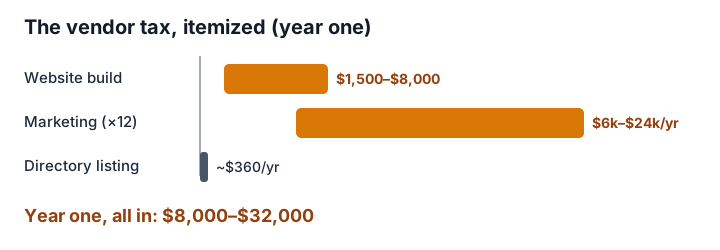
What AI actually replaces for a therapy practice
AI does not shave 10% off the vendor bill. It removes whole line items.
Website building is the clearest case. AI tools draft the copy, the structure, and an editable layout from a plain-language description of your practice. The four-figure project becomes an afternoon you spend yourself, and every future edit is free because you make it. The self-employed are already moving: the JPMorgan Chase Institute (April 2026), measuring real paid adoption rather than survey answers, found professional services at 30.3%, well above the small-business average.
Content is second. AI does not replace your clinical voice; it scales it. You write the idea and the part only a therapist would know, and the tool reshapes it into a post, a set of captions, and an email, the reformatting that used to eat entire evenings or a retainer. Across small businesses, workers reported saving about 5.6 hours a week with AI, per Business.com (January 2026). A vendor-commissioned study put the marketing-specific figure near 13 hours a week, though it came from a company selling marketing software, so I read it as directional (Forbes, July 2025).
Video is third, and the one solo practices almost never priced out at all. AI explainer video is uneven and takes iteration, but it puts a watchable practice video within reach of a weekend instead of a five-figure production.
The confusing part is the part worth paying for
I will not pretend the switch is frictionless. AI is genuinely confusing at first. The tools do not tell you what they are good at, so the first hour feels like fumbling. Then something clicks, and you realize you just did in ten minutes what you were about to sign a retainer for.
That confusing week is the real price of admission, and it is a good trade. A vendor relationship is a cost you pay forever and a skill you never build. An hour of confusion is a cost you pay once and a skill that compounds across every task after it. Small-business generative-AI use climbed to 58% in 2025 from 40% the year before, per the U.S. Chamber of Commerce (August 2025). That curve is a lot of one-person operations discovering the same thing: the leverage is real once you push through the disorientation.
The line that does not move: keep AI out of the room
Everything above is the back office. That is exactly where AI belongs and where the only downside is a clumsy sentence.
The clinical work is not on this list, and never will be. AI does not assess, diagnose, or treat. It does not sit in the chair. It does not touch protected health information unless a tool is specifically built HIPAA-eligible with an executed business associate agreement, and even then a licensed human makes every care decision. When AI has been pointed at the therapeutic relationship without a clinician governing it, it has failed in ways that made national news, missing risk a working therapist would have caught in a heartbeat. The safe version keeps a clinician in the loop and accountable, which is also why the tools that actually help are usually built by people who have carried a caseload.
“Most of the vendor tax is a tax on not having tried the tools yet. The clinical work is the one line you never outsource, to a vendor or to a machine.” — Matthew Sexton, LCSW
That distinction is why I helped build VibeCheck.luxury: a clinician-built platform designed so AI carries the administrative and drafting weight of a practice while the licensed human stays accountable for every clinical decision. It is the vendor stack replaced and the clinical line held at the same time.
If you audit one thing this quarter, itemize your own vendor tax. Write down what you pay for the website, the marketing, the admin, and the directories, then ask which line is really about care and which is just the tax. My guess is that most of it is the second kind, and the same administrative drag pushed a lot of clinicians into private practice to begin with.
FAQ
What does a solo therapist actually spend on vendors to run a practice? The common stack is a website build at $1,500 to $8,000 as a one-time project (Upwork and Fiverr pricing guides, 2025), $500 to $2,000 a month for social or marketing management (Sprout Social, 2026), around $25.66 an hour for a general virtual assistant (Indeed, 2026), and roughly $29.95 a month for a Psychology Today directory listing. By my own math that is roughly $8,000 to $32,000 in the first year for a practice that buys the whole stack.
Is AI actually cheaper than hiring a web designer or agency? For the business side of a practice, yes, by a wide margin. A handful of AI subscriptions typically costs well under a few hundred dollars a month combined and covers website drafting, content, and video that would otherwise be separate vendor line items. What you trade is your time and a short learning curve, and after that the work is cheaper to maintain because you are not re-hiring for every edit.
What should a therapist never hand to AI? The clinical work and any protected health information, unless the tool is built HIPAA-eligible with an executed business associate agreement, and even then a licensed human makes every care decision. AI belongs in the back office, where no client information is involved. It does not assess, diagnose, or treat, and it is not the therapist.
Will using AI make my practice look generic or fake? Only if you publish it unedited. AI drafts in a bland default voice, and if you leave it there, it shows. You supply the real clinical spine and your own voice, and you cut anything that sounds like a robot. Used that way, AI raises your output without flattening your identity.
Sources
- Upwork, How Much Does It Cost to Hire a Web Designer (2025) — small-business website project builds roughly $1,500–$8,000.
- Fiverr, Web Designer Costs (2025) — freelance web design market rates.
- Sprout Social, How Much Does Social Media Management Cost? (2026) — small-business social management commonly $500–$2,000/month.
- Indeed, Virtual Assistant Salaries (2026) — average U.S. virtual assistant pay ~$25.66/hour.
- Clear Health Costs, Therapists say Psychology Today referrals have dried up (Dec 2025) — directory listing ~$29.95/month; reported decline in referrals.
- JPMorgan Chase Institute, Understanding AI Use by Small Businesses (Apr 14, 2026) — professional-services paid AI adoption at 30.3%.
- Business.com, 2026 Small Business AI Outlook Report (Jan 20, 2026, n=1,009) — ~5.6 hours/week saved with AI.
- Forbes / ActiveCampaign (Talker Research), AI Cuts Costs, Adds 13 Hours for SMB Marketers (Jul 20, 2025) — vendor-commissioned; ~13 hours/week saved. Cited as directional.
- U.S. Chamber of Commerce (Teneo Research), Empowering Small Business (Aug 18, 2025) — small-business generative-AI use 58% in 2025, up from 40% in 2024.
Figures current as of July 2026. My $8,000–$32,000 year-one figure is a calculation from sources 1–5 (website + 12 months of social/marketing + directory listing), not a third-party statistic.
Disclaimer
This article is for educational and informational purposes only. It does not constitute medical, clinical, legal, or therapeutic advice, and reading it does not create a therapist-client relationship with Matthew Sexton, LCSW or Mental Wealth Solutions, Inc.. Although the author is a licensed clinical social worker, the content in this article is not clinical assessment, diagnosis, or treatment.
Vendor pricing, artificial-intelligence tools, their capabilities, and the way any specific product handles data or protected health information vary by vendor, jurisdiction, and over time, and may change after this article is published. The cost ranges here are market estimates from the cited sources, and the year-one total is my own calculation from them, not a quote for your practice; nothing here is an endorsement of any particular tool, or business, marketing, or legal advice. Before using any AI tool in connection with your work, evaluate it against your own clinical, ethical, and legal obligations, your licensing board’s rules, and, where protected health information could be involved, qualified counsel and an executed business associate agreement. Tools and circumstances differ, and what is described here may not match your situation.
If you are in immediate emotional crisis, you can reach the 988 Suicide & Crisis Lifeline by calling or texting 988 (US). If you are experiencing domestic violence or are in physical danger, contact the National Domestic Violence Hotline at 1-800-799-7233 or visit thehotline.org. In a life-threatening emergency, call 911.
Frequently asked questions.
- What does a solo therapist actually spend on vendors to run a practice?
- The common stack is a website build at $1,500 to $8,000 as a one-time project (Upwork and Fiverr pricing guides, 2025), $500 to $2,000 a month for social media or marketing management (Sprout Social, 2026), around $25.66 an hour for a general virtual assistant (Indeed, 2026), and roughly $29.95 a month for a Psychology Today directory listing. By my own math that adds up to roughly $8,000 to $32,000 in the first year for a solo practice that buys the whole stack.
- Is AI actually cheaper than hiring a web designer or agency?
- For the business side of a practice, yes, and by a wide margin. A handful of AI subscriptions typically costs well under a few hundred dollars a month combined and covers website drafting, content, and video that would otherwise be separate vendor line items. The cost you trade for it is your time and a short, confusing learning curve. Once you are past that curve, the work is faster to change and cheaper to maintain because you are not re-hiring for every edit.
- What should a therapist never hand to AI?
- The clinical work and any protected health information, unless the tool is built HIPAA-eligible with an executed business associate agreement, and even then a licensed human makes every care decision. AI belongs in the back office, the website, marketing, scheduling copy, and general admin, where no client information is involved. It does not assess, diagnose, or treat, and it is not the therapist. Point it at the business, not the room.
- Will using AI make my practice look generic or fake?
- Only if you let it write unedited. AI drafts in a bland default voice, and if you publish that, it shows. The fix is the same skill a clinician already has: editing. You supply the real clinical spine and your actual voice, and you cut anything that sounds like a robot. Used that way, AI raises your output without flattening your identity. Used lazily, it produces exactly the generic sludge people worry about.
If you're the therapist here.
Your clients get 4 sessions a month. The other 26 days they're on their own. VibeCheck is the between-session companion that carries those days back to you — clients check in daily, and you walk in already knowing what kind of week it was. Built by Matthew Sexton, LCSW, NATC.