In 2025, 58% of small businesses reported using generative AI, up from 40% the year before and 23% in 2023, according to the U.S. Chamber of Commerce (August 2025). For a solo clinician, that number is the difference between a one-person practice and a one-person practice that looks like it has a marketing department behind it. I run the entire business side of my work with AI I operate myself: the website, the writing, the video. I am not a technical person, and I do not hire it out.
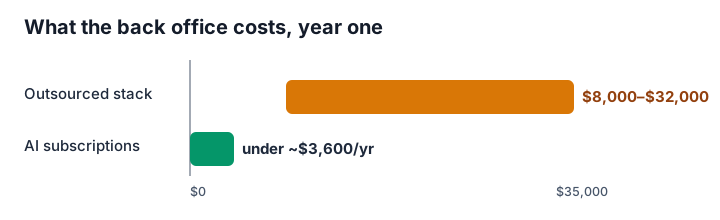
Quick answer: A solo clinician can run a practice’s back office, website, content, scheduling copy, even animated video, with AI directly instead of paying a web designer, an agency, and a VA. By my math the outsourced stack runs $8,000 to $32,000 in year one; a few AI subscriptions replace most of it. The learning curve is real. So is the payoff.
I want to be honest about both halves of that, because most of what you read about AI is either breathless or terrified. The confusing part is real. So is the leverage. Here is what it actually looks like when a therapist sits down and does it.
The vendor tax, and what AI does to it
Before the how, the what-it-replaces. Here is the outsourced stack a solo practice is quietly told it needs, against the AI version I actually run:
| Job | Typical vendor cost | The AI version |
|---|---|---|
| Website build | $1,500–$8,000 one-time (Upwork/Fiverr, 2025) | AI drafts copy + layout; you edit it yourself |
| Social / marketing | $500–$2,000 / month (Sprout Social, 2026) | You write the spine; AI reshapes it across formats |
| Admin / virtual assistant | ~$25.66 / hour (Indeed, 2026) | AI drafts the routine writing; you approve |
| Explainer video | Four to five figures per production | AI animation; a weekend and a couple of retries |
Add the recurring lines up and, by my own calculation, the outsourced back office runs roughly $8,000 to $32,000 in the first year for a solo practice, and four figures a year after that. I have not found anyone else printing that number for therapists specifically, which is exactly why it is worth printing. A few AI subscriptions, usually under a few hundred dollars a month combined, cover most of the same work.
AI is confusing on purpose, and that is the fun part
Nobody hands you a manual. You open the tool, it stares back, and for about an hour you feel like you are doing it wrong. That feeling is normal, and it is temporary. The tools do not advertise what they are good at, so you find out by poking. You ask for a draft, it gives you something 70% right, you tell it what is off, and it fixes it. Ten minutes in, you have done the thing you were about to pay a retainer for.
Think of it like the week you learned your electronic health record. Genuinely irritating at first, then invisible. The difference is that the EHR only ever did one job, and these tools do a dozen. The self-employed are already leaning in: the JPMorgan Chase Institute (April 2026), measuring actual paid AI adoption rather than survey answers, put the professional-services sector at 30.3%, well above the small-business average. Lawyers, accountants, consultants, and clinicians are quietly wiring AI into the parts of the job that were never the job.
The website: an afternoon instead of a two-week vendor cycle
A website is where most solo practices lose the most money for the least return. A small professional-services build runs $1,500 to $8,000 as a project, per Upwork and Fiverr (2025), and that is before the revisions you pay extra for and the part where you cannot change your own hours page without emailing someone.
I build and maintain my sites with AI. I describe the practice in plain language, who I serve, what I treat, how someone books, and the tool drafts copy, structure, and a layout I can actually edit. When my hours change, I change them.
Here is the part that matters clinically, not just financially. You are the one who has to be accurate. AI will happily write a confident sentence about your scope of practice that is subtly wrong, or a therapeutic claim you would never make. Your judgment is the edit pass. That division of labor, machine drafts and clinician decides, is the whole model, and it is the same one that has to govern any AI that gets near actual care. If you want the mechanics of keeping AI supervised, I wrote about what clinician-in-the-loop actually means.
The content: your voice, at a volume you could never hire
The second vendor line is content. Agencies and social managers run $500 to $2,000 a month for a small business, per Sprout Social (2026), and a general virtual assistant averages about $25.66 an hour, per Indeed (2026). For most solo clinicians that is out of reach, so the content never gets made and the practice stays invisible.
AI changes the constraint. It does not replace your voice; it scales it. I write the idea and the clinical spine, the thing only a clinician would know, and AI helps turn it into a blog post, then reshapes that into something short for social, then into an email. The therapist stays the source.
There is a real payoff in hours, and I will flag the source honestly: a widely cited 2026 study found small-business marketers saved roughly 13 hours a week with AI, but it was commissioned by a company that sells marketing software, so read it as directional (Forbes, July 2025). A cleaner number: across small businesses generally, workers reported saving about 5.6 hours a week, per Business.com (January 2026). For a clinician who is also the receptionist, the biller, and the marketer, five hours back is a real evening off, or a fifth session you can actually sit for. The same drag drove a lot of clinicians off insurance panels and into private practice in the first place.
The video: I made the thing that would have cost the most
Video is the line item most solo practices never even price out, because a producer, a script, and an animator feel like a different tax bracket. It is also, increasingly, what people watch before they decide to book.
I make animated explainer videos with AI too. A short practice video, the kind that used to mean a script, a producer, and an animator, now starts as a few sentences I write and becomes something watchable over a weekend. Here is one I built with AI. Is it a Pixar short? No. Does it clearly say who I am and how I work, in a format a prospective client will actually sit through? Yes, and that is the entire job of a practice video. AI video is uneven and takes iteration, and a human eye has to catch the moments it goes strange, but the thing that used to require a five-figure production is now a weekend attempt you land on the third try.
Where AI stops: the clinical line every therapist has to hold
I would not trust this piece if it did not draw the line clearly. Everything above is the back office: the public-facing, no-client-information side of a practice. That is where AI belongs, and where the only real risk is a typo.
The clinical work is a different country. AI does not sit in the chair. It does not assess, diagnose, or treat, and it does not touch protected health information unless a tool is specifically built HIPAA-eligible with an executed business associate agreement, and even then a licensed human makes every care decision. When AI has been pointed at the therapeutic relationship without a clinician governing it, it has failed in ways that made headlines, missing risk any working therapist would have caught. This is the same reason the tools that genuinely help clinicians tend to be built by people who have carried a caseload, and why the admin AI I trust is governed, with the clinician in control.
“The tools are extraordinary assistants and terrible therapists. The entire job is knowing which is which.” — Matthew Sexton, LCSW
That boundary is exactly why I ended up helping build VibeCheck.luxury: a clinician-built platform where AI carries the administrative and drafting weight of a practice while the licensed human stays accountable for every clinical decision. I did not want a tool that replaces the clinician. I wanted the one I was already improvising with a stack of consumer apps, built properly.
If you take one thing from this: the business side of your practice is more learnable, cheaper, and frankly more fun to run yourself than the vendor economy wants you to believe. Start with the website. Tolerate the confusing hour. And if you want the itemized version of what all of this replaces, I broke down the vendor math in a companion piece, AI vs. the vendor tax on a solo therapy practice.
FAQ
Can a therapist really build their own website with AI instead of hiring a designer? Yes. Freelance and agency website builds for a small professional practice typically run $1,500 to $8,000, per marketplace pricing guides from Upwork and Fiverr (2025). AI website tools now draft the copy, structure, and layout from a plain description of your practice, so a clinician can stand up a real site in an afternoon and edit it whenever they want. You still own the judgment: what you say, who you serve, and what is accurate.
Is it safe to use AI in a therapy practice? It depends on where you point it. Using AI for the business side, the website, blog posts, scheduling emails, and marketing video, carries ordinary business risk, not clinical risk, because no client information is involved. The rule I hold to is that AI never touches the clinical work or protected health information unless the tool is built HIPAA-eligible with an executed business associate agreement, and even then a licensed human makes every care decision.
How much does it cost to run a practice’s back office with AI? A handful of subscriptions, usually well under a few hundred dollars a month combined, versus the vendor stack it replaces: a website build in the low-to-mid four figures, social or marketing help at $500 to $2,000 a month per Sprout Social (2026), and a virtual assistant at around $25 an hour per Indeed (2026). By my own math the outsourced stack runs roughly $8,000 to $32,000 in year one.
Why does AI feel so confusing at first? Because the tools do not tell you what they are good at; you find out by poking at them. The first hour is disorienting, and then something clicks and you realize you just did in ten minutes what you were about to pay a retainer for. The confusion is the on-ramp, not a sign you are doing it wrong.
Sources
- U.S. Chamber of Commerce (Teneo Research), Empowering Small Business: The Impact of Technology on U.S. Small Business (Aug 18, 2025) — 58% of small businesses used generative AI in 2025, up from 40% (2024) and 23% (2023).
- JPMorgan Chase Institute, Understanding AI Use by Small Businesses (Apr 14, 2026) — measured paid AI adoption; professional services at 30.3%, above the small-business average.
- Upwork, How Much Does It Cost to Hire a Web Designer (2025) — small-business website project builds roughly $1,500–$8,000.
- Fiverr, Web Designer Costs (2025) — freelance web design market rates.
- Sprout Social, How Much Does Social Media Management Cost? (2026) — small-business social management commonly $500–$2,000/month.
- Indeed, Virtual Assistant Salaries (2026) — average U.S. virtual assistant pay ~$25.66/hour.
- Business.com, 2026 Small Business AI Outlook Report (Jan 20, 2026, n=1,009) — small-business workers reported saving ~5.6 hours/week with AI.
- Forbes / ActiveCampaign (Talker Research), AI Cuts Costs, Adds 13 Hours for SMB Marketers (Jul 20, 2025) — vendor-commissioned; ~13 hours/week saved by SMB marketers. Cited as directional.
Figures current as of July 2026. My $8,000–$32,000 year-one figure is a calculation from sources 3–6 (website + 12 months of social/marketing + directory listing), not a third-party statistic.
Disclaimer
This article is for educational and informational purposes only. It does not constitute medical, clinical, legal, or therapeutic advice, and reading it does not create a therapist-client relationship with Matthew Sexton, LCSW or Mental Wealth Solutions, Inc.. Although the author is a licensed clinical social worker, the content in this article is not clinical assessment, diagnosis, or treatment.
Artificial-intelligence tools, their capabilities, their pricing, and the way any specific product handles data or protected health information vary by vendor, jurisdiction, and over time, and may change after this article is published. Nothing here is an endorsement of any particular tool, or business, marketing, or legal advice for your practice. Before using any AI tool in connection with your work, evaluate it against your own clinical, ethical, and legal obligations, your licensing board’s rules, and, where protected health information could be involved, qualified counsel and an executed business associate agreement. Tools and circumstances differ, and what is described here may not match your situation.
If you are in immediate emotional crisis, you can reach the 988 Suicide & Crisis Lifeline by calling or texting 988 (US). If you are experiencing domestic violence or are in physical danger, contact the National Domestic Violence Hotline at 1-800-799-7233 or visit thehotline.org. In a life-threatening emergency, call 911.
Frequently asked questions.
- Can a therapist really build their own website with AI instead of hiring a designer?
- Yes. Freelance and agency website builds for a small professional practice typically run $1,500 to $8,000, per marketplace pricing guides from Upwork and Fiverr (2025). AI website tools now draft the copy, structure, and layout from a plain description of your practice, so a clinician can stand up a real site in an afternoon and edit it whenever they want. You still own the judgment: what you say, who you serve, and what is accurate. The AI handles the parts that used to require a vendor and a two-week wait.
- Is it safe to use AI in a therapy practice?
- It depends on where you point it. Using AI for the business side, the website, blog posts, scheduling emails, and marketing video, carries ordinary business risk, not clinical risk, because no client information is involved. The rule I hold to is simple: AI never touches the clinical work or protected health information unless the tool is built HIPAA-eligible with an executed business associate agreement, and even then a licensed human makes every care decision. For your public-facing office, AI is a helper. For the room, you stay the clinician.
- How much does it cost to run a practice's back office with AI?
- A handful of subscriptions, usually well under a few hundred dollars a month combined, versus the vendor stack it replaces: a website build in the low-to-mid four figures, social or marketing help at $500 to $2,000 a month per Sprout Social (2026), and a virtual assistant at around $25 an hour per Indeed (2026). By my own math, the outsourced stack runs roughly $8,000 to $32,000 in year one for a solo practice.
- Why does AI feel so confusing at first?
- Because the tools do not tell you what they are good at. You have to poke at them. The first hour is genuinely disorienting, and then something clicks and you realize you just did in ten minutes what you were about to pay someone a retainer for. The confusion is the on-ramp, not a sign you are doing it wrong. Treat it like learning a new EHR: annoying for a week, second nature after.
If you're the therapist here.
Your clients get 4 sessions a month. The other 26 days they're on their own. VibeCheck is the between-session companion that carries those days back to you — clients check in daily, and you walk in already knowing what kind of week it was. Built by Matthew Sexton, LCSW, NATC.