The Narcissistic Abuse Cycle: From Belief to Awakening
A guide to idealization, devaluation, discard, and renewed contact, with practical questions and limits to the cycle model.
Updated with targeted factual corrections. The revision note in the article describes the review scope; other claims and linked articles may remain unreviewed. See current solutions for today’s product information.
Framework descriptions, neuroscience comparisons, and absolute relationship and recovery claims corrected September 9, 2026. The original publication date and author are retained. This scoped correction does not review every linked archive article.
The terms idealization, devaluation, discard, and hoovering can help someone describe changes in a harmful relationship. They are a way to organize a story, not a predictable biological sequence or a test for narcissistic personality disorder. Some relationships include these patterns; others do not. You do not need to pass through every phase, or reach an “awakening,” before seeking help.
What Is the Narcissistic Abuse Cycle?
This article uses “narcissistic abuse cycle” as a descriptive framework for repeated attention, criticism, rupture, and attempts to reconnect. The relevant concern is harmful behavior: coercion, threats, humiliation, or disregard for consent and boundaries. A partner’s diagnosis cannot be inferred from the pattern alone.
There is no rule that every round becomes shorter, more intense, or harder to leave. Nor does abuse need a reconciliation phase to count as harm. The framework is useful only insofar as it helps you describe what has actually happened.
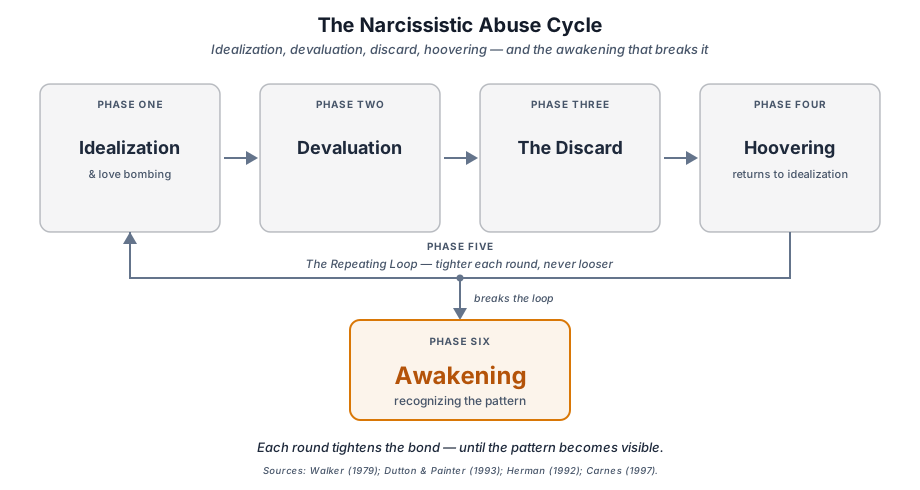
Read this diagram as text
A Possible Pattern of Harm
An illustration of behaviors, not a required sequence or a diagnosis.
- Possible behavior: Idealization and love bombing.
- Possible behavior: Devaluation.
- Possible behavior: Withdrawal.
- Possible behavior: Renewed contact may bring new promises.
The diagram connects these behaviors and shows that they may recur. Patterns vary; recurrence is not inevitable.
A branch from the pattern is labeled “may prompt reflection.” Recognition and seeking support are a possible step.
Recognition can help with planning; it does not guarantee safety. MWS illustration. Support and safety planning should fit the person’s situation.
Dutton and Painter’s 1993 study linked relationship dynamics with attachment after separation. It did not validate this six-part cycle or establish a single physiological process behind it. The phase labels below should not be used to predict another person’s next move with certainty.
Phase One: Idealization and Love Bombing
At first, it may have felt like finally being seen.
The attention was intense. You felt interesting, understood, chosen. Later harm can make those early experiences difficult to interpret. Their importance to you does not make you naive.
“Love bombing” is often used to describe intense attention that comes with pressure, obligation, or attempts to control the pace of a relationship. Enthusiasm alone is not evidence of abuse. Consider whether you could ask for time, maintain other relationships, and decline a request without punishment.
The early connection might have been sincere, manipulative, mixed, or difficult to understand from the outside. You do not need certainty about every motive to notice that promises and later behavior diverged. Claims that a partner engineered a specific dopamine response go beyond what the cited research establishes.
Phase Two: Devaluation
A comment here. Warmth withdrawn there. Repeated experiences of being made to feel like the problem.
This label can help describe belittling, humiliation, or shifting demands. A disagreement is not automatically devaluation; the question is whether a repeated pattern undermines your dignity, choices, or safety.
You might find yourself thinking, if I can explain myself correctly, we can get back to how it was. That hope can coexist with exhaustion, anger, affection, or fear. None of those feelings makes you responsible for another person’s abuse.
Describe specific events where possible: what was said, what happened after you objected, and what options you felt you had. If keeping notes could expose you to retaliation, discuss safer ways to get support. A clinician can assess distress without assuming this phase always causes complex PTSD or puts every nervous system in the same state.
Phase Three: The Discard
“Discard” is a term some people use for an abrupt, rejecting, or confusing ending. Endings vary: they can be cold, prolonged, inconsistent, or followed by renewed contact. A painful breakup alone does not establish an abuse cycle or reveal a deliberate plan to keep you confused.
You may want answers and still be unable to get a useful conversation. You are allowed to decide what contact is worthwhile without obtaining an admission or a satisfying explanation.
Fisher et al. (2010) found reward-related activity during romantic rejection in a small imaging study. It did not study this “discard” phase, prove substance-like detoxification, or establish that an abusive breakup produces proportionally greater withdrawal.
If sleep, concentration, or daily life becomes difficult, seek an assessment rather than assuming the explanation is a particular brain circuit. Distress is worth addressing whether or not this label fits.
Phase Four: Hoovering and the Return to Idealization
Hoovering describes attempts to draw someone back into contact after distance or an ending. That might involve an apology, a crisis, a gift, or a casual message. The term describes a possible function of contact; it does not let us read intent from one message.
Renewed contact may bring relief, hope, anger, fear, or uncertainty. Its timing does not prove that someone knew your nervous system was settling, and it does not reset a verified recovery clock.
Consider behavior over time: Does the person acknowledge what happened? Do they respect a request for distance? Is there sustained change, or renewed pressure to resume the same arrangement? You do not owe renewed access in return for an apology.
If contact includes threats, stalking, or fear of retaliation, seek help with safety planning. You do not need to wait until you know whether “hoovering” is the right word.
Phase Five: The Repeating Loop and Why It Is So Hard to Break
A repeated return to a painful relationship can be difficult to understand from the outside. Reducing it to a chemical loop misses the person’s actual choices and constraints.
Possible considerations include:
- Affection, hope, or a wish to preserve important parts of the relationship.
- Fear of retaliation or concern for children and other dependents.
- Housing, finances, work, disability support, or immigration-related concerns.
- Isolation from people who could offer practical help.
- Uncertainty about what happened and what options are available.
These are examples to ask about, not assumptions about any individual. Staying, leaving, returning, or having to communicate does not tell us whether someone has tried hard enough. Support should attend to the situation, not grade the survivor’s willpower.
S.T.O.I.C.K. is a six-step reflection practice developed by Matthew Sexton, LCSW: Stop, Take a Breath, Observe the Thought or Feeling, Imagine the Consequences, Choose, and Kindness. It offers prompts for considering a response; it is not presented as a validated treatment or a way to reset the nervous system. You can pause before a message, name what you need, and consider your options without expecting the feeling to disappear. Skip breath focus if it is uncomfortable, and prioritize safety over completing a sequence.
R.A.V.E.S., also developed by Sexton, organizes reflection through Recognition, Alignment, Value, Evidence, and Sovereignty. These domains can support a conversation about goals, observations, and agency. They are not a validated outcome measure or a promised path of recovery. Neither framework substitutes for an individual assessment or safety planning.
Phase Six: The Awakening
“Awakening” can name a shift in how you understand the relationship. It is not a clinical stage with a required nervous-system state.
Something may become clearer through conversation, therapy, distance, or comparing events over time. You might recognize a pattern while still feeling affection or uncertainty. You might also need practical help before you can spend time making sense of it.
Recognition can happen while you are still in the relationship. It does not automatically make a change safe or possible. There is no requirement to stop caring, become calm, or interpret every event correctly before receiving support.
Campbell and colleagues (2003) identified separation from a controlling partner as a risk factor in their study of partner homicide. If you fear retaliation, an advocate can help you consider safety and available options. This is a reason for tailored support, not a reason to blame someone for staying or leaving.
You can reclaim a voice in decisions at your own pace. Recognition, grief, practical changes, and seeking help can overlap rather than following a fixed order.
Frequently Asked Questions
Is the narcissistic abuse cycle the same as Lenore Walker’s cycle of violence? They are different descriptive models. The six-part sequence used here should not be treated as interchangeable with Walker’s model or as a validated diagnostic test. Focus on the behavior you are experiencing even if it does not fit a cycle.
Why does the cycle get tighter instead of resolving over time? It does not necessarily follow that course. Harm may repeat or escalate, but there is no universal rule that each round deepens attachment. Look at actual changes in behavior, safety, and available support.
Is hoovering always intentional? The timing or content of a message alone cannot establish intent. Consider repeated behavior and whether your boundaries are respected. You can decline contact without proving the person’s motive.
Can awakening happen while still in the relationship? Yes. You can recognize harm and seek support while still in contact. You do not have to leave first, achieve a particular physiological state, or complete a sequence before being taken seriously.
Why do I still miss them after awakening? Missing someone after a harmful relationship can include grief, affection, habit, hope, or loneliness. Those feelings do not invalidate what you have recognized, and they do not require you to return.
A Note on Recovery
A framework can give you words for an experience; it cannot predict every next event or determine what you must do. Begin with what is happening now, what matters to you, and what help is available. You deserve support even when your story does not fit these phases.
If you would like to discuss support, book a free consultation.
Matthew Sexton, LCSW is a licensed clinical social worker with over a decade of experience treating survivors of narcissistic abuse and complex trauma. He has directed clinical programs across thirteen settings, including substance abuse treatment, forensic assertive community treatment, and disaster case management. He founded Mental Wealth Solutions to support survivors in making sense of harmful relationships, expressing their needs, and considering their next steps.
Disclaimer
This article is for educational and informational purposes only. It does not constitute medical, clinical, legal, or therapeutic advice, and reading it does not create a therapist-client relationship with Matthew Sexton, LCSW or Mental Wealth Solutions, Inc.. Although the author is a licensed clinical social worker, the content in this article is not clinical assessment, diagnosis, or treatment.
This article includes descriptive relationship concepts, practical reflection prompts, and research with stated limits. These do not establish a diagnosis or validate the proprietary frameworks as treatments. Individual experiences vary, and what is described here may not match every reader’s situation. If you are working through narcissistic abuse, complex trauma, or a trauma bond, please consult a licensed mental health professional who can assess your specific circumstances.
If you are in immediate emotional crisis, you can reach the 988 Suicide & Crisis Lifeline by calling or texting 988 (US). If you are experiencing domestic violence or are in physical danger, contact the National Domestic Violence Hotline at 1-800-799-7233 or visit thehotline.org. In a life-threatening emergency, call 911.
References
Primary studies consulted for this correction; none tested R.A.V.E.S. or S.T.O.I.C.K.:
- Dutton & Painter (1993), emotional attachments in abusive relationships. Violence and Victims, 8(2), 105–120.
- Fisher et al. (2010), reward and emotion systems associated with romantic rejection. Journal of Neurophysiology, 104(1), 51–60.
- Campbell et al. (2003), risk factors for femicide in abusive relationships. American Journal of Public Health, 93(7), 1089–1097.
Sources accessed September 9, 2026. The framework definitions and their evidence limits are on R.A.V.E.S. and S.T.O.I.C.K..